How Do Mechanical Locking Features Improve Silicone Overmolding Reliability?
Introduction
Silicone overmolding is often used to create waterproof, dustproof, soft-touch, insulated, and protective components. However, strong performance does not depend only on silicone material or surface bonding. In many custom projects, mechanical locking features such as undercuts, grooves, holes, ribs, wraparound edges, and retaining windows can greatly improve overmolding reliability. This guide explains how mechanical locking design helps reduce peeling, edge lifting, leakage, insert movement, and long-term failure in silicone overmolded parts.
Answer Excerpt
Mechanical locking features improve silicone overmolding reliability by giving the molded silicone a physical way to hold onto the substrate. Instead of depending only on chemical bonding, silicone can flow through holes, around edges, into grooves, or under undercuts to form a stronger integrated structure. This helps reduce peeling, edge lifting, leakage, insert separation, and assembly failure in silicone over plastic, silicone over metal, FPC silicone overmolding, and waterproof sealing projects.
Transition Paragraph
Below are the key questions engineers, product developers, sourcing managers, and OEM/ODM buyers usually ask when designing mechanical locking features for silicone overmolded components.
People Also Ask: What is mechanical locking in silicone overmolding?
Mechanical locking in silicone overmolding means designing physical features on the substrate so the silicone can grip, wrap, pass through, or anchor into the part after molding. These features help the silicone remain attached during bending, pulling, compression, waterproof testing, assembly, and long-term use.
Mechanical locking is different from chemical bonding. Chemical bonding depends on material compatibility, surface condition, primer, self-adhesive LSR, or surface treatment. Mechanical locking depends on part geometry. In many demanding applications, the best solution combines both methods.
Common mechanical locking features include:
Undercuts
Through-holes
Side holes
Grooves
Ribs
Slots
Wraparound edges
Retaining windows
Perforated insert areas
Textured bonding zones
Step structures
Molded anchor points
For B2B buyers, mechanical locking is important because it can reduce the risk of silicone separation. A silicone layer may look attached after molding, but if there is no bonding strength or mechanical retention, it may peel during assembly or after long-term use.
For complex overmolded structures, design and tooling services can help review undercuts, holes, grooves, parting lines, insert positioning, demolding direction, and mold feasibility before mold opening.
People Also Ask: Why should silicone overmolded parts not rely only on surface adhesion?
Silicone overmolded parts should not rely only on surface adhesion because surface bonding can be affected by material compatibility, contamination, moisture, oil, plating, oxidation, surface energy, curing condition, and long-term environmental exposure.
In some projects, silicone can bond well to the substrate after proper material selection and surface treatment. In other projects, the substrate may be difficult to bond. For example, some plastics have low surface energy, some metals have unstable plating or oil residue, and some FPC areas must remain protected from aggressive surface treatment.
If the design depends only on adhesion, the part may pass the first sample test but fail after bending, aging, water exposure, vibration, or repeated assembly. Mechanical locking reduces this risk because the silicone is physically retained by the substrate geometry.
This is especially important for:
Waterproof connector seals
Automotive silicone overmolded parts
FPC protective overmolding
Medical device silicone components
Wearable electronic seals
Mobile phone waterproof components
Beauty device handles
Industrial sensor seals
Metal insert silicone parts
Plastic housing silicone seals
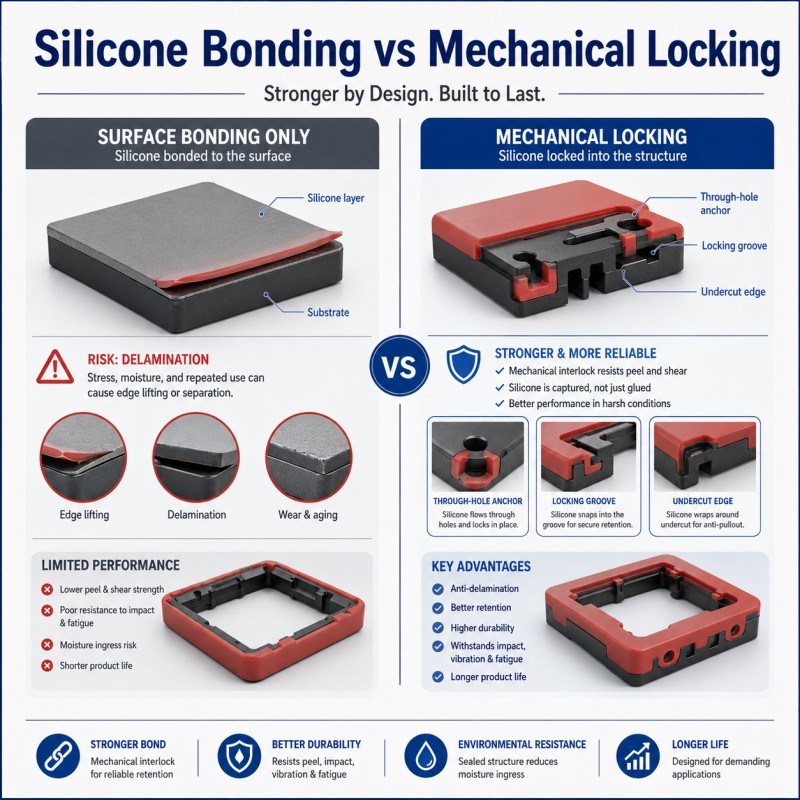
Mechanical locking does not replace good material selection. It strengthens the design. A reliable overmolded part should consider material compatibility, surface preparation, mold design, silicone flow, bonding area, and mechanical retention together.
People Also Ask: What mechanical locking features are commonly used?
Common mechanical locking features include holes, slots, grooves, undercuts, wraparound edges, retaining ribs, side windows, and textured areas. The best feature depends on the substrate, product size, sealing requirement, assembly condition, and mold feasibility.
Through-holes allow silicone to flow through the substrate and connect both sides after curing. This creates a strong physical anchor. Slots can work in a similar way but may provide a longer locking path.
Grooves give silicone a recessed area to sit inside. This can improve edge retention and reduce peeling. Grooves are often useful for plastic housings, connector frames, handles, and waterproof modules.
Undercuts can help the silicone grip the substrate from below or around an edge. However, undercuts must be designed carefully because they may affect demolding and mold complexity.
Wraparound edges allow silicone to cover both the top and side of a substrate. This can improve stability, especially when the part faces peeling force from one direction.
Textured bonding zones or micro-features can increase the contact area and improve retention. However, they should not create flash traps or difficult-to-clean areas if the product requires a clean appearance.
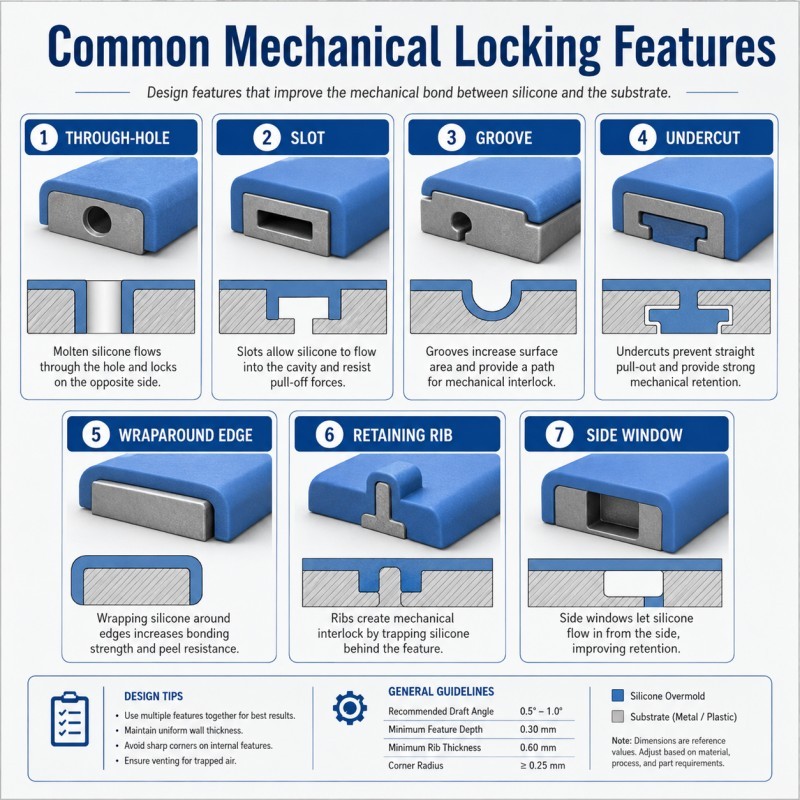
A good mechanical locking design should hold the silicone firmly without creating new problems, such as flash, tearing, difficult demolding, blocked functional areas, or weak substrate strength.
People Also Ask: How does mechanical locking improve waterproof silicone seals?
Mechanical locking improves waterproof silicone seals by helping the silicone remain stable around the sealing path. If the silicone edge lifts, water can enter through the gap. If the silicone shifts during assembly, the compression area may no longer seal correctly.
For waterproof silicone parts, mechanical locking can help in three ways. First, it keeps the silicone in the correct position. Second, it reduces peeling at the bonding edge. Third, it supports the seal during compression, bending, vibration, or repeated assembly.
A waterproof seal may fail even when the silicone material is good. Leakage may happen through a lifted edge, weak bonding area, flash line, poor compression zone, or unstable insert position. Mechanical locking helps reduce the risk of edge lifting and separation.
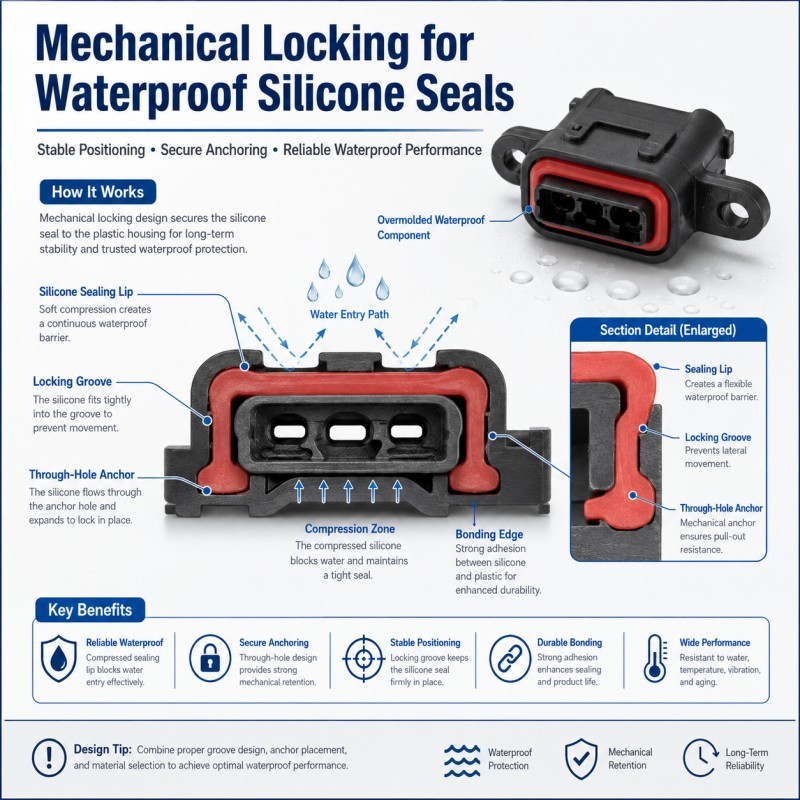
For example, a plastic connector housing may use a groove and small locking holes to anchor silicone around the sealing area. A metal insert may use holes or side slots so silicone can wrap through the metal and resist peeling. An FPC module may use carefully controlled silicone coverage around the edge while keeping exposed pads clear.
Mechanical locking should still be reviewed with waterproof testing. The structure should not create a hidden water path. Holes and slots must be sealed properly by the molded silicone, and the final assembly must provide correct compression.
People Also Ask: How should mechanical locking be designed for plastic substrates?
For plastic substrates, mechanical locking can be designed with grooves, holes, undercuts, ribs, side windows, or wraparound edges. The design should consider plastic strength, wall thickness, molding shrinkage, heat resistance, and final assembly force.
Plastic is commonly used in connector housings, electronic enclosures, buttons, handles, wearable device parts, sensor housings, and waterproof modules. Silicone over plastic can integrate sealing, soft touch, dust protection, vibration damping, and assembly support.
However, plastic substrates can deform if the structure is too thin or if the overmolding process applies too much heat or pressure. Locking holes or grooves should not weaken the substrate. Undercuts should not make the mold too complex or create demolding problems.
For electronic housings, connector frames, waterproof modules, and soft-touch structures, plastic with silicone overmolding can combine sealing, protection, grip, and assembly functions into one molded component.
A good plastic mechanical locking design should answer these questions:
Will the locking feature weaken the plastic part?
Can silicone fill the feature completely?
Can trapped air escape during molding?
Will the locking area create flash?
Will the silicone edge interfere with assembly?
Can the mold be opened safely?
Can the part pass waterproof or pull testing?
Can the structure remain stable in mass production?
People Also Ask: How should mechanical locking be designed for metal inserts?
For metal inserts, mechanical locking is often designed with holes, slots, edge wrapping, surface features, or formed tabs. These features help silicone hold onto the metal even when surface bonding is limited or difficult to control.
Metal substrates may include terminals, shafts, brackets, stamped parts, contacts, electrodes, sensor inserts, or conductive components. Silicone may provide sealing, insulation, cushioning, soft touch, waterproofing, or anti-vibration protection.
Metal has good dimensional stability, but surface condition can vary. Oil, oxidation, plating thickness, burrs, and surface contamination may affect bonding. Mechanical locking can improve retention by giving silicone a physical anchor.
For terminals, inserts, brackets, sensors, and waterproof components, metal with silicone overmolding requires surface condition review, insert positioning, bonding validation, and locking structure design.
For metal inserts, the locking design should not damage electrical function or structural strength. If a metal terminal needs exposed contact areas, the silicone must not cover them. If the metal part is thin, holes or slots should be designed carefully to avoid deformation.
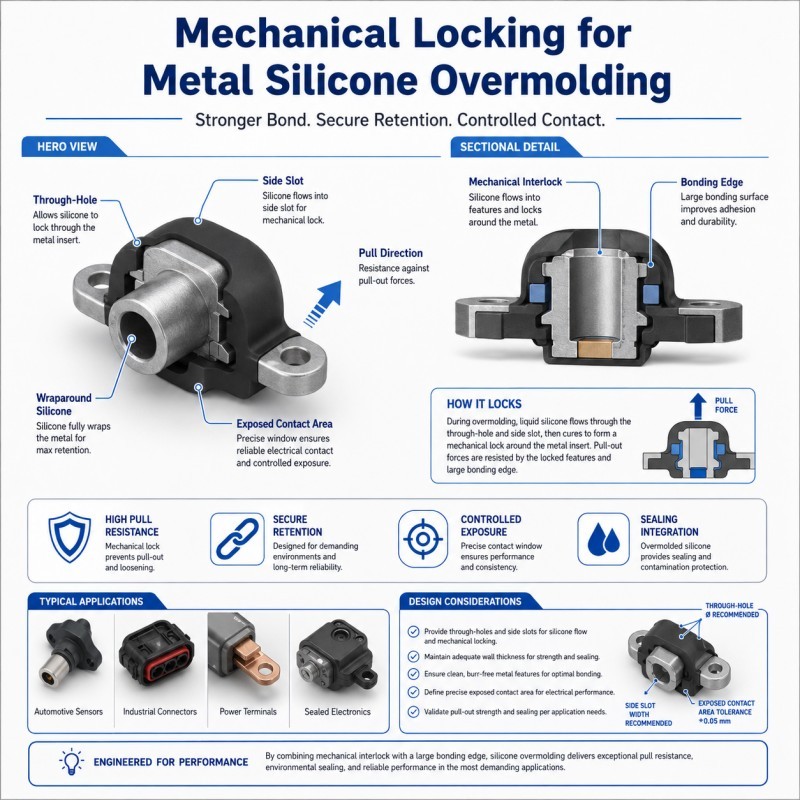
Metal overmolding validation may include pull testing, peel inspection, waterproof testing, dimensional checking, and assembly testing.
People Also Ask: How should mechanical locking be designed for FPC overmolding?
For FPC overmolding, mechanical locking must be designed more carefully because FPC is thin, flexible, and electrically functional. The goal is to protect the FPC without covering pads, damaging traces, restricting bending incorrectly, or creating excessive stiffness.
Unlike plastic or metal, FPC may not allow large holes or deep undercuts. The locking strategy may rely on edge encapsulation, controlled silicone coverage, strain relief geometry, stiffener support, and mold fixture design.
Important FPC locking design points include:
Exposed pad protection
Copper trace location
Bending zone control
Solder joint protection
Silicone coverage boundary
Strain relief area
Stiffener location
Mold fixture support
Electrical testing requirement
Waterproof edge design
For compact electronic modules, FPC with silicone overmolding requires accurate positioning, protected contact areas, controlled silicone flow, waterproof edge design, and electrical function awareness.
For FPC components, mechanical locking should not only focus on bonding strength. It should also support flexibility, waterproof sealing, and electrical reliability. If silicone coverage shifts by a small amount, it may affect the whole module.
People Also Ask: What is the difference between chemical bonding and mechanical locking?
Chemical bonding and mechanical locking are two different ways to improve silicone retention on a substrate. Chemical bonding relies on material and surface interaction. Mechanical locking relies on geometry.
| Method | How It Works | Main Advantage | Main Risk |
|---|---|---|---|
| Chemical Bonding | Silicone bonds to the substrate surface through material compatibility, primer, or surface treatment | Clean structure and strong surface adhesion when materials match | Sensitive to contamination, surface condition, material grade, and process stability |
| Mechanical Locking | Silicone flows into holes, grooves, undercuts, or around edges to form a physical anchor | Reduces peeling risk and improves retention even when bonding is limited | May increase mold complexity or weaken the substrate if poorly designed |
| Combined Design | Uses both bonding and mechanical retention | Best option for demanding waterproof, automotive, electronic, or medical projects | Requires early DFM review and careful tooling design |
| No Locking Feature | Silicone only covers the surface | Simple design and lower tooling complexity | Higher risk of edge lifting, delamination, or separation under stress |
For high-reliability silicone overmolding, combined design is often safer. Chemical bonding provides surface adhesion, while mechanical locking provides physical retention. Together, they help improve durability and reduce project risk.
People Also Ask: How does mold design affect mechanical locking features?
Mold design directly affects whether mechanical locking features can be produced reliably. Silicone must flow into holes, grooves, undercuts, and wrapped areas without creating bubbles, short shots, flash, trapped air, or demolding problems.
For through-holes, the mold must allow silicone to fill the hole completely. For grooves, the design should avoid trapped air. For undercuts, engineers must consider whether the part can be demolded. For FPC, the mold must hold the flexible substrate in place. For metal inserts, the mold must prevent movement during injection.
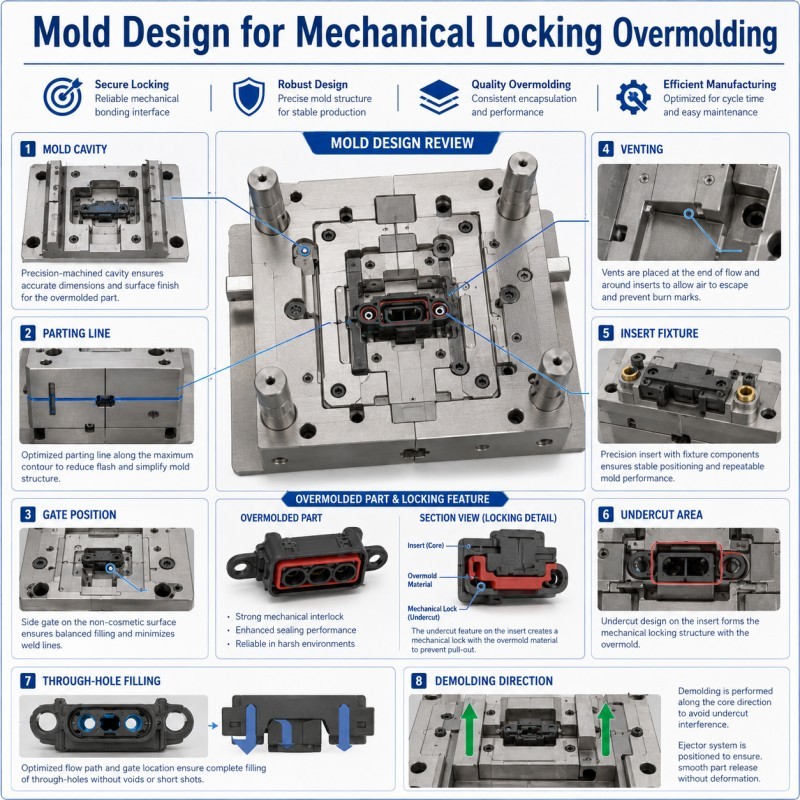
For detailed locking features and precision overmolded parts, liquid silicone injection molding can support fine geometry, controlled silicone flow, stable dimensions, and repeatable production when tooling is properly designed.
The mold should also consider flash-sensitive areas. A locking feature that improves retention but creates flash on a sealing surface may introduce a new failure point. This is why locking design must be reviewed together with parting line, venting, shut-off, and inspection standards.
People Also Ask: How should mechanical locking designs be tested?
Mechanical locking designs should be tested based on the product’s real working conditions. The test may include pull testing, peel testing, bending testing, torsion testing, waterproof testing, aging testing, vibration testing, and assembly testing.
A simple visual check is not enough for demanding overmolded parts. The silicone may look attached, but the locking structure must resist the forces it will face in use.
Useful validation questions include:
Does silicone lift at the edge?
Does the locking area tear?
Does the substrate crack near the hole or groove?
Does the part leak after bending or compression?
Does silicone remain attached after aging?
Does the part pass assembly testing?
Does flash appear around the locking feature?
Can the structure be repeated in mass production?
For waterproof parts, testing should check both mechanical retention and sealing performance. For electronic parts, testing may also need to confirm electrical function after bending, pulling, or water exposure.
People Also Ask: How does SiliconePlus support mechanical locking design?
SiliconePlus supports mechanical locking design by reviewing product structure, substrate material, silicone coverage area, bonding requirement, locking feature feasibility, waterproof path, mold design, insert positioning, and mass production stability before tooling.
Shenzhen Liyongan Silicone Rubber Products Co., Ltd. focuses on custom silicone overmolding manufacturing solutions, including liquid silicone injection molding, silicone over plastic, silicone over metal, FPC silicone overmolding, silicone over silicone, compression molding, mold development, sample production, inspection, and OEM/ODM mass production support.
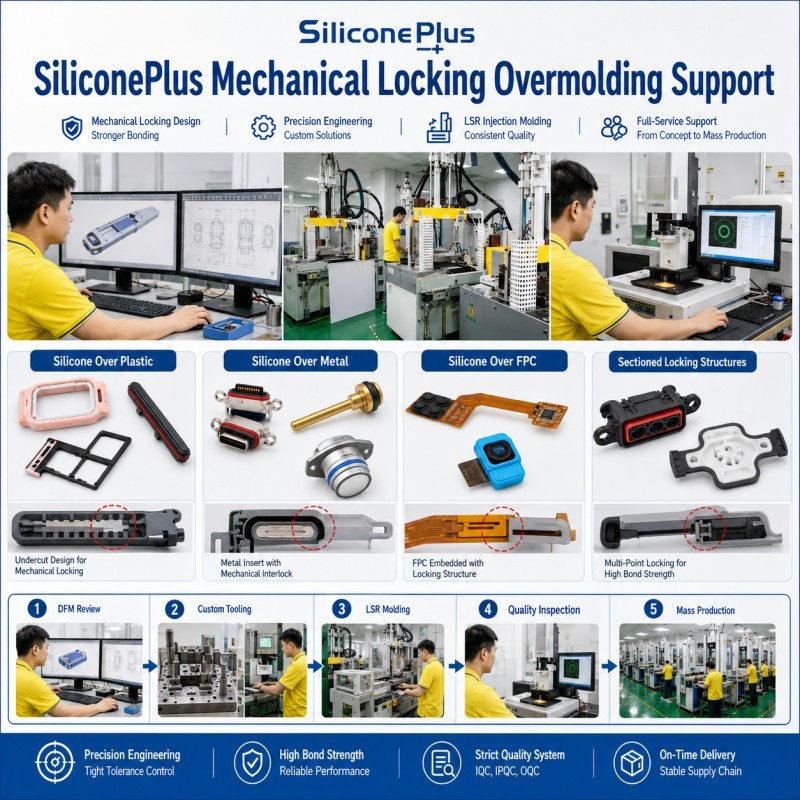
The company can support projects for medical devices, automotive and transportation, 3C electronics, mobile phone waterproofing, wearable electronics, beauty and health care devices, and industrial silicone applications.
For early-stage projects, the engineering team can help buyers review whether the design needs chemical bonding, mechanical locking, or both. For existing projects, the team can evaluate samples and drawings to improve retention, sealing, manufacturability, and production consistency.
A reliable silicone overmolding supplier should not only ask for part size. It should ask where the silicone may peel, where water may enter, where force will be applied, which areas must stay exposed, and what test the part must pass.
FAQ About Mechanical Locking Features in Silicone Overmolding
1. What is mechanical locking in silicone overmolding?
Mechanical locking means using physical structures such as holes, grooves, slots, undercuts, ribs, or wraparound edges to help silicone anchor onto the substrate after molding.
2. Is mechanical locking better than chemical bonding?
Mechanical locking and chemical bonding solve different problems. Mechanical locking provides physical retention, while chemical bonding provides surface adhesion. For demanding projects, using both methods may improve reliability.
3. What substrates can use mechanical locking features?
Mechanical locking can be used with plastic, metal, FPC, silicone, cable, connector, and other insert materials, but the design must match the substrate strength, function, and mold feasibility.
4. Can mechanical locking improve waterproof sealing?
Yes. Mechanical locking can help keep silicone in position and reduce edge lifting, which can improve waterproof sealing reliability. However, the sealing path, compression design, and test condition must still be reviewed.
5. Can mechanical locking features cause molding problems?
Yes. Poorly designed holes, grooves, or undercuts may cause trapped air, flash, incomplete filling, demolding difficulty, or weak substrate areas. DFM review is needed before mold opening.
6. What should I provide for a mechanical locking design review?
Buyers should provide drawings, 3D files, samples, substrate material, silicone coverage area, bonding requirement, waterproof target, pull or peel force requirement, exposed functional areas, and estimated quantity.
Conclusion
Mechanical locking features can significantly improve silicone overmolding reliability when they are designed correctly. Holes, grooves, undercuts, wraparound edges, and retaining structures can help silicone stay attached to plastic, metal, FPC, or silicone substrates during assembly, bending, waterproof testing, and long-term use.
For B2B buyers, mechanical locking should be reviewed before mold development. The best design is not simply adding more holes or undercuts. It is choosing the right locking structure according to substrate material, silicone flow, mold feasibility, waterproof path, exposed functional areas, and validation requirements.
Shenzhen Liyongan Silicone Rubber Products Co., Ltd. provides custom silicone overmolding, liquid silicone injection molding, silicone over plastic, silicone over metal, FPC silicone overmolding, silicone over silicone, waterproof silicone seals, medical silicone parts, automotive silicone components, 3C electronic silicone parts, wearable device seals, and industrial custom silicone components.
If you are developing a silicone overmolded component and are concerned about peeling, edge lifting, leakage, bonding instability, or assembly failure, share your drawings, samples, substrate material, waterproof target, and testing requirements with our engineering team. We can help review the locking structure and suggest a suitable manufacturing solution.
What type of substrate do you need to lock with silicone? Leave a comment, share this guide with your engineering or sourcing team, or contact SiliconePlus to discuss your custom silicone overmolding project.