How Insert Positioning Affects Custom LSR Overmolding Quality
In custom LSR overmolding, insert positioning is one of the most important factors behind stable product quality. A plastic housing, metal insert, FPC, connector part, sensor component, or cable assembly must be placed accurately inside the mold before liquid silicone rubber is injected.
If the insert shifts even slightly, the silicone layer may become uneven. The sealing lip may move away from the designed position. The bonding area may become too narrow. Flash may appear on functional surfaces. The final part may look acceptable at first, but fail during assembly, waterproof testing, pulling tests, or mass production inspection.
For precision silicone overmolded components, insert positioning is not just a mold loading step. It is an engineering control point that affects bonding, sealing, appearance, tolerance, and repeatability.
Answer Excerpt
Insert positioning affects custom LSR overmolding quality by controlling where the plastic, metal, FPC, connector, or electronic insert sits inside the mold. Accurate positioning helps maintain uniform silicone thickness, stable bonding area, correct sealing lip location, low flash, clean appearance, and repeatable mass production quality.
What Is Insert Positioning in LSR Overmolding?
Insert positioning means placing and holding the substrate accurately inside the mold cavity before silicone injection.
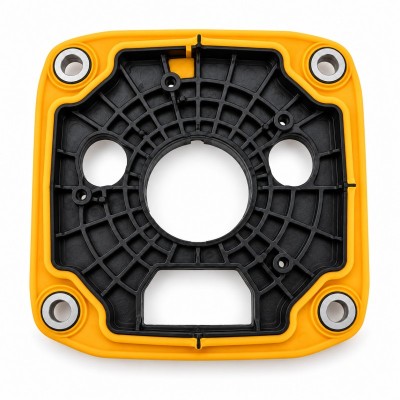
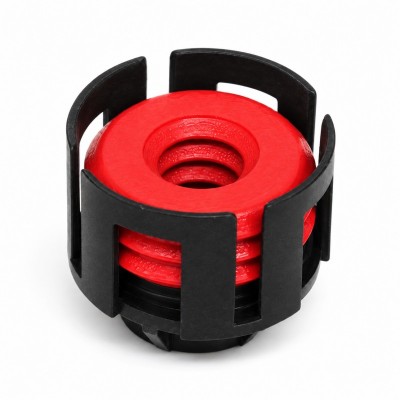
The insert may be a plastic housing, metal terminal, FPC circuit, connector shell, sensor component, cable outlet, or other pre-formed part. During overmolding, liquid silicone rubber flows around selected areas of the insert and cures into the final silicone structure.
The insert must stay in the correct position during mold closing, injection, curing, and demolding. If the insert moves, tilts, bends, floats, or deforms, the finished part may not match the drawing.
Good insert positioning should control location, height, angle, rotation, support, and repeatability.
Why Insert Positioning Accuracy Matters
Insert positioning accuracy affects almost every functional area of an overmolded part.
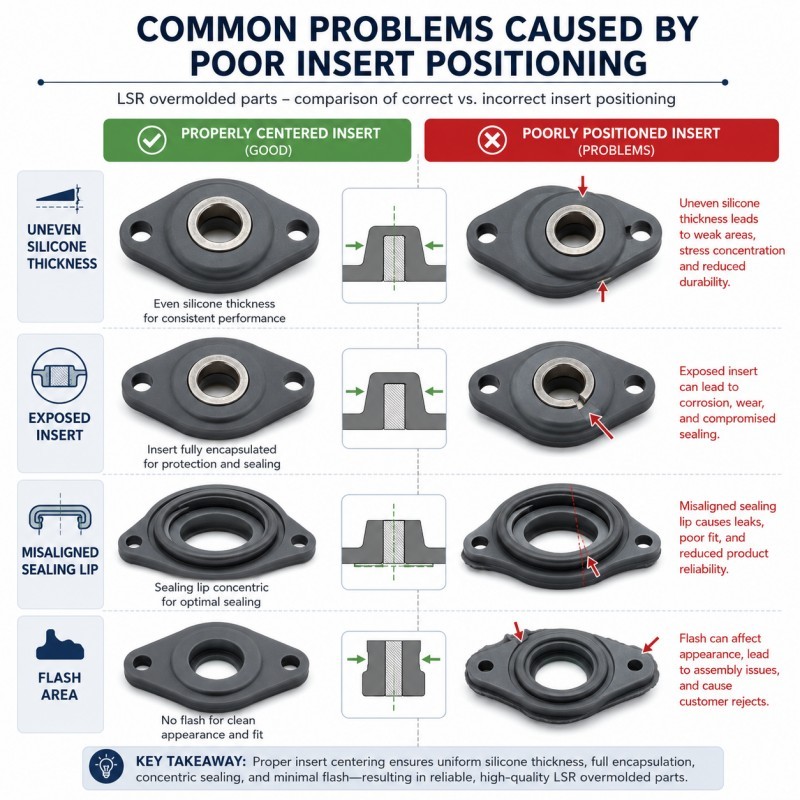
If the insert is too high, the silicone layer may become too thin in some areas. If the insert is too low, silicone may become too thick and affect assembly. If the insert shifts sideways, the sealing lip may no longer align with the housing groove or contact surface.
For waterproof components, even a small positioning error can create leakage risk. For electronic parts, misalignment can affect connector fit, FPC protection, button travel, sensor location, or cable outlet protection.
For mass production, the biggest problem is inconsistency. One sample may pass, but the next batch may show unstable dimensions, uneven silicone, or flash in different locations.
Common Problems Caused by Poor Insert Positioning
Poor insert positioning may cause uneven silicone thickness, exposed substrate areas, misaligned sealing lips, weak bonding edges, flash on assembly surfaces, silicone overflow into functional zones, deformation of thin inserts, poor appearance, unstable dimensions, and assembly interference.
For plastic inserts, poor positioning may also increase deformation risk under heat and pressure.
For metal inserts, poor positioning may create uneven silicone coverage or exposed metal edges.
For FPC parts, poor positioning may cause silicone to cover the wrong area, damage the circuit, or create stress around the bending zone.
For connector and sensor parts, poor positioning may affect waterproof sealing, electrical contact, and final installation.
Different Inserts Need Different Positioning Methods
Plastic, metal, FPC, and cable inserts cannot be positioned in the same way. Each material has different stiffness, tolerance, heat resistance, and deformation risk.
Plastic inserts may need broad support to avoid warping or collapse. The mold should hold the plastic part without damaging sealing surfaces or cosmetic areas.
Metal inserts are usually more rigid, but small pins, terminals, or thin metal parts may still shift under silicone flow. They may require locating holes, magnetic assistance, mechanical clamps, or precision shut-off areas.
FPC inserts are thin and flexible, so the mold must prevent wrinkling, floating, and pressure damage. The FPC positioning area should avoid solder joints, exposed circuits, and critical bending zones.
Cable or connector inserts may need controlled orientation and strain relief alignment. If the cable outlet is not positioned correctly, the final silicone overmold may not protect the real stress area.
Mold Locating Design and Support Points
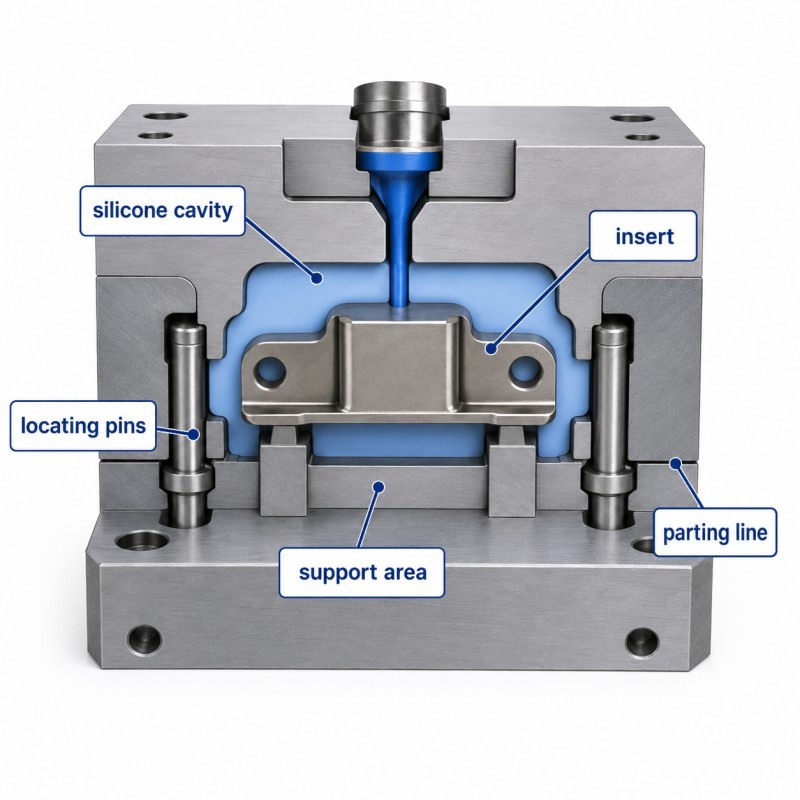
A stable mold locating design is the foundation of accurate insert positioning.
Common locating methods may include locating pins, support blocks, cavity nests, shut-off surfaces, alignment grooves, vacuum assistance, mechanical clamps, and custom loading fixtures.
The locating design should hold the insert firmly, but it should not damage the insert surface. It should also avoid leaving marks on cosmetic or sealing areas whenever possible.
For small precision parts, repeatable loading is just as important as the mold structure itself. If operators cannot place the insert consistently, mass production quality will still be unstable.
A good mold design should make correct loading easy and incorrect loading difficult.
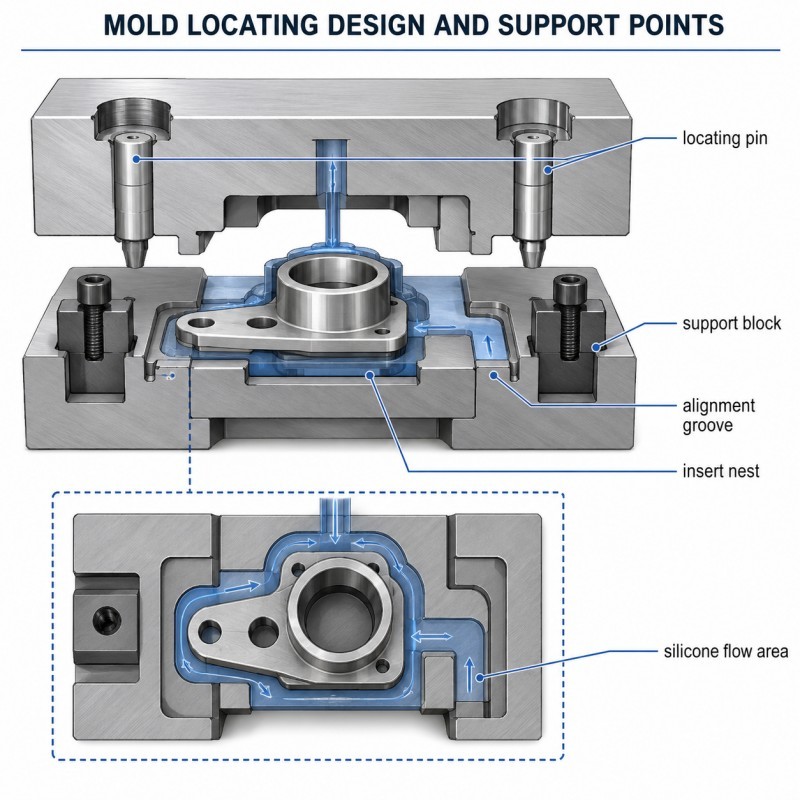
Silicone Flow Can Move the Insert
Liquid silicone rubber has excellent flowability, which helps fill thin sealing lips, small ribs, and complex cavities. However, silicone flow can also push the insert if the mold support is not strong enough.
Gate position, injection pressure, flow direction, venting, and cavity balance all affect insert stability.
If the gate directs silicone flow toward a weak insert area, the insert may lift, tilt, or shift. If venting is poor, trapped air may create local pressure and affect filling. If the cavity is unbalanced, silicone may fill one side earlier and push the insert from one direction.
Before tooling, engineers should review how silicone flows around the insert, not only whether the cavity can be filled.
Tolerance Stack-Up Should Be Reviewed Early
Insert positioning is closely related to tolerance stack-up.
The insert has its own tolerance. The mold locating area has tolerance. The silicone overmolded feature has tolerance. The final assembly housing also has tolerance.
If these tolerances are not reviewed together, the final product may fail even when each single part looks acceptable.
For waterproof sealing parts, tolerance stack-up may affect compression ratio and sealing pressure. For connector parts, it may affect mating accuracy. For button parts, it may affect travel and rebound. For FPC parts, it may affect bending stress and circuit protection.
Early tolerance review helps define which dimensions are critical and where inspection should focus.
How to Validate Insert Positioning Before Mass Production
Insert positioning should be validated during sampling and trial production.
Engineers should compare the insert location before molding, after mold closing if possible, after silicone molding, and after functional testing.
Common validation methods include dimensional inspection, cross-section inspection, visual inspection, assembly test, waterproof test, air leakage test, pulling force test, peeling test, bending test, and fixture repeatability check.
For high-precision overmolded parts, inspection should not only measure the outer silicone shape. It should also confirm whether the insert is centered, supported, and aligned with the functional structure.
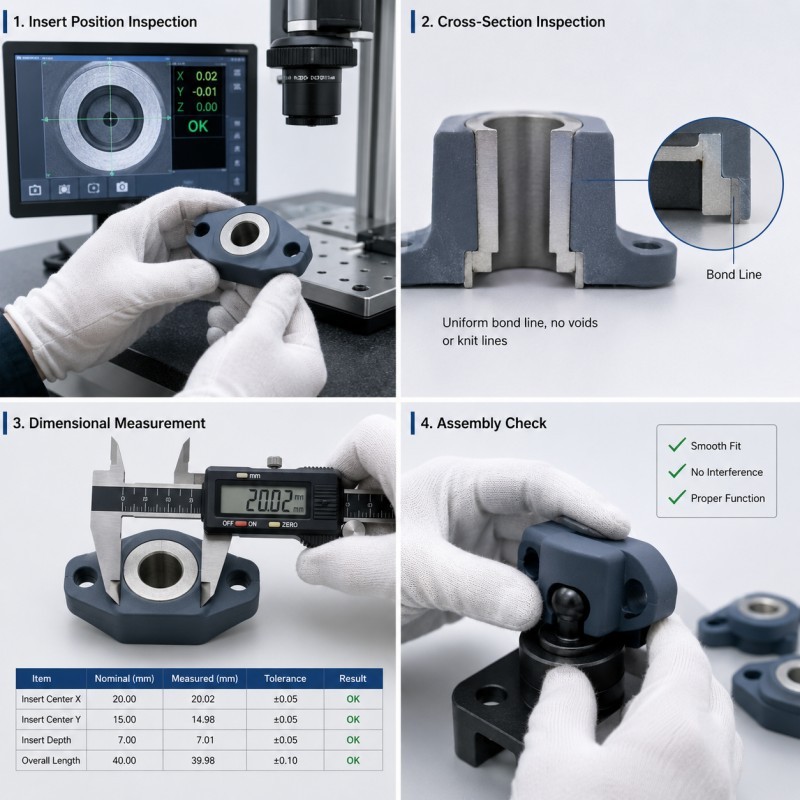
Applications That Require Accurate Insert Positioning
Automotive connector seals require accurate insert positioning because sealing lips, terminal areas, and housing interfaces must align correctly.
Wearable device parts require stable positioning for sensor modules, side buttons, charging areas, and FPC protection structures.
Medical electronic components may require precise positioning to control sealing, soft touch, cleanliness, and functional assembly.
Industrial sensor parts may require positioning accuracy for cable outlets, metal inserts, sealing surfaces, and vibration-resistant structures.
3C electronic components often need clean appearance, low flash, small dimensions, and repeatable assembly fit.
How SiliconePlus Supports Precision Insert Overmolding Projects
SiliconePlus supports custom LSR overmolding projects involving plastic, metal, FPC, silicone, cable, connector, and electronic insert structures. For insert positioning projects, our team can review drawings, samples, substrate tolerance, locating surfaces, silicone coverage, sealing structure, bonding area, mold support, and inspection standards before mold development.
We can support DFM review, silicone material selection, custom tooling, sample production, bonding evaluation, process optimization, inspection, and OEM/ODM mass production.
For automotive connectors, wearable components, medical electronic parts, FPC protection structures, sensor modules, and industrial sealing components, early engineering review can help reduce positioning error, leakage risk, flash problems, bonding failure, and assembly instability.
Conclusion
Insert positioning is a critical factor in custom LSR overmolding quality. It affects silicone thickness, bonding area, sealing path, flash control, appearance, dimensional accuracy, and mass production repeatability.
A successful overmolding project should review insert material, insert tolerance, mold locating design, support points, silicone flow direction, gate position, venting, tolerance stack-up, and inspection methods before tooling.
If you are developing a custom LSR overmolded component with plastic, metal, FPC, cable, connector, or sensor inserts, send us your drawings, samples, material information, tolerance requirements, testing standards, and estimated quantity. SiliconePlus can help evaluate the right insert overmolding solution from prototype to mass production.