How to Choose a Silicone Rubber Manufacturer in China for Custom LSR Overmolding
Introduction
Finding silicone rubber manufacturers in China is not difficult. The real challenge is identifying a supplier that can support product development, precision tooling, material selection, overmolding, quality validation, and consistent mass production.
Many suppliers can produce basic silicone gaskets, rings, pads, or household products. However, custom projects involving liquid silicone rubber, plastic or metal inserts, FPC, waterproof sealing, tight tolerances, or complex assemblies require a different level of engineering and process control.
For buyers, product engineers, purchasing managers, and brand owners, supplier selection should not be based only on unit price. The manufacturer must understand the complete project, including application conditions, substrate material, silicone hardness, bonding structure, mold design, inspection requirements, and expected production quantity.
This guide explains how to evaluate a silicone rubber manufacturer in China for custom LSR overmolding and precision silicone parts.
Answer Excerpt
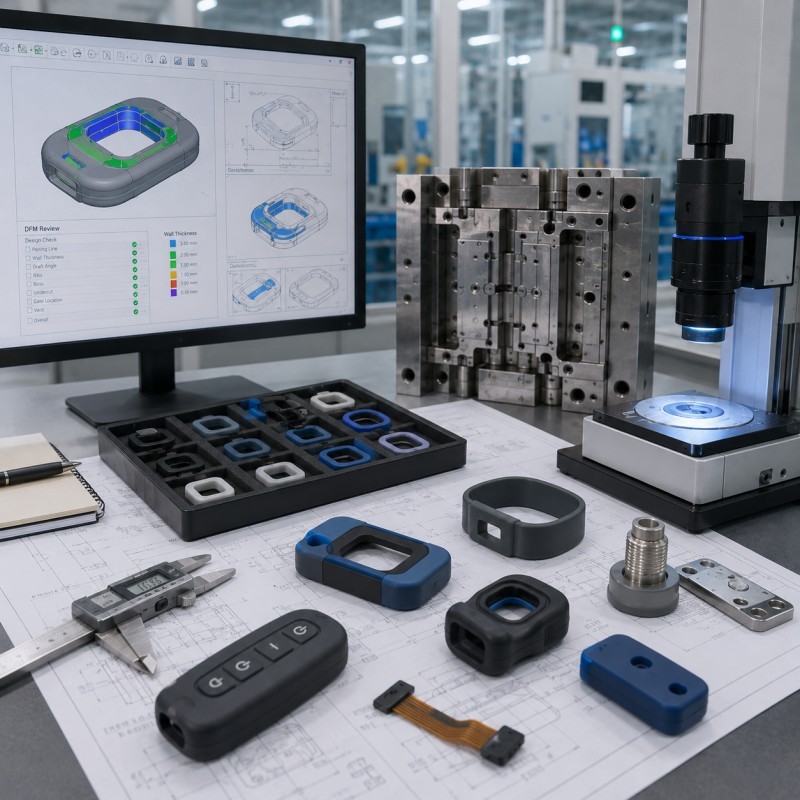
A qualified silicone rubber manufacturer in China should provide more than molding capacity. Buyers should evaluate whether the supplier can support DFM review, material selection, mold development, LSR injection molding, silicone overmolding, insert positioning, bonding validation, dimensional inspection, waterproof testing, sample approval, and repeatable mass production.
For custom silicone overmolding projects, buyers should also confirm whether the manufacturer has experience with plastic, metal, FPC, cable, and other inserts. The right supplier should identify design and production risks before tooling begins instead of discovering them after the mold is completed.
1. Define the Project Before Comparing Manufacturers
Before requesting quotations, buyers should clearly define what they need the manufacturer to produce.
A complete project description should include:
- Product application
- 2D or 3D drawing
- Product dimensions
- Silicone material requirement
- Target hardness
- Substrate or insert material
- Required color
- Surface texture
- Waterproof or sealing requirement
- Working temperature
- Chemical exposure
- Estimated order quantity
- Target market
- Inspection standard
- Expected project schedule
A general request such as “Please quote this silicone part” is usually not enough for an accurate technical evaluation.
For example, a pure silicone gasket, a silicone-over-plastic connector seal, and an FPC overmolded sensor component may look similar in size, but their mold structure, processing method, bonding mechanism, inspection plan, and tooling cost can be very different.
The more complete the project information is, the more accurately the manufacturer can evaluate feasibility, risk, price, and lead time.
2. Confirm That the Manufacturing Process Matches the Product
Not every silicone factory uses the same molding process.
Common silicone manufacturing methods include:
- Liquid silicone injection molding
- Solid silicone compression molding
- Silicone extrusion
- Insert molding
- Silicone overmolding
- Die cutting and punching
- Secondary assembly
- Silicone bonding
For high-precision, complex, automated, or integrated sealing components, liquid silicone injection molding is often more suitable than basic compression molding.
LSR injection molding can support:
- Fine sealing structures
- Thin silicone sections
- Complex flow paths
- Stable automated production
- Insert overmolding
- Repeatable dimensions
- Lower contamination risk
- High-volume production
However, compression molding may remain appropriate for many solid silicone seals, pads, gaskets, and simpler components.
A professional manufacturer should explain which process is suitable for the product instead of automatically recommending the process that is easiest for its factory.
3. Evaluate the Manufacturer’s DFM Capability
DFM means Design for Manufacturing.
A strong silicone manufacturer should review the drawing before mold development and identify possible manufacturing problems.
Important DFM points include:
- Silicone wall thickness
- Parting-line position
- Demolding direction
- Undercut structure
- Insert positioning
- Gate location
- Venting design
- Flash-control area
- Silicone flow distance
- Bonding area
- Compression ratio
- Assembly tolerance
- Deformation risk
- Blind-hole blockage
- Logo and texture feasibility
For silicone overmolding, DFM is particularly important because the silicone part and insert must function as one integrated component.
If the plastic or metal insert is not positioned correctly, silicone may flow into unwanted areas, block holes, create uneven coverage, or cause deformation.
A capable supplier should propose changes before tooling begins. This reduces repeated mold modification, sample delays, and mass-production risk.
4. Check Material and Substrate Compatibility
Material selection should be based on the actual application rather than only the lowest available material cost.
Buyers should discuss:
- Silicone type
- Hardness range
- Color requirement
- Temperature resistance
- Compression set
- Tear strength
- Chemical resistance
- Skin-contact or food-contact requirements
- Electrical insulation
- Outdoor weathering
- Sterilization or cleaning conditions
For overmolding projects, the substrate material must also be reviewed.
Common substrates include:
- PC
- PA
- PBT
- ABS
- PPS
- Stainless steel
- Aluminum
- Copper
- FPC
- Cable
- Electronic inserts
Different substrates have different bonding and heat-resistance characteristics. Some materials can support chemical bonding with silicone, while others require surface treatment, primer, mechanical locking, or structural adjustment.
The manufacturer should not promise permanent bonding without first reviewing the exact substrate grade and product structure.
5. Verify Silicone Overmolding Experience
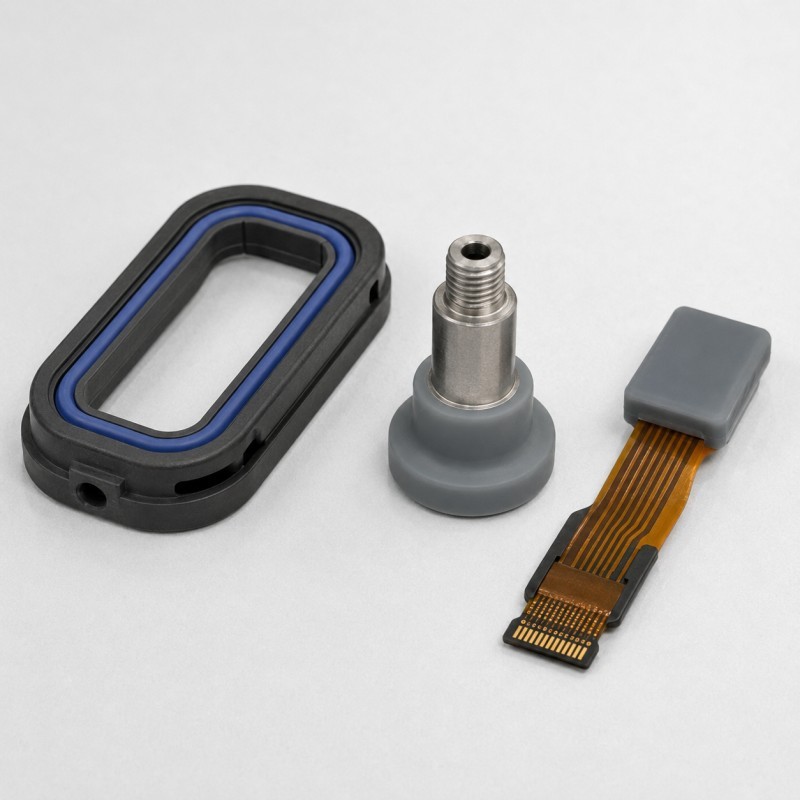
Silicone overmolding is more complex than molding a separate silicone part.
The manufacturer must control:
- Insert cleanliness
- Insert positioning
- Surface preparation
- Mold sealing
- Injection pressure
- Curing temperature
- Material flow
- Air venting
- Bonding area
- Flash
- Product removal
- Post-molding inspection
Buyers should ask whether the manufacturer has experience with:
- Silicone over plastic
- Silicone over metal
- Silicone over FPC
- Silicone over cable
- Silicone over electronic inserts
- Silicone-to-silicone secondary molding
A factory that mainly produces simple silicone rings may not have enough experience to manage substrate deformation, bonding failure, insert movement, blind-hole blockage, or precision sealing structures.
Relevant samples and engineering explanations are more valuable than a long list of unrelated products.
6. Ask How the Manufacturer Prevents Delamination
Delamination or peeling is one of the most common risks in silicone overmolding.
Possible causes include:
- Incompatible material combination
- Contaminated insert surface
- Oil or mold-release residue
- Insufficient bonding area
- Poor surface activation
- Incorrect primer
- Inadequate curing conditions
- Excessive product deformation
- Weak mechanical locking
- Incorrect storage conditions
The manufacturer should evaluate chemical bonding and mechanical locking together.
Mechanical features such as holes, grooves, ribs, undercuts, and wraparound structures can improve reliability when chemical bonding alone is not sufficient.
For demanding projects, the supplier may also need to evaluate cleaning, plasma treatment, primer application, heat aging, peel testing, or repeated bending tests.
A successful first sample is not enough. The bonding method must remain stable during mass production and real product use.
7. Review Tooling Capability
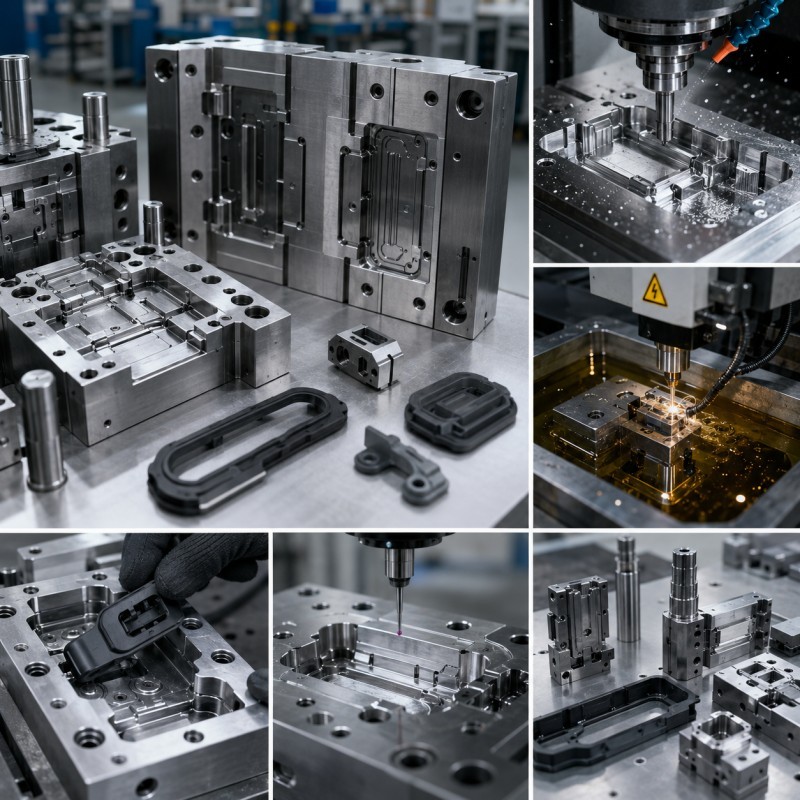
Precision silicone parts depend heavily on mold quality.
A manufacturer with in-house tooling capability can often respond faster to DFM changes, mold adjustments, sample corrections, and maintenance requirements.
Buyers should evaluate:
- CNC machining capability
- EDM capability
- Mold-material selection
- Mold tolerance
- Cold-runner experience
- Insert fixture design
- Venting design
- Parting-line control
- Mold maintenance
- Spare insert management
- Mold-change records
For LSR overmolding, the mold must accurately seal around the insert while allowing silicone to fill the intended area.
Poor mold precision may result in:
- Flash
- Short shots
- Air traps
- Uneven sealing lips
- Insert movement
- Material leakage
- Blocked holes
- Inconsistent dimensions
Tooling should therefore be treated as part of product engineering, not only as an initial cost.
8. Evaluate Waterproof-Sealing Capability Carefully
Many automotive, electronic, medical, wearable, and industrial products require protection against water, dust, sweat, oil, cleaning agents, or environmental exposure.
However, waterproof performance is not determined by silicone material alone.
It depends on:
- Sealing-lip geometry
- Compression ratio
- Silicone hardness
- Groove dimensions
- Product tolerance
- Insert stability
- Assembly force
- Surface condition
- Sealing continuity
- Test pressure
- Test duration
- Temperature conditions
A manufacturer should not claim that every silicone component is automatically IP67 or IP68.
Waterproof sealing performance up to IP68 may be achievable depending on product design, material, assembly structure, and validation conditions.
For a new project, buyers should define the test method before final sample approval.
9. Check Prototype-to-Mass-Production Consistency
One of the biggest B2B manufacturing risks is receiving an acceptable sample but inconsistent mass-production parts.
Buyers should ask how the factory controls:
- Material batch
- Color batch
- Mixing and feeding
- Mold temperature
- Injection pressure
- Curing time
- Insert placement
- Product dimensions
- Silicone hardness
- Flash
- Surface quality
- Bonding strength
- Packaging deformation
The production process should be documented and repeatable.
For precision parts, sample inspection should not depend only on visual judgment. The manufacturer should define measurable standards for dimensions, appearance, bonding, sealing, and function.
Pilot production may also be useful before full-volume manufacturing.
10. Review Inspection Equipment and Quality Control
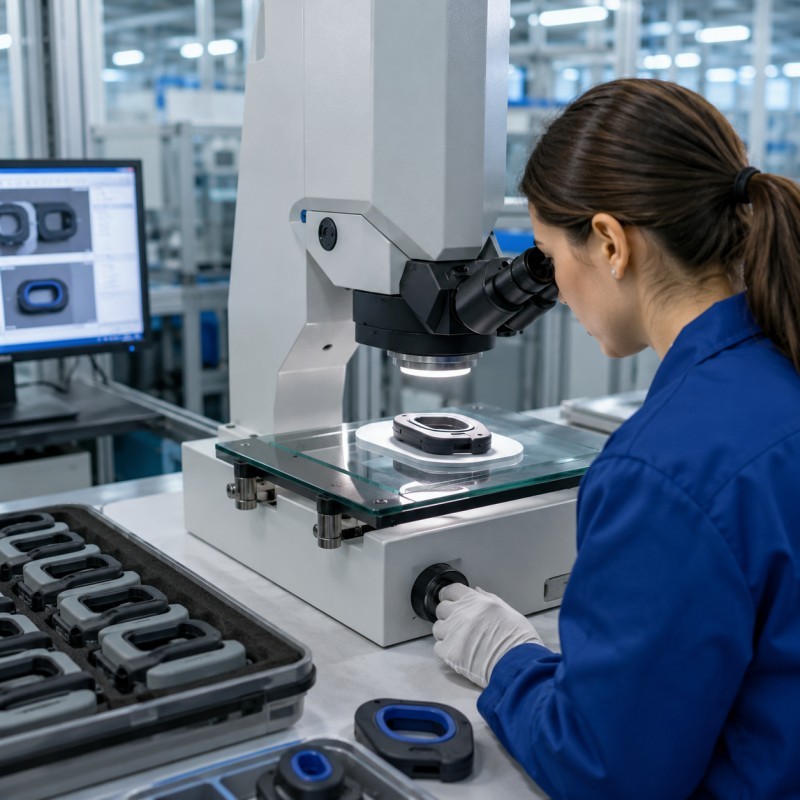
A supplier may claim to have strict quality control, but buyers should ask what is actually measured and recorded.
Typical inspection methods may include:
- Caliper measurement
- Height gauge
- Optical measurement
- Projector measurement
- Hardness testing
- Pull or peel testing
- Compression testing
- Waterproof testing
- Air-leak testing
- Visual inspection
- Surface inspection
- Functional assembly testing
The inspection plan should match the product.
For example, a waterproof connector seal may require dimensional inspection, sealing-lip inspection, assembly testing, and leak testing. A cosmetic soft-touch part may require stricter surface, color, and parting-line control.
Buyers should confirm:
- Critical dimensions
- Inspection frequency
- Sampling standard
- Acceptance criteria
- Inspection records
- Traceability method
- Handling of nonconforming products
11. Compare Quotations on the Same Technical Basis
A lower quotation does not always mean a lower total project cost.
Two suppliers may quote different prices because they have assumed different:
- Silicone grades
- Mold structures
- Cavities
- Insert processes
- Surface treatments
- Inspection standards
- Packaging methods
- Testing responsibilities
- Production quantities
- Tooling ownership terms
Before comparing prices, buyers should confirm that all suppliers are quoting the same specification.
A complete quotation should clarify:
- Mold cost
- Sample cost
- Unit price
- MOQ
- Material
- Color
- Tooling structure
- Number of cavities
- Sample lead time
- Production lead time
- Packaging
- Testing
- Shipping terms
- Mold ownership
- Mold maintenance
This helps prevent unexpected costs after the order is placed.
12. Evaluate Communication and Engineering Response
Custom silicone projects often require several rounds of technical communication.
The supplier should be able to clearly discuss:
- Drawing changes
- Material alternatives
- Mold risks
- Sample defects
- Production limitations
- Testing methods
- Cost changes
- Project schedule
Fast replies are useful, but technical accuracy is more important than a fast answer that ignores manufacturing risk.
A reliable supplier should be willing to say when additional information, testing, or design adjustment is required.
Clear communication before tooling is usually less expensive than correcting misunderstandings after sample production.
13. Use a Supplier Evaluation Checklist
Before selecting a silicone rubber manufacturer in China, buyers can use this checklist:
- Does the supplier understand the product application?
- Can it review 2D and 3D drawings?
- Does it provide DFM suggestions?
- Does it offer the required molding process?
- Can it develop molds in-house?
- Does it have relevant overmolding experience?
- Can it evaluate plastic, metal, FPC, or cable inserts?
- Does it understand bonding and delamination risks?
- Can it control waterproof sealing structures?
- Does it have suitable inspection equipment?
- Can it support samples and pilot production?
- Does it document mass-production parameters?
- Can it provide traceable inspection records?
- Are quotations technically complete?
- Is the communication clear and consistent?
A supplier does not need to be the largest factory. It needs to have the right process, engineering knowledge, equipment, and quality system for the project.
How SiliconePlus Supports Custom LSR Overmolding Projects
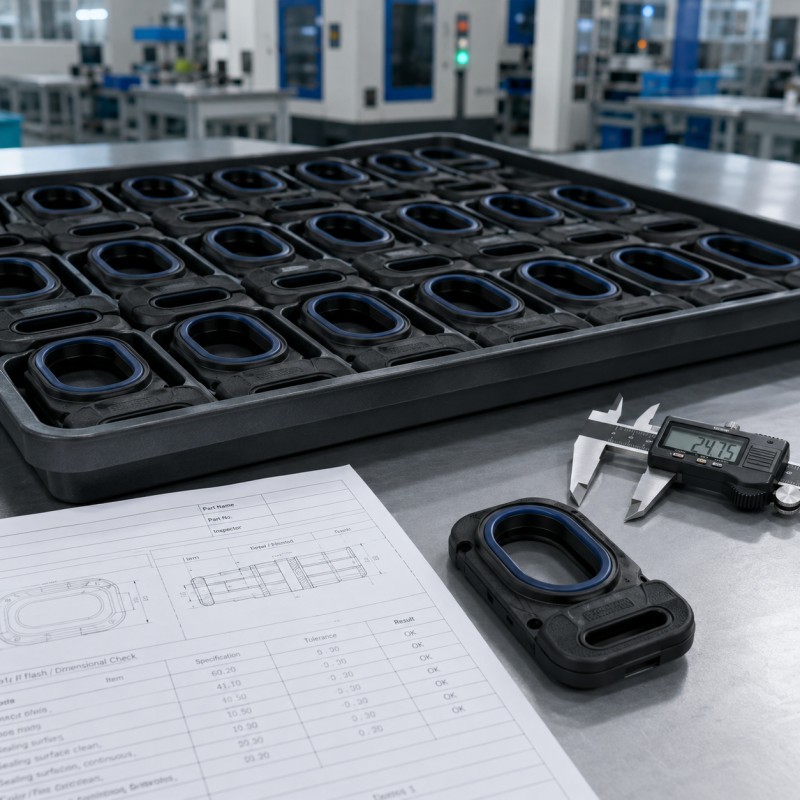
SiliconePlus focuses on custom LSR overmolding and precision silicone component manufacturing.
Our capabilities include:
- Liquid silicone injection molding
- Silicone over plastic
- Silicone over metal
- Silicone over FPC
- Insert molding
- Waterproof silicone sealing components
- Solid silicone compression molding
- Custom mold development
- DFM support
- Prototype-to-mass-production support
With more than 25 years of silicone manufacturing experience, a production base of more than 6,000 square meters, an engineering and production team of more than 100 people, and experience across more than 6,000 customer and project requirements, we support custom development for automotive, electronics, medical, wearable, beauty-device, and industrial applications.
Our manufacturing resources include CNC mold-processing centers, imported Makino EDM equipment, automated solid-silicone molding equipment, liquid silicone injection equipment, and precision inspection instruments.
Depending on the product structure and project requirements, our team can support precision dimensions, integrated waterproof sealing, material selection, surface preparation, mold development, sample validation, and stable batch production.
What Information Should Buyers Send for a Quotation?
To evaluate a project accurately, buyers should provide:
- 2D or 3D drawing
- Product or sample photo
- Silicone material requirement
- Silicone hardness
- Plastic, metal, FPC, or cable material
- Application environment
- Waterproof requirement
- Critical dimensions
- Surface requirement
- Target color
- Testing requirement
- Estimated quantity
- Target production schedule
When drawings are not available, clear photos, dimensions, assembly information, and application details can help with initial evaluation.
Frequently Asked Questions
How do I know whether a silicone manufacturer can handle LSR overmolding?
Ask for information about its LSR equipment, tooling capability, insert-positioning method, material compatibility review, bonding process, relevant samples, and inspection methods.
Is the lowest tooling quotation the best choice?
Not necessarily. A low tooling price may use fewer cavities, simpler mold construction, weaker insert positioning, or less precise processing. Buyers should compare technical scope as well as price.
Can silicone bond directly to every plastic?
No. Bonding depends on the exact plastic grade, silicone formulation, surface condition, structure, treatment method, and curing conditions. Some combinations require mechanical locking or surface treatment.
Can a custom silicone component achieve IP68?
It may be possible depending on the sealing structure, material, tolerance, assembly design, and test conditions. IP68 should be validated for the complete assembled product.
What is the typical MOQ for a custom silicone project?
MOQ depends on product structure, process, material, tooling, and production efficiency. SiliconePlus generally evaluates custom projects from approximately 500 pieces, but the final requirement should be confirmed for each project.
What should be approved before mass production?
Buyers should approve dimensions, material, hardness, color, surface quality, bonding performance, assembly fit, functional testing, packaging, and inspection standards.
Conclusion
Choosing a silicone rubber manufacturer in China requires more than comparing factory size and unit price.
For custom LSR overmolding and precision silicone parts, buyers should evaluate process capability, DFM, material compatibility, mold development, bonding reliability, waterproof design, inspection, communication, and prototype-to-mass-production consistency.
The right supplier should identify risks early and help turn a drawing, sample, or product idea into a stable and manufacturable component.
If you are developing a custom silicone overmolded part, contact SiliconePlus and send us your drawing, sample photo, material requirement, application details, waterproof requirement, and estimated quantity. Our team will review the project and provide practical manufacturing recommendations.