How to Prevent Delamination in Custom Silicone Overmolding Projects
Delamination is one of the most common risks in custom silicone overmolding projects. A part may look good after molding, but after pulling, bending, water exposure, temperature cycling, aging, or long-term assembly stress, the silicone layer may start to peel away from the plastic, metal, FPC, or silicone substrate.
For engineers and sourcing teams, this problem is not only a quality issue. It can affect waterproof sealing, electrical protection, assembly stability, product appearance, and final customer trust.
In custom LSR overmolding, strong bonding does not depend on silicone material alone. It is the result of substrate selection, surface treatment, bonding area design, mold accuracy, process control, and proper validation before mass production.
Answer Excerpt
Custom silicone overmolding delamination can be prevented by selecting the right substrate, designing enough bonding area, using compatible LSR material, controlling surface treatment, improving mold positioning, avoiding excessive internal stress, and validating the part through pulling, peeling, aging, bending, and waterproof tests before mass production.
Why Does Silicone Overmolding Delamination Happen?
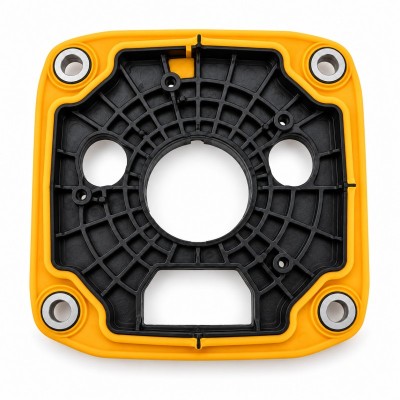
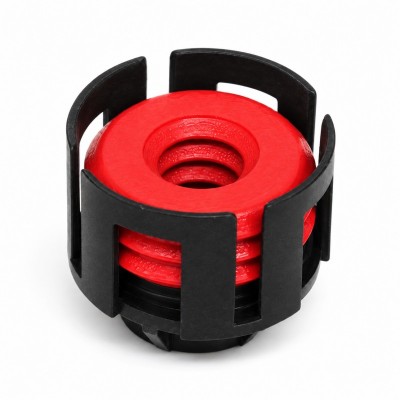
Silicone overmolding is used when liquid silicone rubber needs to bond with another material, such as plastic, metal, FPC, or another silicone part. The goal is to create an integrated structure instead of assembling a separate silicone gasket or cover.
However, if the bonding interface is weak, the silicone may separate from the substrate. This may happen immediately after demolding, during assembly, or after the product has been used for a period of time.
Common causes include:
- Wrong substrate material
- Poor surface cleanliness
- Incompatible silicone grade
- Insufficient bonding area
- Sharp corners or poor transition design
- Incorrect primer application
- Unstable mold temperature
- Poor insert positioning
- Excessive internal stress
- Weak mechanical locking structure
- Incomplete curing
- Poor waterproof or aging resistance
For B2B custom projects, the most dangerous situation is not obvious failure during sampling. The real risk is when the sample passes initial inspection but fails after mass production or after customer-side testing.
Substrate Selection Comes First
The first step is to evaluate the substrate. Different materials have different bonding performance with liquid silicone rubber.
For silicone over plastic parts, engineers need to consider the plastic type, heat resistance, surface energy, dimensional stability, and whether the material can withstand the LSR molding temperature.
Common plastic substrates may include PC, PBT, PA, PPS, and other engineering plastics. Some materials are easier to bond with silicone, while others may require primer, plasma treatment, surface roughening, or a mechanical locking structure.
For silicone over metal parts, the metal surface must be clean and stable. Oil, oxidation, polishing residue, release agent, or surface contamination can reduce bonding strength.
For FPC silicone overmolding, the challenge is different. The FPC is thin and flexible, so the design must protect the circuit area while controlling silicone flow, pressure, bonding position, and deformation risk.
Design Enough Bonding Area
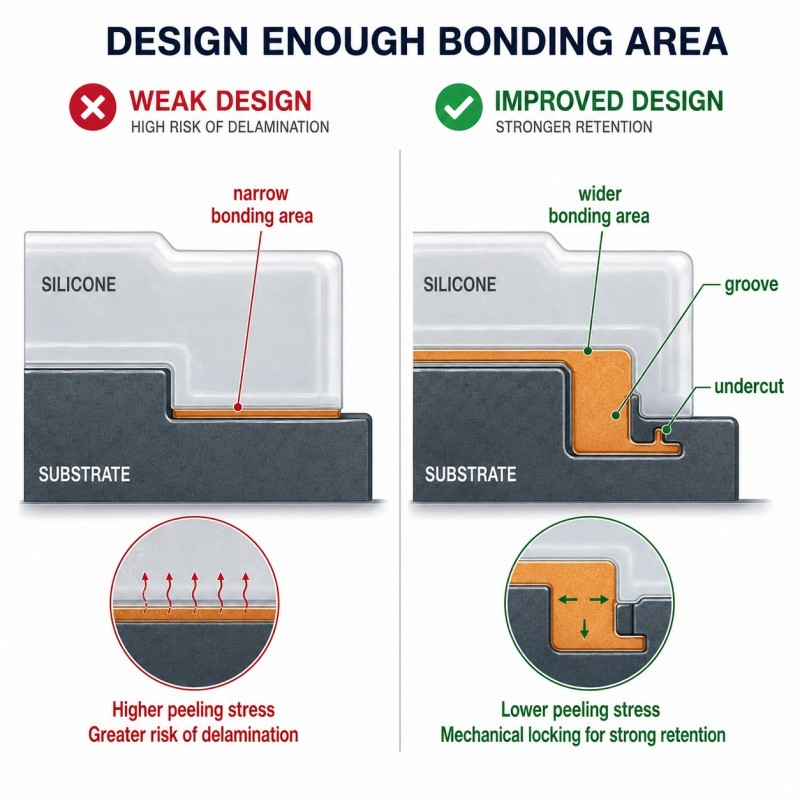
Many overmolding failures happen because the bonding area is too small. Even if the silicone material is correct, the interface may not withstand pulling force, bending force, or compression stress if the bonding area is limited.
A good bonding design should consider:
- Bonding width
- Bonding length
- Silicone thickness
- Transition radius
- Sealing lip position
- Pulling direction
- Assembly force direction
- Whether mechanical locking is needed
- Whether the product will be bent or twisted
If the silicone only sits on a smooth flat surface with little bonding area, the risk of peeling will be higher. For demanding applications, bonding should not rely only on chemical adhesion. A reasonable structure should also use mechanical support, undercuts, holes, grooves, ribs, or wrap-around features where possible.
Avoid Sharp Transitions and Stress Concentration
Sharp corners can create stress concentration. During demolding, assembly, pulling, bending, or long-term use, stress may accumulate at the edge of the silicone layer. Once a small crack or gap appears, water, dust, or repeated movement may make the delamination worse.
A better design usually uses smooth transitions, rounded edges, proper silicone thickness, and enough support around the bonding area.
For waterproof sealing parts, the sealing lip and bonding edge should be separated clearly. The sealing lip needs controlled compression, while the bonding area needs enough contact and stable adhesion. If these two functions are mixed without proper design, the part may either leak or delaminate.
Choose the Right LSR Material
Not all LSR materials are suitable for overmolding. Some silicone grades are designed for general molding, while others are developed for bonding with specific substrates.
Material selection should consider:
- Substrate compatibility
- Hardness
- Tear strength
- Tensile strength
- Elongation
- Compression set
- Aging resistance
- Temperature resistance
- Waterproof requirement
- Medical-grade or food-grade requirement
- Color or transparency requirement
- Electrical insulation requirement
For parts that need strong adhesion, self-adhesive LSR or primer-assisted bonding may be required. For parts used in high-humidity, outdoor, automotive, or medical environments, the material should also be evaluated for long-term stability.
Choosing a low-cost silicone material without testing may reduce the sampling cost, but it can increase the risk of failure during mass production.
Surface Treatment Must Be Controlled
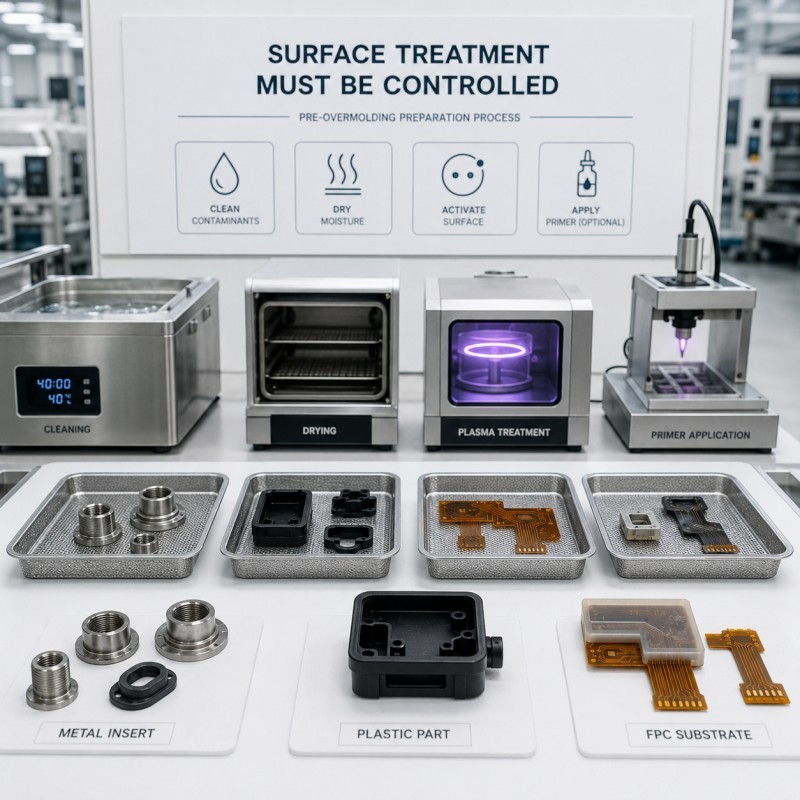
Surface treatment is often the hidden factor behind bonding failure. Even when the drawing, mold, and silicone material look correct, poor surface preparation can still cause delamination.
Depending on the substrate, surface treatment may include:
- Cleaning
- Drying
- Degreasing
- Plasma treatment
- Primer coating
- Baking
- Surface roughening
- Oxide layer control
- Dust and oil prevention
For metal inserts, oil contamination is a common issue. For plastic substrates, moisture, release agent, and storage conditions may affect bonding. For FPC parts, surface treatment must be controlled carefully to avoid damaging the circuit.
The key point is consistency. A sample can pass bonding tests if it is cleaned carefully by hand, but mass production requires a repeatable process.
Mold Positioning Affects Bonding Quality
In silicone overmolding, the substrate must be placed accurately inside the mold. If the insert shifts, the silicone thickness, bonding area, and sealing path may change.
Poor positioning can cause:
- Thin silicone in critical areas
- Uneven bonding width
- Flash around the sealing edge
- Silicone overflow into functional areas
- Deformation of FPC or plastic substrate
- Poor appearance
- Unstable waterproof performance
For precision LSR overmolding, mold design should control insert positioning, parting line location, venting, silicone flow, demolding direction, and flash control.
This is especially important for small parts, connector seals, wearable device components, sensor seals, medical silicone parts, and FPC overmolded components.
Process Parameters Need Stability
Even if the material and mold are correct, unstable molding parameters can still affect bonding performance.
Key process factors include:
- Mold temperature
- Injection pressure
- Injection speed
- Curing time
- Clamping force
- Insert preheating
- Silicone mixing ratio
- Venting condition
- Demolding timing
- Post-curing requirement
If the silicone does not cure properly, the bonding strength may be weak. If the temperature is too high or pressure is too strong, the substrate may deform. If venting is poor, trapped air may create voids near the bonding interface.
Stable LSR overmolding requires both tooling experience and production process control.
Testing Before Mass Production Is Necessary
A good-looking sample does not always mean the design is safe for mass production. Before production approval, the overmolded part should be tested based on the real application environment.
Common validation tests include:
- Pulling force test
- Peeling test
- Bending test
- Torsion test
- Aging test
- Temperature cycling test
- Waterproof test
- Air leakage test
- Compression test
- Assembly test
- Visual inspection
- Dimensional inspection
For automotive, medical, wearable, 3C, and industrial electronic applications, testing should not only check appearance. It should verify whether the bonding area can survive real use conditions.
Common Applications That Require Strong Bonding
Silicone Over Plastic Parts
Silicone over plastic is often used for waterproof housings, electronic buttons, connector seals, wearable parts, beauty device components, and medical device parts. The main challenge is plastic compatibility, heat resistance, and bonding stability.
Silicone Over Metal Parts
Silicone over metal is commonly used for metal inserts, sensor components, connector sealing parts, handles, valves, and structural protection parts. The key factors are surface cleaning, primer control, mechanical locking, and long-term adhesion.
FPC Silicone Overmolding
FPC silicone overmolding is used when flexible circuits need waterproof protection, insulation, strain relief, or soft encapsulation. The challenge is to protect the circuit while keeping accurate silicone positioning and stable bonding.
Waterproof Sealing Components
Waterproof sealing parts require both strong bonding and proper compression. If the silicone bonds poorly, water may enter from the interface. If the sealing lip is not designed correctly, the part may still leak even when bonding is acceptable.
How SiliconePlus Supports Custom Silicone Overmolding Projects
SiliconePlus supports custom silicone overmolding and LSR injection molding projects for plastic, metal, FPC, and silicone substrates. We can review drawings, samples, material requirements, bonding areas, sealing structures, and application environments before mold development.
For projects that require OEM/ODM customization, our team can support DFM review, material selection, mold development, sample production, process optimization, inspection, and mass production.
If your project involves silicone over plastic, silicone over metal, FPC silicone overmolding, waterproof sealing parts, or precision LSR overmolded components, early engineering review can help reduce delamination risk before tooling and production.
Conclusion
Delamination in silicone overmolding is rarely caused by one single factor. It is usually the result of material mismatch, poor surface treatment, insufficient bonding area, unstable mold positioning, incorrect process parameters, or a design that does not match the real application environment.
To prevent failure, engineers should evaluate the substrate, silicone material, bonding structure, mold design, surface treatment, and production process before mass production.
A reliable custom silicone overmolding project should not only focus on whether the first sample looks good. It should also prove that the part can maintain bonding strength, sealing performance, and dimensional stability during actual use.
If you are developing a custom LSR overmolded part and want to reduce delamination risk, send us your drawings, samples, application requirements, material information, and estimated quantity. SiliconePlus can help evaluate the right overmolding solution from prototype to mass production.