What Is Liquid Silicone Injection Molding?
Introduction
Many product developers and sourcing teams ask whether liquid silicone injection molding is the right process for waterproof seals, overmolded parts, medical silicone components, or precision industrial rubber parts. Choosing the wrong molding method can lead to leakage, flash, delamination, unstable dimensions, and failed assembly. This article explains how LSR injection molding works, where it is used, and how to choose the right manufacturing partner.
Answer Excerpt
Liquid silicone injection molding is a precision manufacturing process that injects two-component liquid silicone rubber into a heated mold to produce flexible, durable, and high-accuracy silicone parts. It is ideal for custom silicone seals, LSR overmolded parts, medical silicone components, automotive waterproof seals, electronic waterproof parts, wearable device seals, and OEM/ODM silicone manufacturing projects requiring stable mass production.
Transition Paragraph
For engineering buyers, the real question is not only “What is LSR molding?” It is how this process reduces product risk, improves waterproof sealing, and supports reliable mass production.
People Also Ask: What Is Liquid Silicone Injection Molding?
Liquid silicone injection molding, also called LSR injection molding or liquid silicone rubber injection molding, is a manufacturing process used to produce high-quality silicone rubber parts with stable dimensions and repeatable quality. Liquid silicone rubber is usually supplied as a two-part material system. These two components are accurately metered, mixed, injected into a heated mold cavity, and cured into the final elastomer part.
Unlike ordinary plastic injection molding, liquid silicone injection molding requires dedicated material metering, mixing, mold temperature control, mold sealing, and curing control. Before curing, LSR has very low viscosity, allowing it to flow into complex cavities, thin walls, sealing lips, micro holes, fine ribs, and precision surface details.
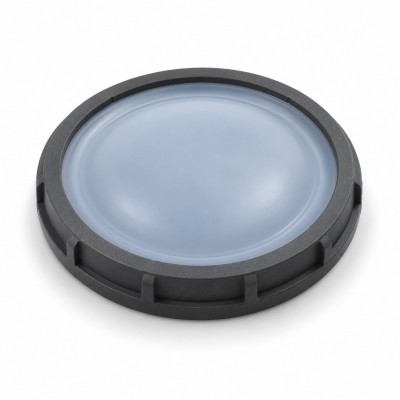
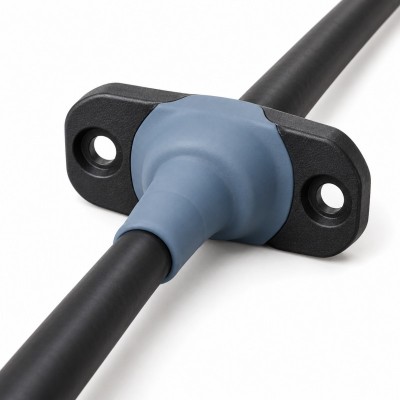
This makes the process especially suitable for precision silicone gaskets, waterproof connector seals, medical silicone valves, Type-C waterproof seals, wearable device gaskets, automotive wire harness grommets, and custom industrial silicone rubber parts.
For Shenzhen Liyongan Silicone Rubber Products Co., Ltd., liquid silicone injection molding is not only a single production process. It is part of a complete OEM/ODM manufacturing system, including DFM evaluation, mold design, liquid silicone injection molding, silicone overmolding, silicone bonding with metal, plastic, FPC, or silicone, rapid prototyping, mass production, CCD inspection, and quality control.
People Also Ask: How Does the Liquid Silicone Injection Molding Process Work?
The liquid silicone injection molding process begins with product evaluation. Before opening a mold, engineers review the customer’s 2D drawings, 3D files, samples, product photos, tolerance requirements, waterproof level, material hardness, assembly method, and application environment. This step is important because many silicone part failures are caused by poor early-stage design rather than the molding process alone.
After DFM review, the correct LSR material is selected. Different projects may require different hardness, color, transparency, tensile strength, elongation, tear resistance, compression set, bonding performance, or medical-grade options.
For automotive connector seals, buyers usually care about temperature resistance, anti-vibration performance, oil resistance, dustproof structure, and long-term sealing stability. For medical silicone parts, buyers may focus on medical-grade material options, clean production, biocompatibility, and stable dimensions. For electronic waterproof parts, thin-wall design, stable sealing, and small-size precision are often key concerns.
Next, the two components of liquid silicone rubber are accurately metered and mixed. The mixed material is injected into a heated mold cavity, where it cures into a solid silicone elastomer. The process depends on accurate control of injection pressure, mold temperature, curing time, shot size, venting, and clamping force.
Once the part is cured, it is demolded and inspected. Some parts may require trimming, post-curing, assembly, surface treatment, or additional inspection. For precision projects, quality control can include appearance inspection, dimensional measurement, sealing structure inspection, and CCD visual inspection.
People Also Ask: What Are the Advantages of Liquid Silicone Injection Molding?
The first major advantage of liquid silicone injection molding is precision. LSR injection molding can produce complex silicone parts with fine details, thin-wall structures, sealing lips, stable dimensions, and repeatable quality. This is important for waterproof seals, medical components, electronic devices, automotive connectors, and industrial assemblies.
The second advantage is production consistency. Once the mold design, process parameters, material selection, and curing conditions are stable, the process can support repeatable mass production. For B2B buyers, this matters because the first sample is not the final goal. The real challenge is producing thousands or millions of parts with consistent quality.
The third advantage is material performance. Liquid silicone rubber can offer flexibility, high and low temperature resistance, aging resistance, water resistance, electrical insulation, and biocompatibility depending on the material grade. This makes LSR suitable for demanding applications in automotive, medical, electronics, wearable devices, and industrial markets.
The fourth advantage is design freedom. Because uncured LSR flows easily, it can fill complex mold cavities and create integrated sealing structures. Engineers can design sealing lips, gaskets, plugs, ribs, membranes, soft-touch areas, and overmolded bonding structures that are difficult to achieve with many traditional molding methods.
The fifth advantage is overmolding capability. LSR can be molded around plastic, metal, FPC, or silicone inserts when the design, material, surface treatment, and process are properly controlled. This helps create integrated waterproof sealing structures instead of relying only on separate O-rings, manual assembly, or adhesive bonding.
People Also Ask: What Products Are Made by Liquid Silicone Injection Molding?
Liquid silicone injection molding is widely used for parts that require precision, sealing, flexibility, durability, and stable performance.
In new energy vehicles and automotive electronics, LSR injection molding can be used for automotive connector seals, EV connector silicone seals, wire harness grommets, battery pack sealing parts, BMS silicone parts, charging port seals, sensor gaskets, and anti-vibration silicone components. These products often require IP67/IP68 waterproof sealing, high and low temperature resistance, anti-aging performance, and stable compression.
In electronic devices, LSR injection molding can produce Type-C waterproof seals, SIM card tray seals, power button seals, volume button seals, microphone gaskets, speaker gaskets, battery cover gaskets, electronic enclosure seals, and waterproof rubber plugs. These parts are usually small, thin, and highly sensitive to dimensional tolerance.
In wearable devices, typical parts include smartwatch waterproof seals, wearable connector seals, sensor gaskets, charging pin seals, soft-touch silicone components, sweat-resistant seals, and smart device structural sealing parts. Wearable applications often require comfort, flexibility, skin-contact material options, and reliable sealing under sweat, movement, and repeated use.
In medical and health care devices, LSR injection molding is suitable for medical silicone seals, silicone valves, duckbill valves, fluid control valves, medical device gaskets, respiratory device parts, diagnostic equipment seals, and laboratory instrument components.
For more demanding healthcare applications, medical grade silicone parts can be customized according to material, structure, sealing, and assembly requirements.
In beauty and health care devices, LSR parts can be used for waterproof device seals, soft-touch overmolded handles, silicone interface components, skin-contact silicone covers, and sealing components for electronic beauty devices.
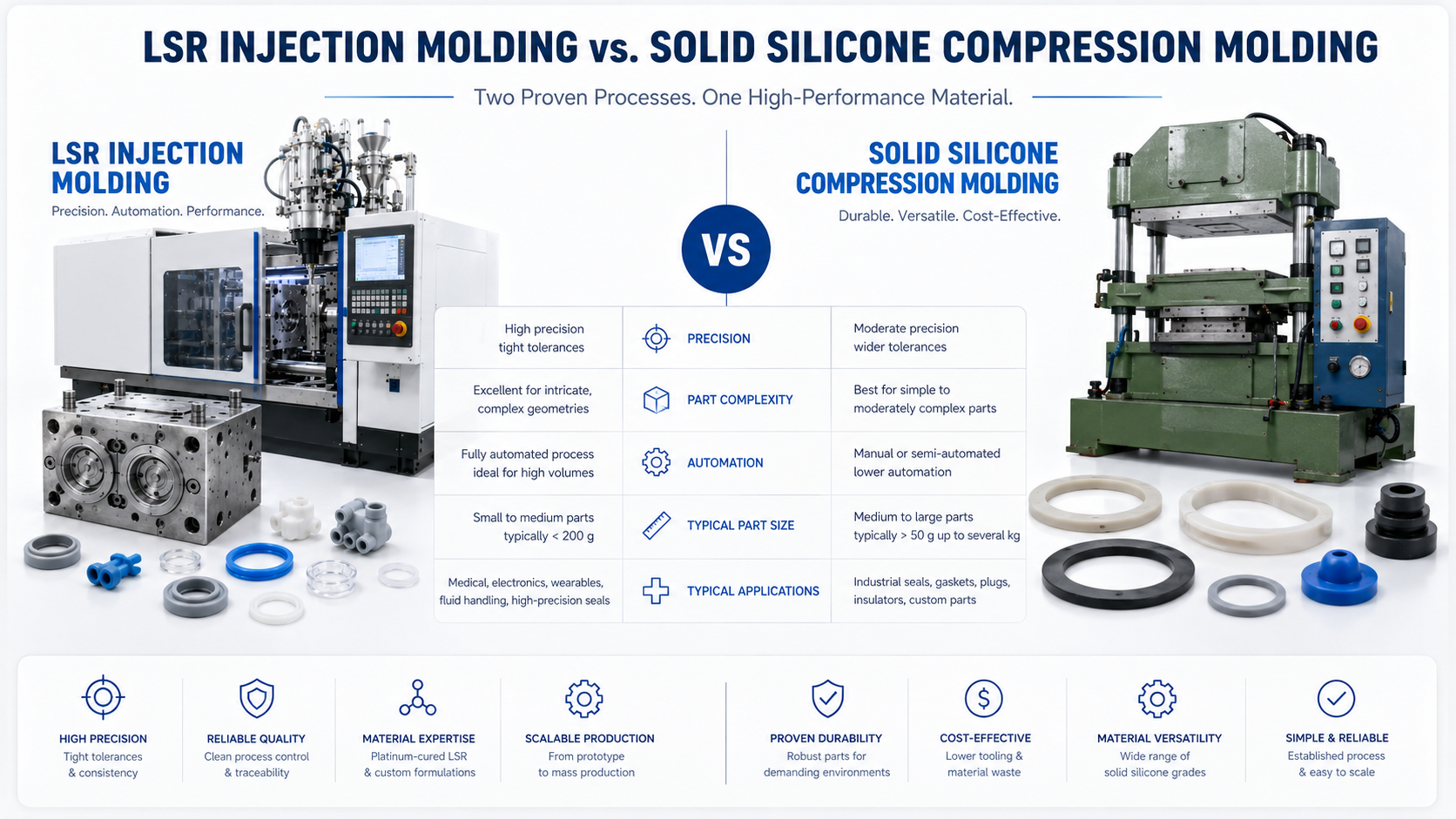
People Also Ask: What Is the Difference Between LSR Injection Molding and Silicone Compression Molding?
LSR injection molding uses liquid silicone rubber and dedicated injection molding equipment. The material is metered, mixed, injected, and cured in a heated mold. This process is usually preferred for high-precision parts, complex structures, thin-wall designs, small components, overmolded insert parts, and high-volume production.
Silicone compression molding usually uses solid silicone rubber. The material is placed into a mold cavity, compressed, heated, and cured. Compression molding is often suitable for simpler silicone parts, larger gaskets, O-rings, pads, plugs, sleeves, and lower-volume projects.
The difference is not simply which process is better. The right choice depends on part structure, production volume, tolerance requirements, tooling cost, material performance, and target unit price.
LSR Injection Molding vs Silicone Compression Molding
| Comparison Item | LSR Injection Molding | Silicone Compression Molding |
|---|---|---|
| Material Form | Two-component liquid silicone rubber | Solid silicone rubber compound |
| Best For | High-precision parts, thin-wall parts, complex structures, and overmolded parts | Simple gaskets, O-rings, plugs, pads, and larger silicone parts |
| Production Volume | Better for medium to high-volume production | Better for low to medium-volume production |
| Tolerance Control | Higher dimensional accuracy and repeatability | Moderate accuracy, depending on mold and part design |
| Tooling Requirement | Requires precise injection mold and LSR equipment | Requires compression mold and manual or semi-automatic loading |
| Typical Applications | Automotive connector seals, medical silicone parts, waterproof electronics, wearable seals, silicone overmolding parts | Silicone rings, pads, sleeves, plugs, and general molded silicone parts |
| Buyer Type | OEM/ODM buyers requiring precision, waterproof sealing, complex design, and repeatable quality | Buyers requiring simple silicone parts with flexible quantity and lower tooling investment |
People Also Ask: Can Liquid Silicone Be Overmolded onto Metal, Plastic, FPC, or Silicone?
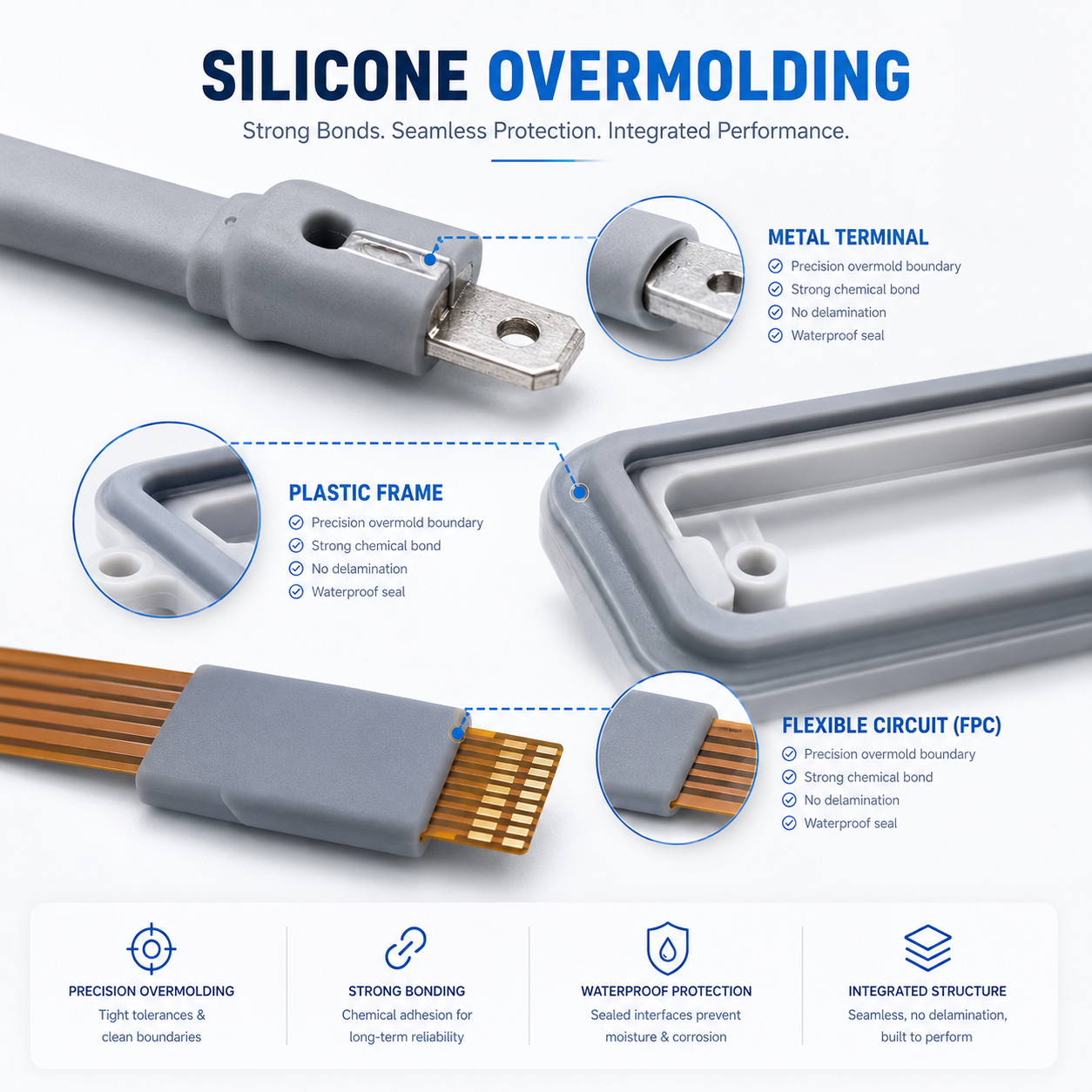
Yes. Liquid silicone can be overmolded onto metal, plastic, FPC, or silicone when the engineering conditions are correct. This process is commonly called silicone overmolding, LSR overmolding, insert molding, silicone over metal, silicone over plastic, FPC silicone overmolding, or silicone and silicone overmolding.
For projects requiring strong bonding and integrated sealing, silicone overmolding solutions can help combine silicone with metal, plastic, FPC, or silicone substrates.
However, silicone overmolding is more technically demanding than ordinary silicone molding. Silicone is chemically stable, so it does not naturally bond strongly to every substrate. Strong bonding may require compatible material selection, mechanical locking design, surface treatment, primer, plasma treatment, mold temperature control, injection pressure control, and curing optimization.
For B2B buyers, the key is not whether silicone can cover the insert. The key is whether the final part can resist delamination, water leakage, edge lifting, separation, and bonding failure during long-term use.
This matters in automotive connectors, waterproof electronics, FPC sensor modules, medical device seals, wearable device waterproof parts, and beauty device components. If the silicone layer separates from the plastic, metal, or FPC, the product may lose its waterproof function. A reliable supplier should evaluate bonding risk before mold opening and optimize both structure and process.
People Also Ask: Why Is LSR Injection Molding Important for IP67/IP68 Waterproof Sealing?
IP67/IP68 waterproof sealing requires more than a soft material. It requires correct material hardness, sealing structure, compression design, tolerance control, assembly conditions, and long-term reliability. Liquid silicone rubber is useful because it is elastic, stable, and capable of forming precise sealing lips, gaskets, ribs, plugs, and overmolded waterproof edges.
In electronic products, water usually enters through weak points such as charging ports, buttons, SIM trays, battery covers, speaker holes, microphone holes, connector joints, and housing seams. Precision molded silicone seals help block water and dust while maintaining flexibility during assembly and repeated use.
In automotive and EV systems, waterproof sealing faces additional challenges. Components may be exposed to vibration, heat, cold, dust, oil, moisture, and long service life requirements. EV connector seals, wire harness grommets, battery pack gaskets, and BMS silicone components must maintain sealing performance even after thermal cycling and mechanical stress.
For EV connectors, wire harnesses, battery packs, and automotive electronics, automotive waterproof silicone seals are often used to improve long-term sealing reliability.
LSR overmolding can improve waterproof reliability by integrating the silicone sealing structure directly onto the plastic, metal, FPC, or silicone substrate. Compared with separately assembled gaskets, integrated overmolded silicone structures can reduce assembly steps, improve positioning accuracy, and reduce the risk of gasket displacement.
People Also Ask: What Defects Can Happen in Liquid Silicone Injection Molding?
Common LSR injection molding defects include flash, under-filling, bubbles, poor curing, whitening, burn marks, deformation, contamination, bonding failure, and dimensional instability.
Flash is one of the most common challenges because uncured LSR has very low viscosity. If the mold parting line, insert fit, venting, or clamping condition is not well controlled, liquid silicone can flow into tiny gaps and create excess material. This may increase trimming cost and reduce appearance quality.
Under-filling can happen when shot size, injection pressure, injection speed, material viscosity, venting, or mold temperature is not suitable. Poor curing can happen when material mixing, mold temperature, curing time, or catalyst balance is not controlled. Bubbles may result from trapped air, poor venting, moisture, vacuum problems, or process instability.
For overmolded parts, bonding failure is another major risk. If the substrate material, surface treatment, bonding design, or molding parameters are wrong, the silicone layer may peel, lift, or delaminate. This is especially dangerous for waterproof sealing projects.
A capable manufacturer should not only produce samples but also understand how to prevent defects before mass production. This requires engineering experience, mold accuracy, stable equipment, controlled processing, and strict quality inspection.
People Also Ask: How Do You Choose a Liquid Silicone Injection Molding Manufacturer?
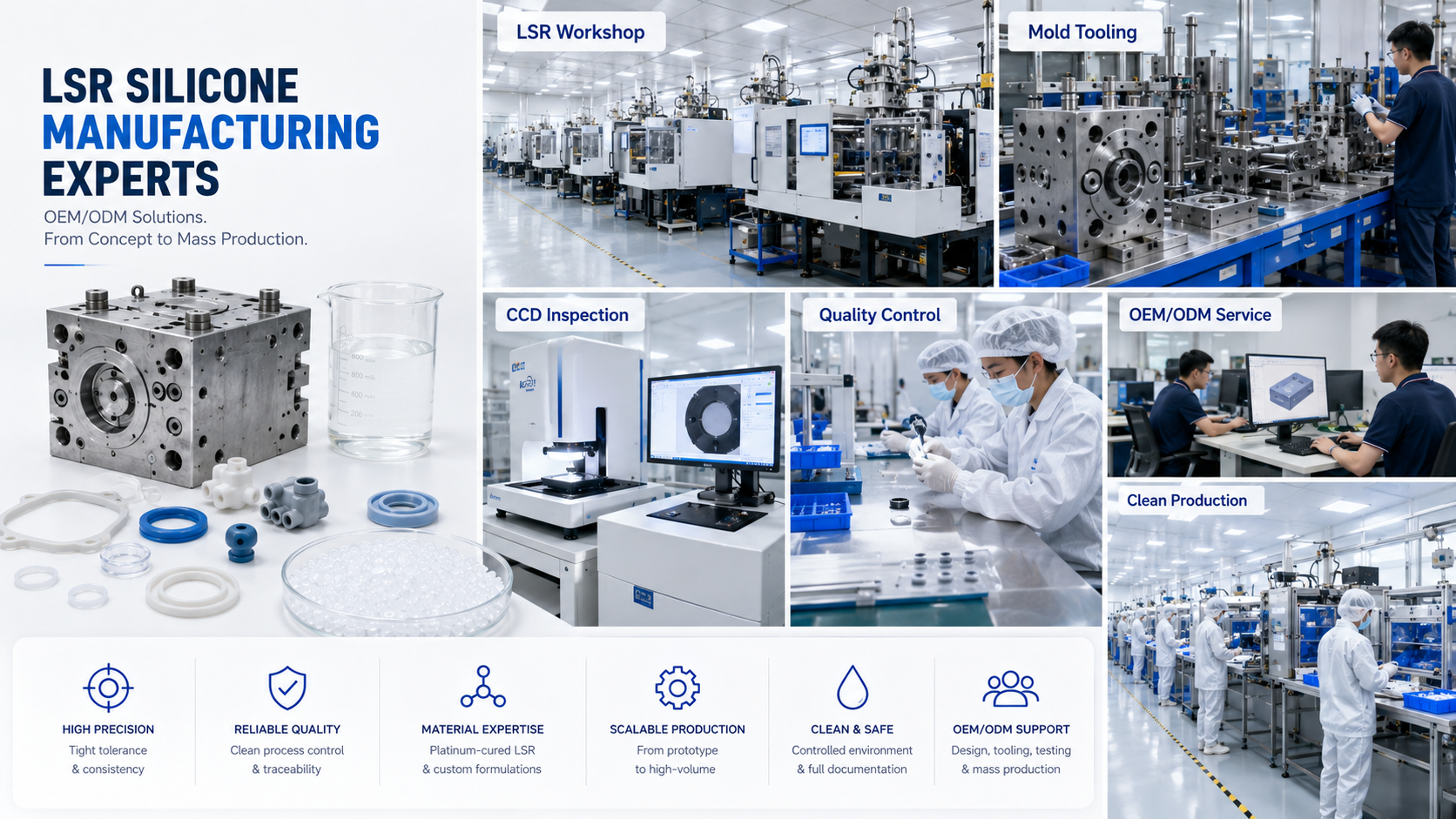
Choosing the right liquid silicone injection molding manufacturer requires evaluating engineering ability, mold capability, process control, production equipment, quality inspection, and experience in similar applications.
A strong supplier should provide DFM support before tooling. This helps identify wall thickness problems, flash risks, sealing design issues, bonding risks, demolding problems, and assembly tolerance concerns. Without early DFM review, buyers may spend money on a mold that cannot produce stable parts.
The supplier should also understand different silicone molding processes, including LSR injection molding, silicone overmolding, insert molding, compression molding, extrusion, precision cutting, and secondary processing. This matters because different parts require different manufacturing solutions.
For waterproof sealing projects, the supplier should understand IP67/IP68 sealing requirements, compression design, sealing lip geometry, material hardness, tolerance stack-up, and application environment. For automotive projects, the supplier should understand anti-vibration requirements, temperature resistance, connector assembly, battery pack sealing, and long-term aging resistance. For medical and health care projects, the supplier should offer appropriate medical-grade silicone options and strict quality control.
Shenzhen Liyongan Silicone Rubber Products Co., Ltd. owns a 4500+ square meter silicone processing plant in China, with 12 liquid silicone injection molding machines, 26 compression molding machines, 20 CCD inspection devices, a mold workshop, liquid silicone molding workshop, solid silicone molding workshop, dust-free workshop, engineering team, production team, and quality control team.
The company supports OEM/ODM custom silicone overmolding parts, LSR injection molded parts, silicone over metal parts, silicone over plastic parts, FPC silicone overmolding parts, medical-grade silicone parts, automotive waterproof silicone seals, electronic waterproof parts, wearable device seals, beauty and health care silicone components, and industrial custom silicone rubber parts.
People Also Ask: What Information Should Buyers Provide for an LSR Injection Molding Project?
To receive accurate technical feedback and quotation, buyers should provide complete project information. Useful files include 2D drawings, 3D models, samples, product photos, material requirements, hardness requirements, color requirements, tolerance requirements, target waterproof level, application environment, annual quantity, expected production volume, and testing standards.
For silicone overmolding projects, buyers should also provide insert material information. The supplier needs to know whether the insert is plastic, metal, FPC, silicone, or another material. If it is plastic, the exact plastic grade is important. If it is metal, surface treatment may affect bonding. If it is FPC, bending, temperature resistance, and insert positioning must be evaluated.
For waterproof sealing parts, buyers should provide the mating structure if possible. A silicone seal cannot be fully judged alone. Groove size, compression ratio, assembly gap, mating material, screw force, operating temperature, and water pressure all affect sealing performance.
The more information a buyer provides, the faster the supplier can evaluate feasibility, recommend material, design the mold, provide DFM suggestions, and reduce sampling risk.
FAQ About Liquid Silicone Injection Molding
1. What is liquid silicone injection molding used for?
Liquid silicone injection molding is used to produce high-precision silicone rubber parts such as automotive connector seals, EV waterproof silicone seals, medical silicone components, Type-C waterproof seals, wearable device gaskets, silicone valves, and custom industrial silicone parts. It is suitable for products requiring flexibility, sealing performance, temperature resistance, and stable mass production.
2. Is liquid silicone injection molding suitable for waterproof parts?
Yes. Liquid silicone injection molding is highly suitable for waterproof parts because LSR offers excellent elasticity, compression recovery, aging resistance, and sealing stability. It is often used for IP67/IP68 waterproof seals in automotive electronics, consumer electronics, wearable devices, medical equipment, and industrial electronic modules.
3. Can LSR be molded over metal, plastic, or FPC?
Yes. LSR can be overmolded onto metal, plastic, FPC, or silicone when the correct material, surface treatment, mold design, and process parameters are used. This process is commonly used for silicone over metal parts, silicone over plastic parts, FPC silicone overmolding parts, and waterproof electronic assemblies.
4. What information is needed for a custom LSR injection molding project?
Buyers should provide 2D drawings, 3D files, samples, product photos, material requirements, hardness, color, tolerance, application environment, waterproof level, testing standards, and estimated order quantity. For overmolding projects, the insert material and bonding requirements should also be provided.
5. What is the difference between LSR injection molding and silicone compression molding?
LSR injection molding uses liquid silicone rubber and is better for precision parts, complex structures, thin-wall designs, overmolded parts, and stable mass production. Silicone compression molding uses solid silicone rubber and is more suitable for simple gaskets, O-rings, pads, plugs, and lower-volume silicone parts.
6. How do I choose a reliable liquid silicone injection molding manufacturer?
A reliable manufacturer should have LSR injection molding machines, mold design capability, engineering support, DFM review, silicone overmolding experience, strict quality inspection, and stable mass production capacity. For waterproof or overmolded parts, experience with IP67/IP68 sealing and silicone bonding is especially important.
Conclusion
Liquid silicone injection molding is a high-value manufacturing process for producing precision silicone parts with stable dimensions, excellent flexibility, strong sealing performance, and reliable mass production consistency. It is especially suitable for automotive waterproof silicone seals, EV connector seals, electronic waterproof components, medical silicone parts, wearable device seals, beauty device components, and industrial custom silicone rubber parts.
For buyers, the most important point is not only understanding what LSR injection molding is. The real value is choosing the right process, material, mold design, sealing structure, and manufacturing partner. A professional LSR injection molding manufacturer should provide engineering support, DFM review, mold development, overmolding experience, stable production, and strict quality inspection.
Shenzhen Liyongan Silicone Rubber Products Co., Ltd. provides custom liquid silicone injection molding, silicone overmolding, silicone bonding with metal, plastic, FPC, and silicone, rapid prototyping, OEM/ODM production, and quality inspection for global B2B customers.
If you are developing waterproof silicone seals, LSR overmolded parts, medical-grade silicone parts, or custom industrial silicone components, you can request a custom LSR molding quote by sharing your drawings, samples, or project requirements with our engineering team.
What kind of liquid silicone injection molded part are you developing? Leave a comment, share this article with your engineering or sourcing team, or contact us to discuss your custom silicone molding project.