Why DFM Review Matters Before Custom LSR Overmolding Tooling
Many custom LSR overmolding projects do not fail because the idea is wrong. They fail because the design goes into tooling too early.
A 3D drawing may look complete, but it may still have hidden risks in material bonding, sealing structure, silicone thickness, insert positioning, venting, flash control, demolding, tolerance stack-up, or mass production repeatability.
For silicone over plastic, silicone over metal, FPC silicone overmolding, and silicone over silicone projects, DFM review is not just a simple drawing check. It is an engineering evaluation before mold development.
A good DFM review can help reduce mold modification, shorten sampling time, improve bonding reliability, and avoid unexpected failure during assembly or mass production.
Answer Excerpt
DFM review is important before custom LSR overmolding tooling because it helps identify design risks before mold development. It evaluates substrate material, silicone bonding area, sealing path, compression ratio, insert positioning, wall thickness, mold flow, venting, flash control, demolding, tolerance, and production feasibility. This helps reduce tooling risk and improve mass production stability.
What Is DFM Review in LSR Overmolding?
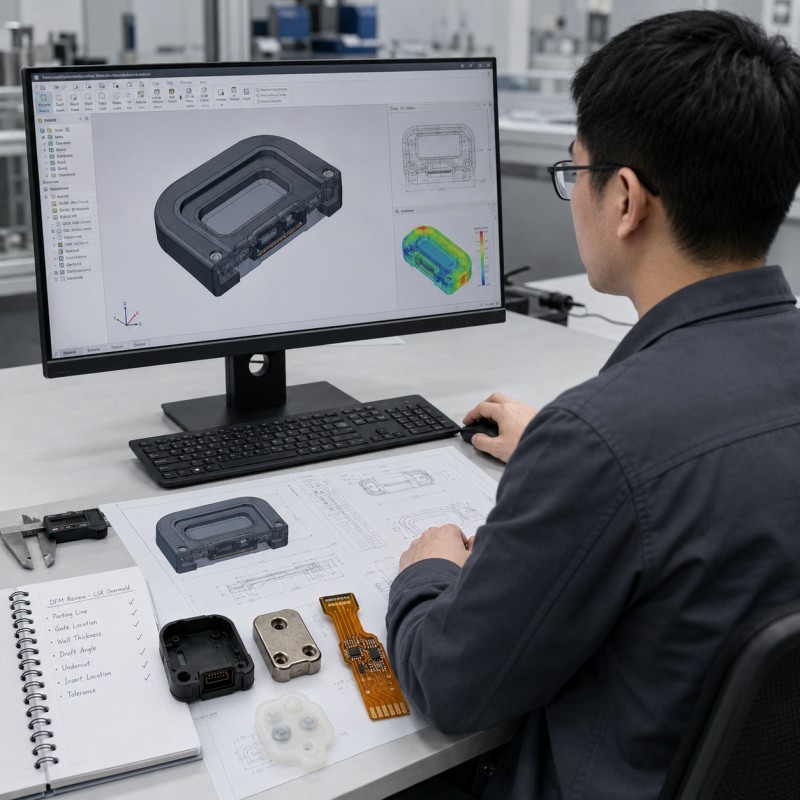
DFM means Design for Manufacturing. In custom LSR overmolding, it means reviewing whether the product design can be molded, bonded, sealed, inspected, assembled, and mass-produced reliably.
It is not only about whether the mold can be made. It is about whether the final part can meet the real application requirements.
For LSR overmolding projects, DFM review usually checks:
- Substrate material compatibility
- Silicone bonding area
- Sealing lip structure
- Silicone wall thickness
- Insert positioning
- Part tolerance
- Mold parting line
- Gate location
- Venting design
- Flash control
- Demolding direction
- Assembly interference
- Testing requirements
- Mass production repeatability
Without DFM review, a project may pass the drawing stage but fail during sampling, waterproof testing, pull testing, assembly, or customer validation.
Why DFM Review Should Be Done Before Tooling
Custom overmolding molds are not easy to modify after production begins. Once the mold structure is fixed, problems such as poor bonding, flash, insert shifting, thin silicone areas, or difficult demolding can become expensive to correct.
DFM review helps identify these risks before steel cutting.
For example, if the bonding area is too narrow, the mold may still produce a beautiful sample, but the silicone may not survive pulling or bending tests. If the sealing lip is too thin, it may deform during assembly. If the parting line is placed on a critical sealing surface, flash may affect waterproof performance.
These problems are easier to correct during the design stage than after mold completion.
Substrate Material Must Be Evaluated First
In LSR overmolding, the substrate is the foundation of the project. Silicone may be overmolded onto plastic, metal, FPC, or another silicone component, but each substrate has different bonding and molding behavior.
For silicone over plastic parts, engineers need to check plastic heat resistance, deformation risk, surface energy, shrinkage, and bonding compatibility.
For silicone over metal parts, surface cleanliness, oil contamination, oxidation, primer control, and mechanical locking design are important.
For FPC silicone overmolding, the key challenge is protecting the circuit while controlling silicone flow, pressure, bonding position, and bending stress.
If the substrate is not suitable for the required molding temperature, bonding method, or sealing function, the whole project may become unstable.
Bonding Area Design Affects Long-Term Reliability
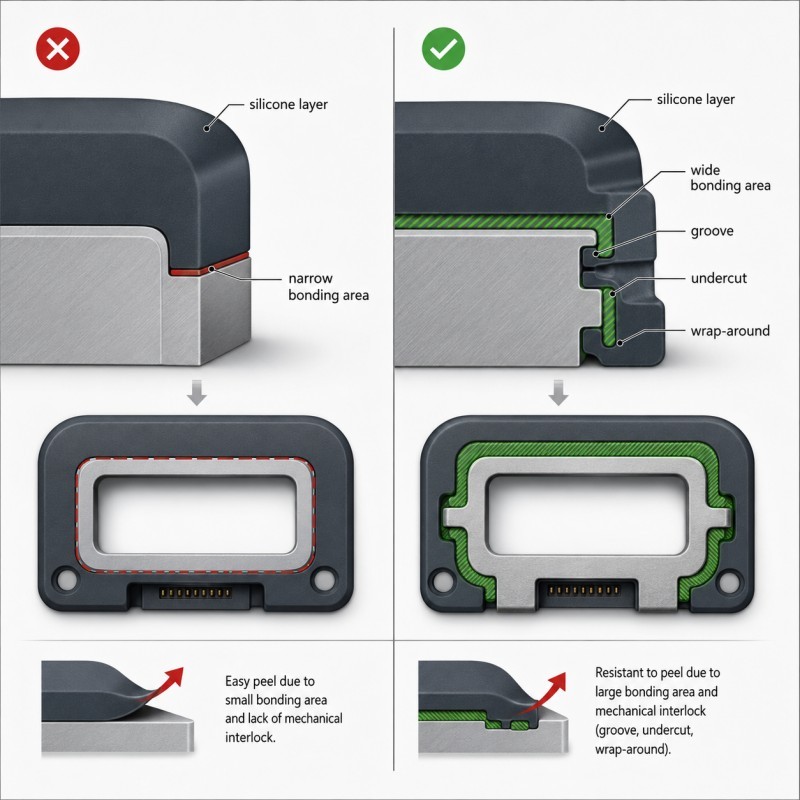
Strong bonding does not only depend on silicone material. The structure must also provide enough bonding area.
During DFM review, engineers should check whether the silicone has enough contact width, whether the bonding edge is protected, and whether the pulling direction may cause peeling.
A good bonding design may include:
- Wider bonding zones
- Smooth transition edges
- Wrap-around silicone structure
- Groove design
- Undercut structure
- Holes or mechanical locking points
- Proper silicone thickness
- Separation between bonding area and sealing lip
For parts that need waterproof sealing, the bonding interface must be especially stable. If water can enter through the bonding edge, the part may fail even when the sealing lip looks correct.
Sealing Structure Needs Compression Control
For waterproof or dustproof components, the silicone sealing lip must be designed according to real assembly conditions.
Too little compression may cause leakage. Too much compression may cause difficult assembly, silicone deformation, stress relaxation, or early failure.
DFM review should check:
- Sealing lip height
- Sealing lip width
- Compression ratio
- Housing tolerance
- Contact surface flatness
- Assembly direction
- Long-term compression environment
- Waterproof test condition
- Dustproof requirement
The sealing function should not be designed only based on appearance. It must match the actual housing, assembly force, and working environment.
Silicone Wall Thickness Should Be Balanced
Uneven silicone thickness can cause molding problems and performance risks.
If the silicone is too thin, it may tear, fail to fill properly, or lose sealing pressure. If the silicone is too thick, it may increase curing time, create internal stress, affect appearance, or cause unnecessary material cost.
During DFM review, engineers should evaluate whether the silicone wall thickness is suitable for injection flow, curing, demolding, and functional performance.
For precision LSR overmolding, uniform thickness and smooth transitions are usually better than sudden thickness changes.
Insert Positioning Is Critical
In overmolding, the substrate must be placed inside the mold before silicone injection. If the insert shifts during molding, the silicone position will also change.
Poor insert positioning may cause:
- Uneven silicone thickness
- Exposed substrate areas
- Misaligned sealing lips
- Flash on functional surfaces
- Poor bonding at the edge
- FPC deformation
- Plastic housing deformation
- Inconsistent part dimensions
DFM review should check whether the substrate can be positioned accurately and repeatedly inside the mold. This is especially important for small connectors, FPC parts, medical components, wearable parts, and automotive electronic seals.
Mold Flow and Venting Cannot Be Ignored
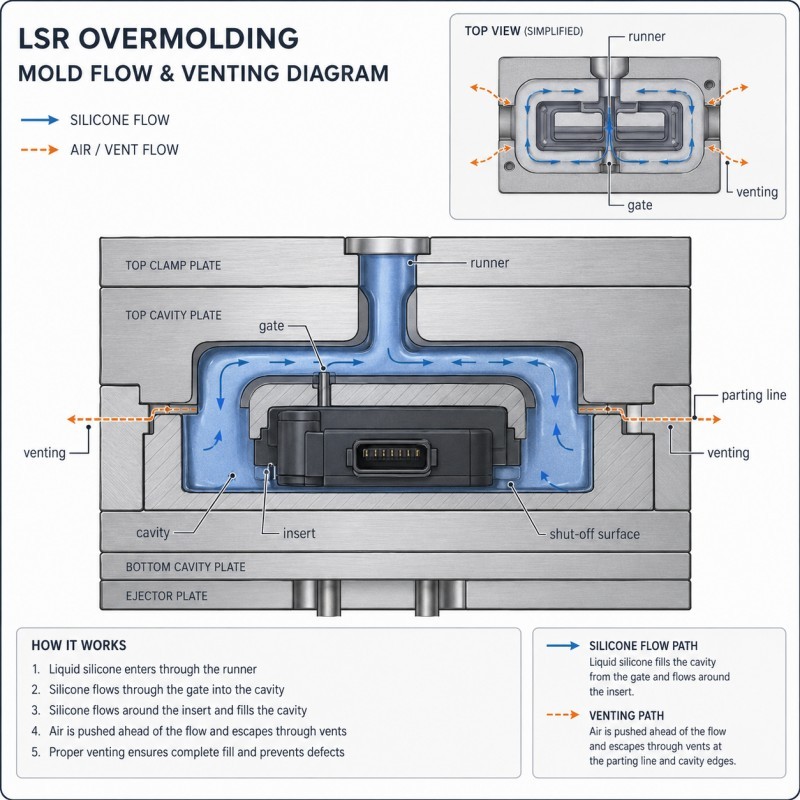
LSR has excellent flowability, but that does not mean the mold can be designed casually.
If the gate position is not suitable, silicone flow may be unbalanced. If venting is poor, trapped air may cause bubbles, short shots, burn marks, or weak bonding areas. If the flow path crosses a sensitive insert area, it may deform or shift the substrate.
DFM review should consider:
- Gate position
- Flow direction
- Venting location
- Air trap risk
- Insert movement risk
- Filling balance
- Flash-sensitive areas
- Appearance requirements
Good mold flow and venting design help improve appearance, bonding, dimensional stability, and production efficiency.
Parting Line and Flash Control Affect Assembly
Flash is one of the most common problems in precision silicone parts. In some products, small flash may not affect function. But in waterproof seals, connectors, wearable components, medical parts, or electronic interfaces, flash can become a serious problem.
DFM review should avoid placing parting lines on critical sealing surfaces or assembly contact areas whenever possible.
Engineers should also check whether the product structure allows stable clamping, proper venting, and clean demolding. If flash appears on the sealing lip or bonding edge, it may affect waterproof performance and assembly accuracy.
Demolding Direction Should Be Reviewed Early
Some silicone structures look reasonable in 3D drawings but are difficult to demold in real production.
Deep undercuts, sharp edges, thin lips, negative angles, and weak silicone bridges may cause tearing, deformation, or unstable demolding.
During DFM review, the team should check:
- Demolding direction
- Draft angle
- Undercut depth
- Silicone flexibility
- Mold release risk
- Product deformation risk
- Whether secondary trimming is required
A design that is difficult to demold may increase scrap rate, cycle time, and production cost.
Tolerance Stack-Up Must Match Real Assembly
Custom silicone overmolded parts often work together with plastic housings, metal parts, PCBs, FPCs, connectors, covers, or other assemblies.
Even if each single part is within tolerance, the final assembly may still fail if tolerance stack-up is not reviewed.
DFM review should evaluate:
- Substrate tolerance
- Silicone molding tolerance
- Assembly gap
- Compression space
- Sealing surface tolerance
- Insert placement tolerance
- Customer housing tolerance
- Inspection method
For waterproof sealing and precision electronic components, tolerance control is often as important as material selection.
Prototype Testing Should Be Planned Before Mass Production
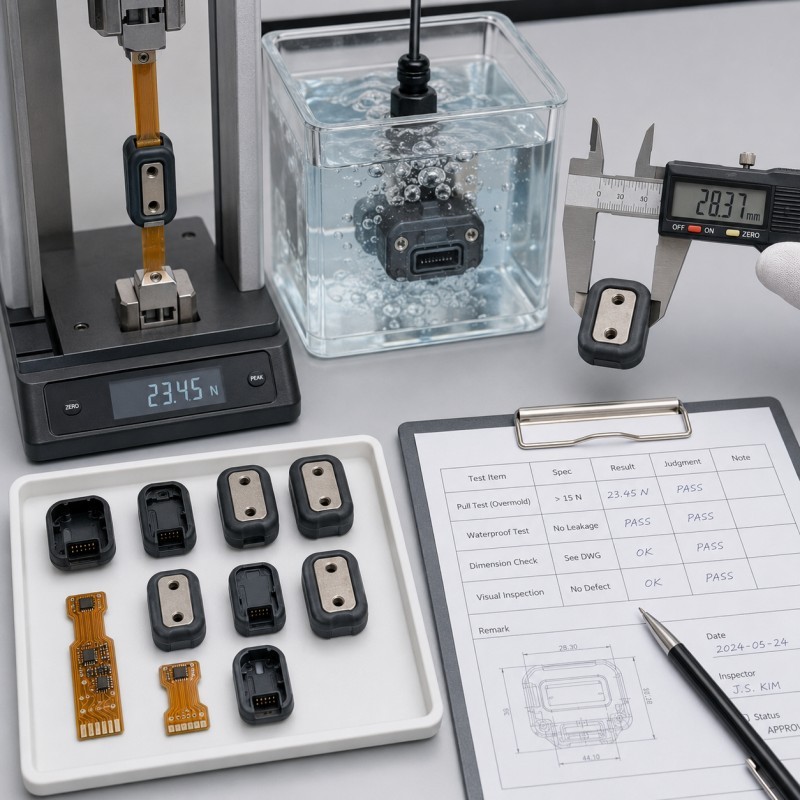
DFM review should not only focus on mold feasibility. It should also define how the part will be validated after sampling.
Depending on the application, prototype testing may include:
- Dimensional inspection
- Visual inspection
- Pulling force test
- Peeling test
- Waterproof test
- Air leakage test
- Compression test
- Assembly test
- Bending fatigue test
- Temperature cycling test
- Aging test
Testing standards should be discussed before tooling, because test requirements may affect the structure, material, mold design, and inspection plan.
Applications That Need Strong DFM Review
Automotive Electronic Components
Automotive silicone overmolded parts may face vibration, heat, cold, moisture, dust, and long-term assembly stress. DFM review helps improve sealing, bonding, and dimensional stability for connector seals, sensor seals, wire harness parts, and EV-related components.
Wearable Device Parts
Wearable products often require soft touch, waterproof sealing, skin-contact safety, and compact structure. DFM review helps balance comfort, sealing, FPC protection, and appearance.
Medical Silicone Components
Medical silicone components may require clean production, stable material selection, precise molding, and reliable inspection. DFM review helps reduce contamination risk, molding defects, and assembly instability.
3C Electronic Sealing Parts
3C electronic components often have small dimensions and strict appearance requirements. DFM review helps control flash, sealing lip precision, interface fit, and production repeatability.
Industrial Sensor Seals
Industrial sensor parts may face oil, water, dust, vibration, and harsh environments. DFM review helps optimize sealing structure, material choice, and long-term durability.
How SiliconePlus Supports DFM Review for Custom LSR Overmolding
SiliconePlus supports custom LSR overmolding projects involving silicone over plastic, silicone over metal, FPC silicone overmolding, and silicone over silicone structures.
Before mold development, our team can review product drawings, samples, material requirements, substrate structure, sealing path, bonding area, tolerance requirements, testing standards, and estimated quantity.
We can also support custom tooling, sample production, process optimization, inspection, and OEM/ODM mass production for precision silicone overmolded components.
For projects that require waterproof sealing, bonding reliability, clean appearance, low flash, and stable mass production, early DFM review can help reduce project risk before tooling begins.
Conclusion
DFM review is one of the most important steps before custom LSR overmolding tooling. It helps identify problems that may not be obvious in the drawing but can affect bonding, sealing, assembly, inspection, and mass production.
For silicone over plastic, silicone over metal, FPC silicone overmolding, and silicone over silicone projects, the success of the final part depends on more than material selection. It also depends on bonding area, sealing structure, silicone thickness, insert positioning, mold flow, venting, flash control, demolding, tolerance, and validation testing.
If you are developing a custom LSR overmolded component, send us your drawings, samples, application requirements, substrate material, testing standards, and estimated quantity. SiliconePlus can help review your design before tooling and support your project from prototype to mass production.