How Do You Choose the Right Silicone Hardness for LSR Overmolding?
Answer Excerpt
The correct silicone hardness for LSR overmolding should be selected according to the complete product structure rather than one general hardness value. Engineers must consider sealing compression, silicone thickness, flexibility, assembly force, tear resistance, insert stress, demolding and service temperature. A suitable hardness should maintain functional deformation without becoming too soft to support the structure or too hard to assemble and seal.
Silicone hardness is commonly discussed during the early stage of an overmolding project, but it is often evaluated separately from product geometry.
This can lead to incorrect material selection.
A thin section made from a harder silicone may still bend easily, while a thick section made from a softer silicone may feel rigid. Sealing lips, buttons, cable strain reliefs and protective overmolds may therefore require different hardness and thickness combinations.
The selected LSR grade must also be compatible with the substrate, bonding method, molding temperature and required compliance documents.
For projects requiring precision sealing and integrated soft components, liquid silicone injection molding should be reviewed together with the final assembly and test conditions.
Why Does Silicone Hardness Matter in LSR Overmolding?
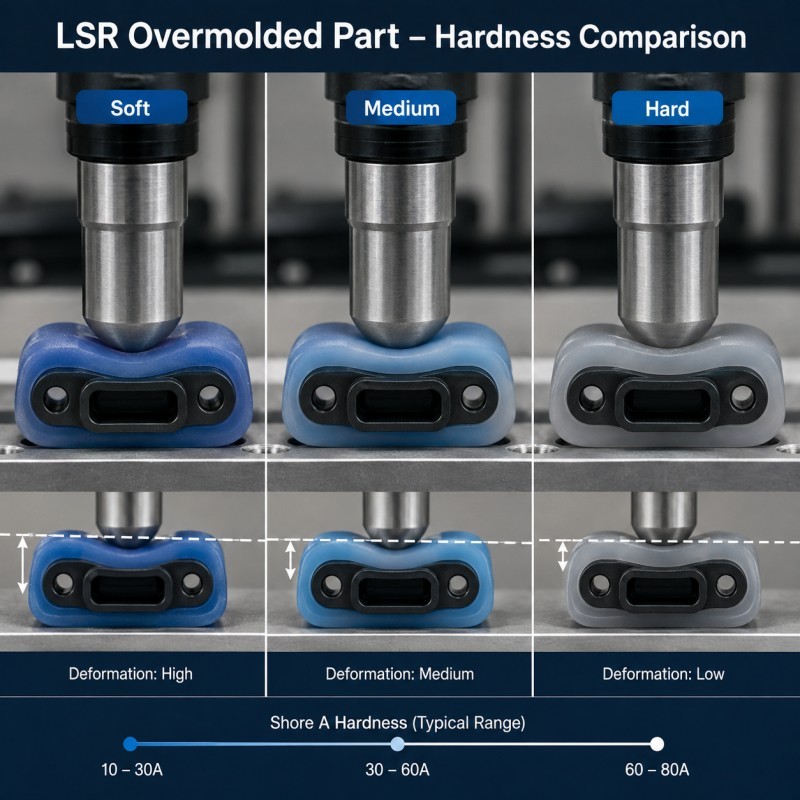
Silicone hardness affects how the overmolded component deforms, seals, assembles and survives mechanical loading.
It can influence:
• Seal compression
• Assembly force
• Button actuation force
• Cable bending
• Surface feel
• Tear resistance
• Demolding stability
• Insert deformation
• Long-term recovery
• Vibration absorption
However, hardness alone does not determine final performance.
The same LSR hardness may behave differently when the silicone wall thickness, rib structure, sealing-lip height or support condition changes.
Material selection should therefore be completed together with structural DFM rather than after the mold design has already been finalized.
What Happens If the Silicone Is Too Soft?
A softer silicone can provide flexibility, soft touch and lower assembly resistance, but excessive softness may reduce structural stability.
Possible problems include:
• Sealing lips folding during assembly
• Thin edges tearing during demolding
• Buttons feeling unstable
• Cable strain reliefs bending at the wrong location
• Overmolded surfaces becoming difficult to control dimensionally
• Silicone being displaced under pressure
• Poor support around functional openings
• Increased sensitivity to flash or deformation
A soft sealing lip may compress easily but may also roll, twist or move out of the intended sealing groove.
For thin overmolded sections, engineers must evaluate whether the material can withstand demolding, handling and repeated assembly without tearing.
What Happens If the Silicone Is Too Hard?
A harder silicone may provide better shape retention, but excessive hardness can create assembly and sealing risks.
Possible problems include:
• Excessive connector insertion force
• Insufficient sealing-lip deformation
• Plastic housing distortion
• High button actuation force
• Reduced cable flexibility
• Stress concentration at the bonding edge
• Poor contact with uneven mating surfaces
• Increased peel loading on the silicone-to-plastic interface
A hard silicone seal may appear dimensionally stable but fail to compensate for plastic tolerance, housing warpage or assembly variation.
For silicone over plastic components, the plastic wall must also be strong enough to resist the compression or assembly force created by the silicone.
Plastic with silicone overmolding should therefore be evaluated as a complete multi-material structure.
Why Does Product Geometry Change the Effective Stiffness?
The user does not experience material hardness alone. The user experiences the combined stiffness of the silicone material and product geometry.
Important structural factors include:
• Silicone wall thickness
• Sealing-lip height
• Rib thickness
• Root radius
• Unsupported length
• Compression direction
• Plastic support
• Hollow or solid construction
• Local thickness transitions
For example, a thin hollow button may feel softer than a thick solid button made from the same LSR grade.
A long cable strain-relief transition may bend more gradually than a short thick section with the same hardness.
A sealing lip with sufficient height can deform more easily than a short, wide seal made from the same material.
Hardness should therefore not be changed before checking whether the structure itself is causing excessive stiffness or instability.
DFM Checklist for Silicone Hardness Selection
| DFM Item | What Engineers Should Confirm |
Product function | Sealing, soft touch, insulation, bending or protection is defined |
Compression | Minimum and maximum seal compression are calculated |
Wall thickness | Thin and thick silicone sections are identified |
Assembly force | Connector, housing or button force is acceptable |
Insert strength | Plastic, metal or FPC can resist molding and assembly stress |
Bonding edge | Hardness will not create excessive peel stress |
Demolding | Thin lips and edges can be removed without tearing |
Operating temperature | Required flexibility is maintained across service conditions |
| Material compliance | Required material documentation is confirmed |
| Validation | Prototype parts will be tested in the final assembly |
The silicone mold design and tooling review should evaluate hardness together with silicone thickness, sealing geometry, insert support, gate location and demolding direction.
How Should Silicone Hardness Be Validated?
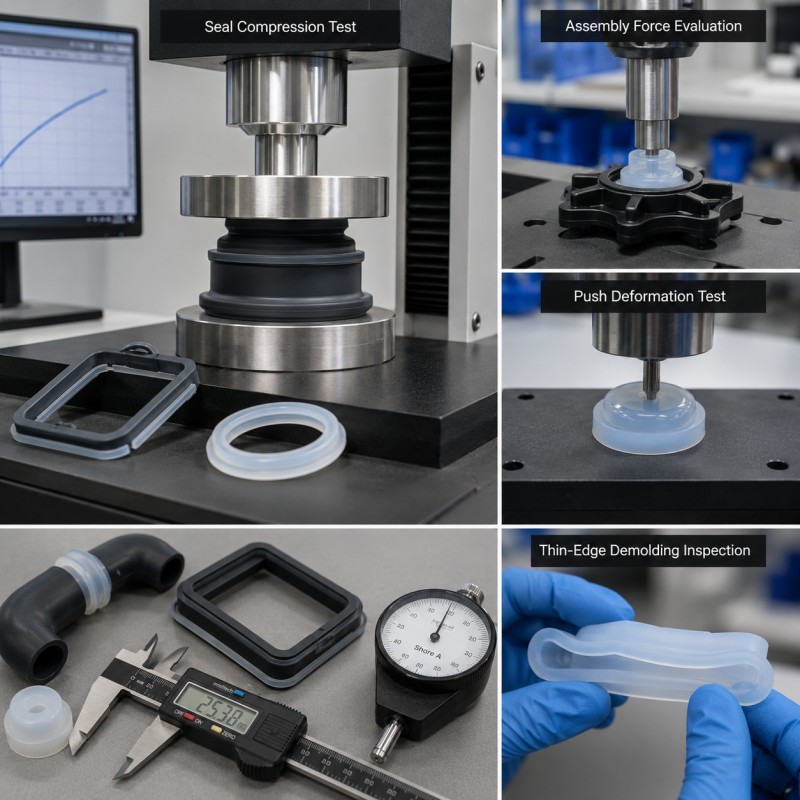
The final hardness should be approved through molded samples and application-specific testing.
Recommended validation includes:
1. Assembly Test
Confirm that the completed component can be installed without excessive force, seal rolling or plastic distortion.
2. Compression Test
Measure the sealing feature before, during and after compression.
3. Functional Deformation Test
Evaluate button travel, cable bending, soft-touch deformation or vibration absorption according to the product function.
4. Pull or Peel Test
For bonded overmolds, confirm that the selected hardness does not create excessive stress at the material interface.
5. Demolding Inspection
Check thin lips, holes, edges and undercuts for tearing or permanent deformation.
6. Thermal and Environmental Testing
Repeat functional testing after thermal cycling, heat aging, humidity or application-specific fluid exposure.
7. Pilot Production
Validate multiple consecutive molding cycles instead of approving only one sample.
Where the design is sensitive to hardness, engineers may compare two or more candidate LSR grades using the same product geometry.
How SiliconePlus Supports LSR Material Selection
SiliconePlus supports LSR overmolding projects from material and structural review through tooling, sampling, inspection and mass production.
Project support can include:
• Silicone hardness and material review
• Seal-compression analysis
• Wall-thickness and transition review
• Plastic, metal, FPC or cable insert evaluation
• Bonding and mechanical-retention design
• Precision mold manufacturing
• LSR injection molding
• Dimensional and functional inspection
• Compression, pull and waterproof test support
• Prototype and pilot-production validation
SiliconePlus has 25 years of silicone manufacturing experience, more than 6,000 developed silicone projects, in-house CNC and EDM mold-processing capability, liquid silicone injection equipment and precision inspection resources.
Specific hardness, tolerance, waterproof performance and compliance requirements should be confirmed according to the actual product structure, material grade and agreed test method.
FAQ
Does Softer Silicone Always Provide Better Waterproof Sealing?
No. Softer silicone compresses more easily, but it may fold, roll or become unstable. Seal geometry, compression and mating-part tolerance must also be evaluated.
Does Harder Silicone Have Better Tear Resistance?
Not necessarily in every structure. Tear performance depends on the LSR grade, edge thickness, radius, notch and demolding method.
Can Different Hardnesses Be Used in the Same Product?
Multiple hardnesses may be possible, but they increase material, tooling and process complexity. The requirement should be reviewed during DFM.
Why Does the Final Part Feel Harder Than the Material Sample?
The molded part may be thicker, more highly supported or more constrained than the flat material sample.
Can Silicone Hardness Affect Bonding?
Hardness itself is not the only bonding factor, but a stiffer overmold can create higher peel stress at the interface during assembly or bending.
What Information Is Needed for Hardness Selection?
Provide the product drawing, silicone thickness, substrate material, function, assembly method, operating temperature, sealing requirement and expected tests.
Conclusion
Selecting silicone hardness for LSR overmolding requires more than choosing a softer or harder material.
Reliable performance depends on the combined control of:
• Silicone hardness
• Wall thickness
• Seal compression
• Assembly force
• Insert strength
• Bonding stress
• Demolding
• Operating conditions
• Functional testing
The best hardness should be confirmed through DFM, molded samples and final-assembly validation.