How Should Cosmetic Acceptance Standards Be Defined for LSR Overmolded Parts?
Answer Excerpt
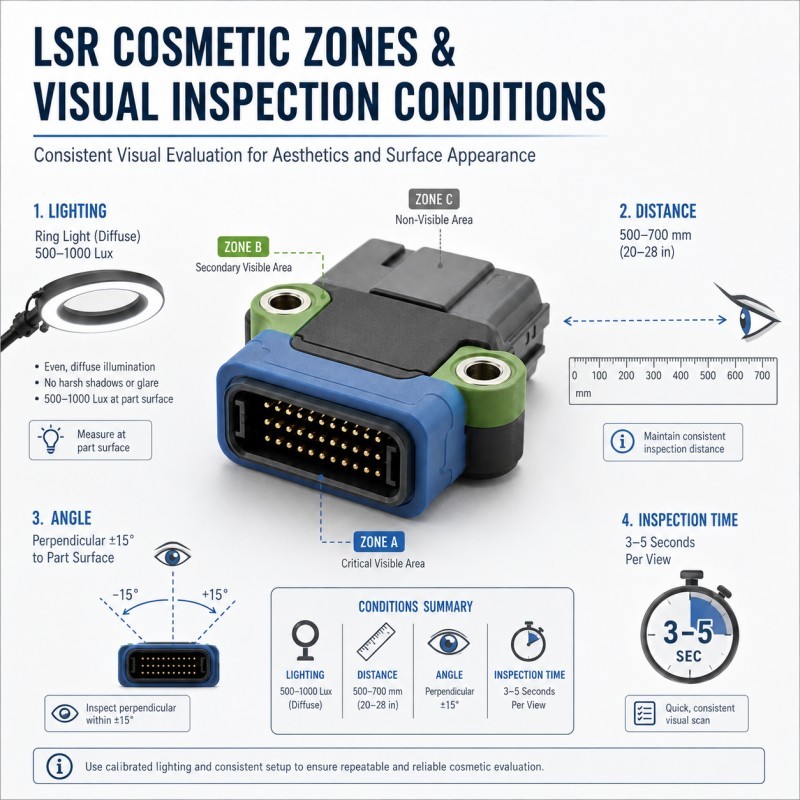
Cosmetic acceptance standards for LSR overmolded parts should be agreed before mass production and should define inspection lighting, viewing distance, viewing angle, inspection time, cosmetic zones, defect categories, allowable defect size and quantity, and functional no-defect areas. Approved reference samples should be used whenever written descriptions cannot clearly show the acceptance boundary.
LSR overmolded parts often combine silicone with plastic, metal, FPC, cable or electronic inserts.
These components may perform correctly but still be rejected because of black spots, white particles, color streaks, flow marks, gloss differences, flash, scratches, bubbles or an uneven silicone boundary.
Descriptions such as “good appearance,” “clean surface” or “no obvious defects” are too subjective for stable production.
The buyer and manufacturer should use the same inspection conditions and the same approved acceptance samples.
For precision multi-material components, liquid silicone injection molding should be reviewed together with mold design, insert cleanliness, material handling and final appearance requirements.
Why Are Cosmetic Acceptance Standards Important?
A cosmetic standard prevents the buyer, factory and quality inspector from using different definitions of an acceptable part.
Without an agreed standard, the same surface mark may be:
• Accepted during sampling
• Rejected during pilot production
• Accepted by one inspector
• Rejected by another inspector
• Considered cosmetic by the factory
• Considered functional by the customer
This creates unnecessary rework, sorting, delivery delays and quality disputes.
Appearance standards are especially important for:
• Wearable devices
• Consumer electronics
• Medical device housings
• Beauty and personal-care products
• Automotive control components
• Visible waterproof seals
• Soft-touch buttons and grips
Functional areas should always take priority over ordinary cosmetic areas.
For example, a small flash line may be acceptable on a hidden edge but unacceptable on a sealing surface, connector opening, FPC contact area or assembly datum.
Which Appearance Defects Should Be Defined?
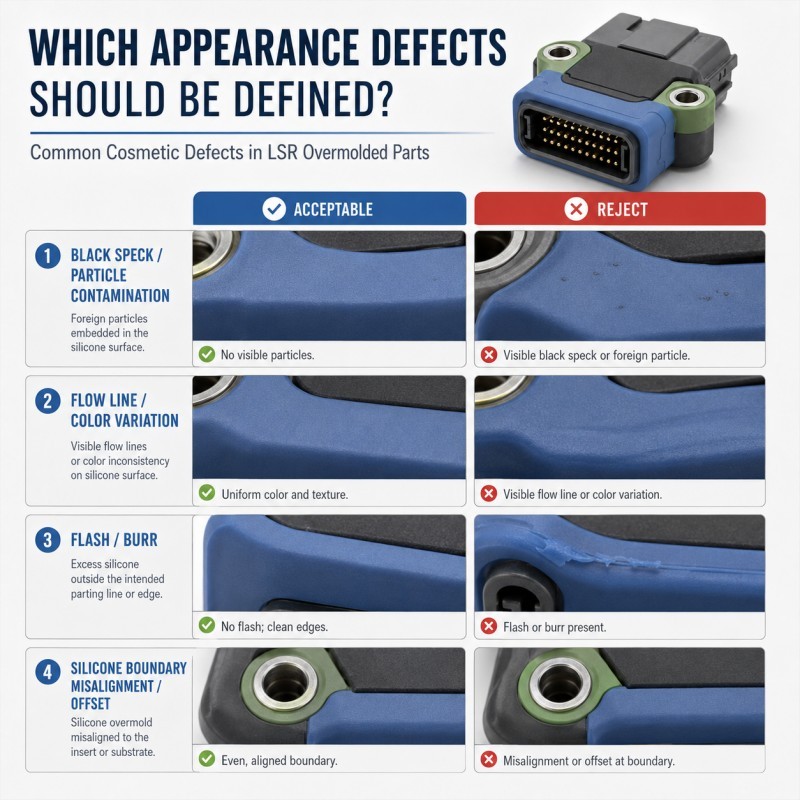
The cosmetic standard should identify each defect type instead of using one general rejection statement.
Common LSR overmolding appearance defects include:
• Black spots
• White particles
• Dust or fibers
• Color streaks
• Flow marks
• Weld lines
• Gloss differences
• Oily or cloudy areas
• Bubbles
• Surface dents
• Scratches
• Silicone flash
• Short shots
• Uneven silicone boundaries
• Exposed inserts
• Edge lifting
• Gate marks
• Parting-line marks
Each defect should be evaluated according to its location, size, quantity, contrast and effect on product function.
A small particle on a hidden surface may be acceptable, while the same particle on a transparent sensor window or visible consumer-electronics surface may be unacceptable.
For a detailed investigation of contamination-related defects, review black spots, streaks or surface contamination in LSR overmolded parts.
How Should Cosmetic Zones Be Divided?
Cosmetic zones should be defined according to product visibility and function.
The names Zone A, Zone B and Zone C may be used, but they are project-specific labels rather than one universal industry rule.
Zone A — Primary Visible Surface
This is the surface most visible to the end user during normal use.
Examples include front covers, visible buttons, wearable surfaces and customer-facing soft-touch areas.
Zone A normally requires the strictest limits for particles, scratches, flow marks, color variation and gate marks.
Zone B — Secondary Visible Surface
This area may be visible during assembly, handling or occasional use but is not the primary viewing surface.
Moderate cosmetic limits may be permitted if function and assembly are unaffected.
Zone C — Hidden or Internal Surface
This area is normally hidden after assembly.
Minor cosmetic defects may be acceptable, but functional problems such as flash, short shots, contamination, poor bonding or blocked openings are still unacceptable.
Functional No-Defect Area
Some areas require stricter control regardless of whether they are visible.
These include:
• Sealing lips
• Connector openings
• Contact pads
• Assembly datums
• Button movement areas
• Sensor windows
• Bonding edges
• Critical compression surfaces
The drawing should clearly mark each cosmetic and functional zone.
Cosmetic Inspection Checklist
| Inspection Item | What Must Be Defined | Recommended Control |
Viewing condition | Lighting, distance, angle and inspection time | Use the same condition for buyer and factory |
Cosmetic zone | Zone A, B, C and functional areas | Mark zones on the approved drawing |
Particle or spot | Maximum size, quantity and spacing | Use defect-size samples or gauges |
Flash | Allowed width, thickness and location | No flash in critical functional areas |
Flow or weld mark | Visibility and acceptable contrast | Compare with approved boundary samples |
Color difference | Approved color range | Use approved color samples when required |
| Scratch or dent | Length, width, depth and location | Separate handling damage from molding defects |
| Silicone boundary | Position and tolerance | Measure from stable insert datums |
| Gate or parting line | Allowed location and appearance | Keep away from primary visible surfaces |
Flash and dimensional acceptance should be reviewed together because an appearance defect may also affect assembly, sealing or electrical function. Review how to control flash and tolerance in LSR overmolding when defining critical no-flash areas.
How Should Cosmetic Standards Be Validated Before Mass Production?
Written standards should be supported by physical samples and production data.
Recommended validation steps include:
1. Approve a Golden Sample
The golden sample represents the intended color, surface finish, silicone boundary and general appearance.
2. Approve Boundary Samples
Boundary samples show the maximum acceptable particle, flow mark, flash or color difference.
3. Check Every Mold Cavity
Different cavities may produce different gate marks, flash or surface appearance.
4. Run Consecutive Production Cycles
Appearance should remain stable after the mold reaches normal production temperature.
5. Review Multiple Insert Lots
Plastic, metal, FPC or cable variation may affect silicone boundaries and surface quality.
6. Confirm Inspection Lighting
The customer and factory should use comparable lighting and viewing conditions.
7. Verify Packaging
Soft silicone surfaces may collect dust, become compressed or develop marks during packaging and transportation.
8. Record the Approved Standard
The drawing version, samples, defect limits, inspection method and packaging standard should be traceable.
One manually adjusted sample is not enough to prove stable mass-production appearance.
How SiliconePlus Supports Cosmetic Quality Control
SiliconePlus supports custom LSR overmolding projects from drawing and cosmetic-zone review through tooling, sampling, inspection and mass production.
Project support can include:
• Cosmetic-zone definition
• Silicone coverage-boundary review
• Mold parting-line and gate-position review
• Insert cleanliness and handling control
• Flash and contamination-risk analysis
• Golden-sample and boundary-sample preparation
• Dimensional and visual inspection
• CCD or optical inspection planning
• Pilot-production validation
• Packaging and mass-production quality review
SiliconePlus has 25 years of silicone manufacturing experience, more than 6,000 developed silicone projects, in-house CNC and EDM mold-processing capability, liquid silicone injection equipment and precision measuring resources.
Specific cosmetic limits, sampling frequency and inspection conditions should be agreed according to the actual product, customer market and functional requirements.
FAQ
Is There One Universal Cosmetic Standard for LSR Overmolded Parts?
No. Cosmetic standards depend on product visibility, function, market positioning, material color, surface finish and customer requirements.
What Is a Golden Sample?
A golden sample is an approved reference part that represents the intended overall appearance, color, silicone boundary and workmanship.
What Is a Boundary Sample?
A boundary sample represents the maximum acceptable level of a specific defect, such as a particle, flow mark, flash line or color difference.
Should Magnification Be Used for Every Inspection?
Not automatically. Magnification should only be used when it is included in the agreed inspection method. Otherwise, the buyer and factory may reach different conclusions.
Can a Cosmetic Defect Also Be a Functional Defect?
Yes. Flash, silicone boundary shift, short shots, bubbles and contamination may affect sealing, assembly, bonding or electrical contact.
Why Do Sample Parts Look Better Than Mass-Production Parts?
Samples may be manually selected or adjusted. Mass production introduces cavity differences, continuous mold temperature, material-lot variation, insert handling and packaging conditions.
Conclusion
Cosmetic acceptance standards for LSR overmolded parts should define:
• Inspection conditions
• Cosmetic zones
• Functional no-defect areas
• Defect categories
• Size and quantity limits
• Golden samples
• Boundary samples
• Packaging requirements
• Pilot-production consistency
The best time to define these standards is before sample approval and mass production.
For a project-specific quality review, send your product drawing, cosmetic-zone requirements, defect limits and approved samples to the SiliconePlus engineering team.