How Do You Control Flash and Tolerance in LSR Overmolding?
Introduction
For precision silicone overmolding projects, small defects can create big problems. A thin flash line may affect waterproof sealing. A small insert shift may block a contact area. A slight tolerance deviation may cause assembly failure. This guide explains how engineers and OEM/ODM buyers can control flash and tolerance in LSR overmolding projects before mold development and mass production.
Answer Excerpt
To control flash and tolerance in LSR overmolding, engineers should optimize mold precision, parting line position, shut-off surfaces, venting, insert positioning, silicone flow path, material shrinkage, curing conditions, and inspection standards. For waterproof seals, FPC overmolded parts, silicone over plastic, and silicone over metal components, flash and tolerance control must be reviewed before tooling because they directly affect bonding, sealing, assembly, and mass production stability.
Transition Paragraph
Below are the key questions product engineers, sourcing managers, quality teams, and OEM/ODM buyers usually ask when developing precision silicone overmolded parts.
People Also Ask: Why are flash and tolerance control important in LSR overmolding?
Flash and tolerance control are important because LSR overmolding often produces functional parts, not simple rubber accessories. These parts may seal water, protect electronics, hold metal inserts, cover FPC modules, cushion plastic housings, or support medical and automotive device assemblies.
In LSR overmolding, liquid silicone rubber flows easily before curing. This helps fill thin walls, small sealing lips, fine ribs, and complex cavities. However, the same flow behavior also means LSR can enter tiny mold gaps and create flash. If the mold shut-off, insert fit, or parting line is not controlled, flash may appear on functional areas.
Tolerance control is equally important. If the silicone layer is too thick, the part may not assemble. If the sealing lip is too short, waterproof performance may fail. If the insert shifts, the silicone may cover a metal contact, FPC pad, screw hole, button area, or connector interface.
For B2B buyers, the main question is not only whether the sample looks good. The real question is whether the manufacturer can control flash and tolerance repeatedly during mass production.
For precision small parts and complex sealing structures, liquid silicone injection molding can support stable dimensions, thin sealing lips, fine details, and repeatable production when tooling and process control are properly managed.
People Also Ask: Why does flash happen in liquid silicone overmolding?
Flash happens when uncured silicone flows into small gaps between mold surfaces, insert edges, parting lines, shut-off areas, vents, or poorly fitted substrates. Because liquid silicone has low viscosity before curing, it can enter gaps that may not cause problems in some other molding processes.
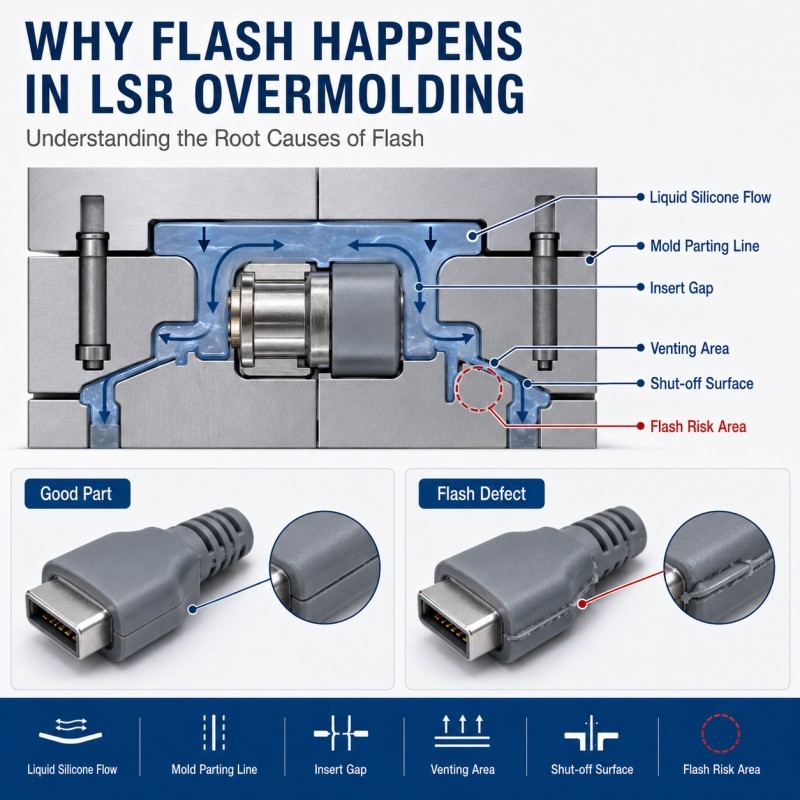
Common flash causes include:
Poor mold shut-off accuracy
Parting line placed on functional areas
Insert tolerance variation
Unstable plastic, metal, or FPC positioning
Improper venting design
Excessive injection pressure
Inconsistent clamping force
Worn mold surfaces
Substrate deformation during molding
Incorrect mold temperature or curing condition
Insufficient DFM review before tooling
Flash is not always only an appearance issue. In many overmolded silicone parts, flash can affect function. A small flash near a waterproof sealing surface can create a leakage path. Flash near a connector may affect assembly. Flash on an FPC pad may affect electrical connection. Flash near a button may affect movement or tactile response.
This is why flash control should be considered during mold design, not only during trimming or final inspection.
People Also Ask: Which areas need the strictest tolerance control?
The strictest tolerance control is usually required on sealing lips, gasket thickness, insert position, exposed contact areas, FPC pad openings, button movement areas, connector interfaces, assembly grooves, holes, ribs, and any surface that affects waterproofing or final assembly.
Not every dimension has the same importance. Some surfaces are cosmetic. Some are functional. Some are critical to sealing, bonding, assembly, or electrical connection. Before production, the buyer and manufacturer should identify CTQ dimensions, which means critical-to-quality dimensions.
For waterproof silicone seals, important dimensions may include seal height, seal width, compression area, groove fit, and parting line location. For silicone over plastic parts, the silicone edge, bonding width, and assembly surface may be important. For silicone over metal parts, insert alignment and exposed metal areas may be critical. For FPC silicone overmolding, pad exposure and silicone coverage area are often critical.
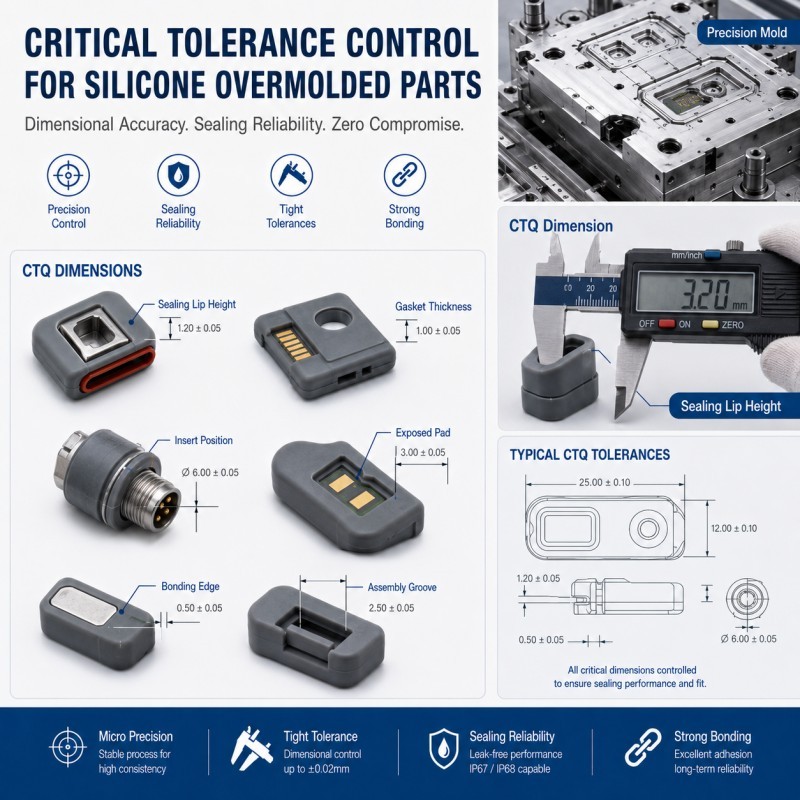
A professional silicone manufacturer should not inspect all dimensions with the same priority. The inspection plan should focus on dimensions that affect function, safety, sealing, assembly, or customer validation.
People Also Ask: How does mold design reduce flash and tolerance variation?
Mold design reduces flash and tolerance variation by controlling the parting line, gate position, venting, shut-off surface, insert fixture, cavity precision, demolding direction, and silicone flow path. Good mold design is the foundation of stable LSR overmolding.
If the mold parting line is placed on a sealing surface, flash may directly affect waterproof performance. If the gate position causes uneven flow, the part may have bubbles, short shots, or dimensional variation. If venting is poor, trapped air may cause defects. If the insert fixture is weak, the insert may shift during molding.
For overmolding projects, mold design must also consider the substrate. Plastic inserts may shrink or deform. Metal inserts may vary due to plating or stamping tolerance. FPC inserts may bend or move. Pre-molded silicone substrates may compress or shift inside the mold.
For precision silicone projects, design and tooling services help review parting lines, shut-off areas, insert positioning, mold feasibility, sealing surfaces, venting, and low-flash production risk before mold opening.
A good tooling plan should answer these questions:
Where should the parting line be placed?
Which surfaces are functional sealing areas?
How will the insert be positioned?
Where should air escape?
How will silicone flow into thin areas?
Which areas cannot accept flash?
Which dimensions need strict inspection?
Can the mold support mass production, not only sampling?
Mold design should be discussed before tooling starts because correcting flash or tolerance problems after the mold is finished may require mold modification and delay the project.
People Also Ask: How do inserts affect tolerance control in silicone overmolding?
Inserts affect tolerance control because the final part accuracy depends not only on the silicone mold but also on the plastic, metal, FPC, or silicone substrate inside the mold. If the insert varies, the overmolded silicone result may also vary.
For plastic inserts, material shrinkage, warpage, moisture absorption, and molding tolerance may affect final silicone coverage. If the plastic part is not stable, the silicone overmolded part may show uneven thickness or assembly problems.
For metal inserts, stamping tolerance, plating thickness, burrs, oil residue, and deformation may affect fit inside the mold. If the metal insert sits too high or too low, the silicone layer may not form correctly.
For FPC inserts, positioning is more challenging. FPC is thin and flexible, so the mold must hold it accurately without damaging copper traces, solder joints, stiffeners, or exposed pads.
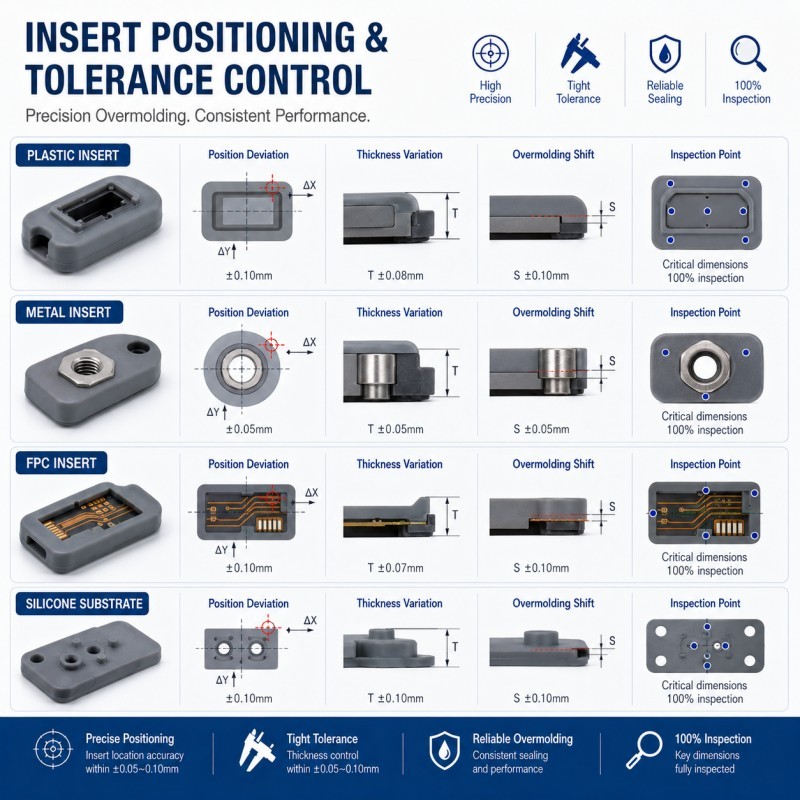
For compact electronic modules, FPC with silicone overmolding requires accurate positioning, exposed pad protection, controlled silicone flow, and careful inspection before mass production.
Insert inspection should happen before overmolding. If poor-quality inserts enter production, the silicone molding process may not be able to correct the variation.
People Also Ask: What is the difference between cosmetic flash and functional flash?
Cosmetic flash affects appearance. Functional flash affects assembly, sealing, bonding, electrical contact, movement, or product reliability. The difference must be defined clearly before mass production.
| Flash Type | Where It Appears | Why It Matters |
|---|---|---|
| Cosmetic Flash | Non-functional outer edge or hidden surface | May affect appearance or trimming cost but may not affect function |
| Sealing Surface Flash | Sealing lip, gasket face, compression surface | Can create leakage path or reduce waterproof performance |
| Assembly Area Flash | Groove, hole, snap-fit area, screw area, connector edge | Can block assembly or change fit |
| Electrical Contact Flash | Metal contact, FPC pad, terminal area | Can affect conductivity or device function |
| Button Movement Flash | Button edge, membrane edge, moving area | Can affect tactile feel, rebound, or movement |
| Bonding Edge Flash | Silicone-to-substrate interface | Can hide bonding problems or create peeling risk |
This table helps buyers and suppliers define inspection standards more clearly. A part may pass cosmetic inspection but still fail function if flash appears in critical areas.
People Also Ask: How should buyers define tolerance and flash standards?
Buyers should define tolerance and flash standards according to product function, assembly requirement, waterproof target, cosmetic level, and inspection method. Without clear standards, quality disputes may appear after sampling or shipment.
A good drawing should mark important dimensions, tolerance ranges, material hardness, silicone coverage areas, exposed functional areas, and special inspection points. For overmolded parts, the drawing should clearly show where silicone should cover and where it must not cover.
For flash standards, buyers should separate cosmetic areas from functional areas. Some hidden outer edges may allow minor flash after trimming. Sealing surfaces, connector interfaces, FPC pads, button movement areas, and bonding edges may need stricter standards.
For waterproof parts, buyers should also define the test condition. If the target is IP67 or IP68, the manufacturer needs to know whether testing is done on the part alone or on the final assembly. Test depth, time, pressure, sample quantity, and pass/fail criteria should be discussed before mass production.
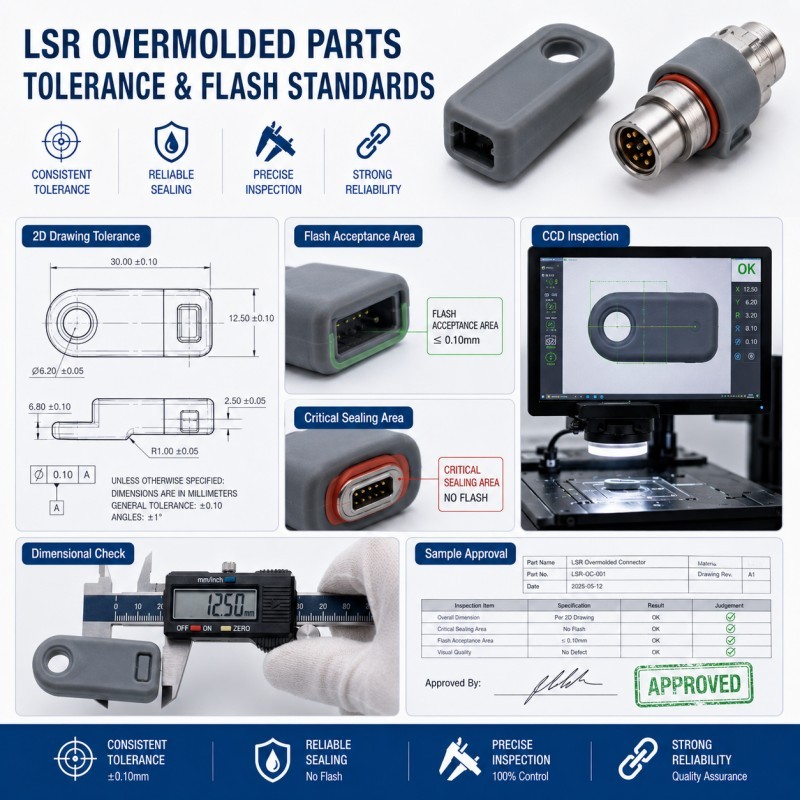
A clear standard helps both sides. The buyer gets better production control. The manufacturer gets a practical inspection target. The project becomes easier to scale from sample to mass production.
People Also Ask: How does process control affect tolerance stability?
Process control affects tolerance stability because LSR overmolding depends on consistent material mixing, injection pressure, mold temperature, curing time, clamping force, insert loading, demolding, and inspection. Even a good mold can produce unstable parts if the process is not controlled.
Key process factors include:
A/B silicone mixing ratio
Injection pressure
Injection speed
Mold temperature
Curing time
Clamping force
Insert loading position
Demolding method
Trimming process
Post-curing requirement
Inspection frequency
Packaging method
For example, excessive injection pressure may increase flash. Unstable mold temperature may affect curing and dimensions. Poor insert loading may cause offset. Rough demolding may deform thin sealing lips. Incorrect packaging may bend soft silicone parts.
Mass production should not rely only on operator experience. It should use documented parameters, inspection records, and clear quality standards.
People Also Ask: How does SiliconePlus support low-flash precision silicone overmolding?
SiliconePlus supports low-flash precision silicone overmolding through DFM review, mold development, LSR injection molding, insert positioning control, sample inspection, CCD inspection, dimensional checking, and mass production support.
Shenzhen Liyongan Silicone Rubber Products Co., Ltd. focuses on custom silicone overmolding manufacturing solutions, including silicone over plastic, silicone over metal, FPC silicone overmolding, silicone over silicone, liquid silicone injection molding, compression molding, tooling development, sample production, inspection, and OEM/ODM manufacturing.
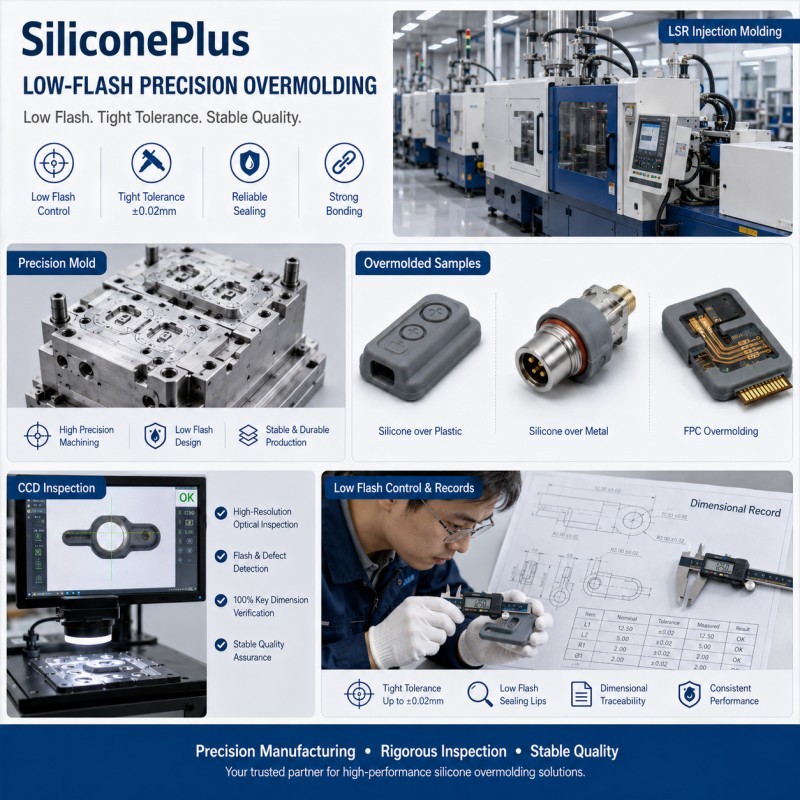
For connector housings, electronic enclosures, waterproof modules, and soft-touch structures, plastic with silicone overmolding requires accurate shut-off design, insert positioning, bonding control, and low-flash production.
For terminals, inserts, brackets, sensors, and waterproof components, metal with silicone overmolding requires surface condition review, insert positioning, bonding validation, and tolerance inspection.
A reliable supplier should help buyers identify critical dimensions, define flash standards, improve mold design, and verify production stability before full-scale manufacturing. This is especially important for medical devices, automotive connectors, 3C electronics, mobile phone waterproofing, wearable devices, beauty and health care products, and industrial silicone applications.
People Also Ask: What should buyers prepare before starting a precision LSR overmolding project?
Buyers should prepare drawings, 3D files, samples, substrate material, silicone coverage area, critical dimensions, tolerance requirements, flash acceptance standards, waterproof target, assembly method, testing standards, and estimated production quantity.
If the part is used for waterproof sealing, buyers should provide the mating structure whenever possible. The manufacturer needs to understand the groove, compression area, assembly gap, mating surface, and test method.
If the part includes metal contacts, FPC pads, buttons, holes, clips, or connector interfaces, the drawing should clearly mark areas that must remain free of silicone flash.
A useful project brief may include:
Product application
2D drawing
3D STEP file
Sample or product photo
Substrate material
Silicone hardness
Silicone color
Critical dimensions
Functional surfaces
Flash-sensitive areas
Waterproof target
Assembly method
Testing standard
Estimated quantity
Annual forecast
Packaging requirement
Clear information helps the engineering team choose a suitable mold design, process route, inspection plan, and production strategy.
FAQ About Flash and Tolerance Control in LSR Overmolding
1. Why is flash common in LSR overmolding?
Flash is common because liquid silicone rubber has low viscosity before curing. It can flow into tiny gaps around mold parting lines, insert edges, vents, and shut-off areas if mold precision or insert fit is not well controlled.
2. Can LSR overmolded parts be made with low flash?
Yes. Low-flash LSR overmolded parts can be produced when mold design, shut-off surfaces, insert positioning, venting, clamping force, injection parameters, and inspection standards are properly controlled.
3. What areas should not have flash?
Functional sealing surfaces, electrical contacts, FPC pads, connector interfaces, button movement areas, assembly grooves, screw holes, and bonding edges usually need strict flash control because flash may affect function.
4. What causes tolerance variation in silicone overmolding?
Tolerance variation may be caused by silicone shrinkage, mold temperature, curing time, insert tolerance, substrate deformation, demolding, trimming, process instability, or inconsistent inspection standards.
5. How can buyers define tolerance requirements clearly?
Buyers should mark critical dimensions on drawings, define tolerance ranges, identify functional surfaces, specify flash-sensitive areas, provide mating structures, and explain assembly or waterproof test requirements.
6. Can SiliconePlus support precision LSR overmolding projects?
Yes. SiliconePlus supports custom LSR injection molding, silicone over plastic, silicone over metal, FPC silicone overmolding, silicone over silicone, mold development, sample production, CCD inspection, and OEM/ODM mass production for precision silicone parts.
Conclusion
Flash and tolerance control are critical for precision LSR overmolding. A small flash line, insert offset, or dimensional change can affect waterproof sealing, bonding, electrical connection, button movement, assembly fit, or long-term reliability.
For B2B buyers, the best way to reduce risk is to define critical dimensions, flash-sensitive areas, substrate quality, waterproof targets, and inspection standards before mold development. A professional silicone manufacturer should review these points during DFM, not only after the sample is made.
Shenzhen Liyongan Silicone Rubber Products Co., Ltd. provides custom silicone overmolding, liquid silicone injection molding, silicone over plastic, silicone over metal, FPC silicone overmolding, silicone over silicone, waterproof silicone seals, medical silicone parts, automotive silicone components, 3C electronic silicone parts, wearable device seals, and industrial custom silicone components.
If you are developing a precision LSR overmolded part and need low flash, tight tolerance, stable sealing, and reliable mass production, share your drawings, samples, substrate material, critical dimensions, and testing requirements with our engineering team. We can help review the manufacturability and suggest a suitable molding solution.
What type of precision silicone overmolded part are you developing? Leave a comment, share this guide with your engineering or sourcing team, or contact SiliconePlus to discuss your custom silicone manufacturing requirements.