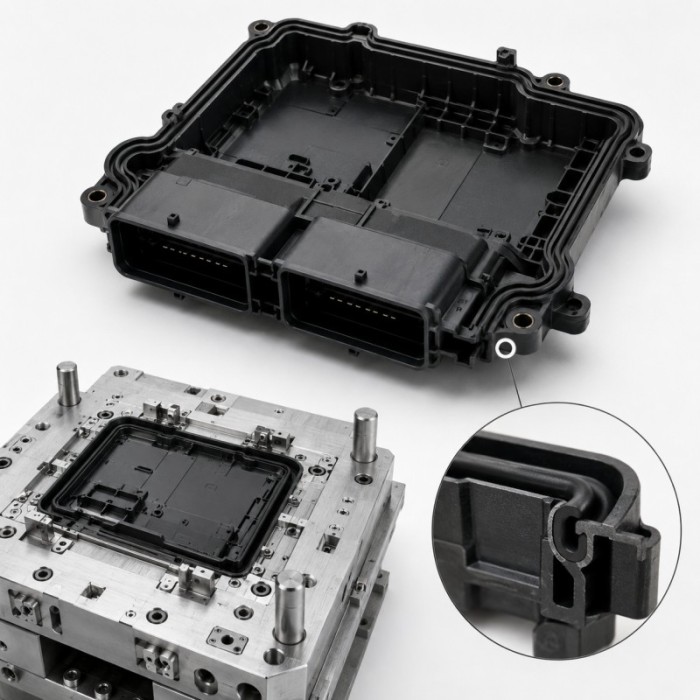
Custom LSR Overmolded ECU Housing Waterproof Seal
| Share | |
|---|---|
| Categories | Automotive Silicone Overmolding |
| Brand | SiliconePlus | Silicone OverMolding Manufacturing |
| Brand | SiliconePlus |
| Material | Liquid Silicone Rubber (LSR) |
| Substrate | Heat-Resistant Plastic Housing |
| Process | LSR Overmolding / Insert Molding |
| Silicone Hardness | Customized to Sealing Requirements |
| Function | Waterproof / Dustproof / Vibration Damping |
| Application | Automotive ECU / BMS / Control Module |
| Service | OEM / ODM / DFM / Tooling / Mass Production |
| Download |  |
Product Overview
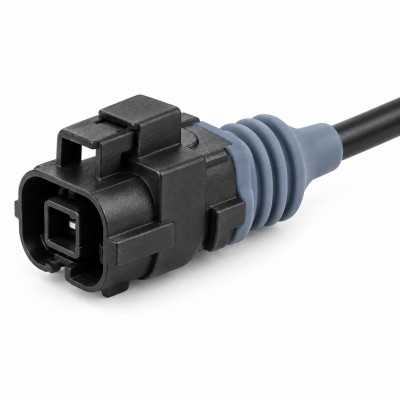
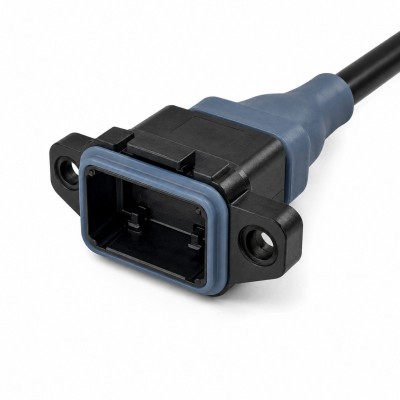
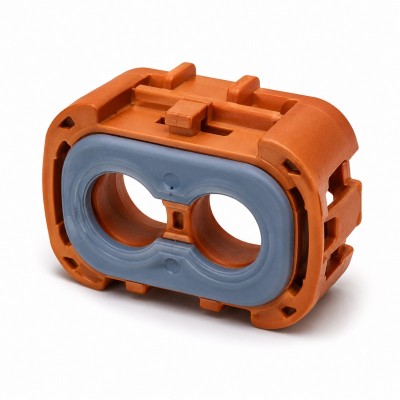
Custom LSR overmolded ECU housing seals are designed for automotive electronic control units, battery management systems, sensor modules and other electronic housings that require integrated waterproof sealing.
Liquid silicone rubber is molded directly onto selected areas of a heat-resistant plastic housing, creating a stable sealing structure without separately installing a loose gasket. The finished component can combine waterproof protection, dust resistance, vibration damping and assembly simplification in one part.
This product is manufactured according to customer drawings, samples, assembly conditions and testing requirements. It is not a standard stock gasket.
What Is an LSR Overmolded ECU Housing Seal?
An LSR overmolded ECU housing seal is an integrated plastic-and-silicone component manufactured through plastic with silicone overmolding.
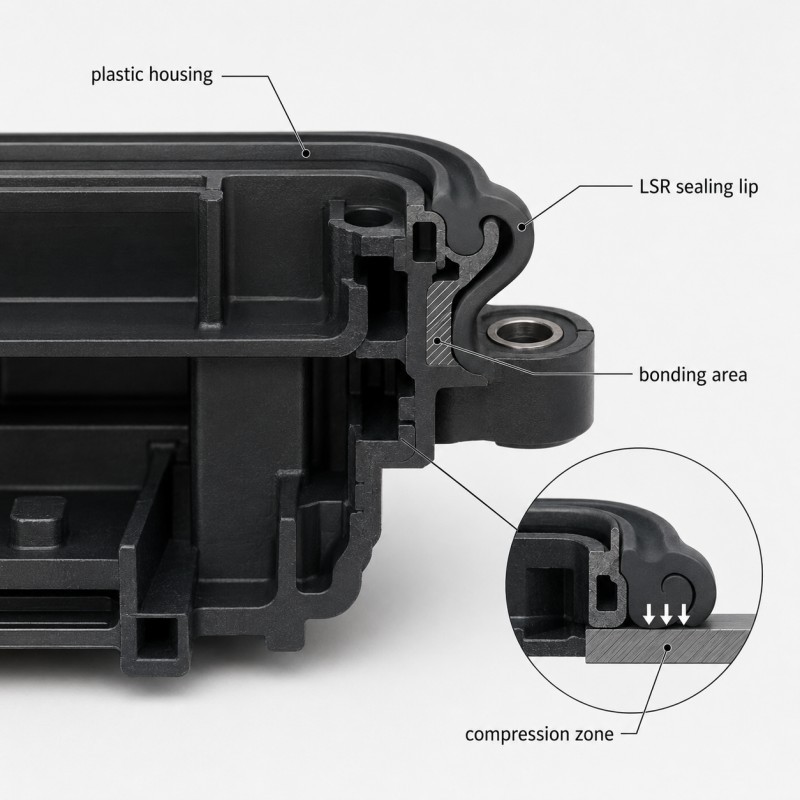
The plastic ECU housing is positioned inside a precision mold. Liquid silicone rubber is then injected around the designed sealing area and cured directly onto the housing. Depending on the substrate material and structural requirements, the silicone may use chemical bonding, mechanical locking or a combination of both.
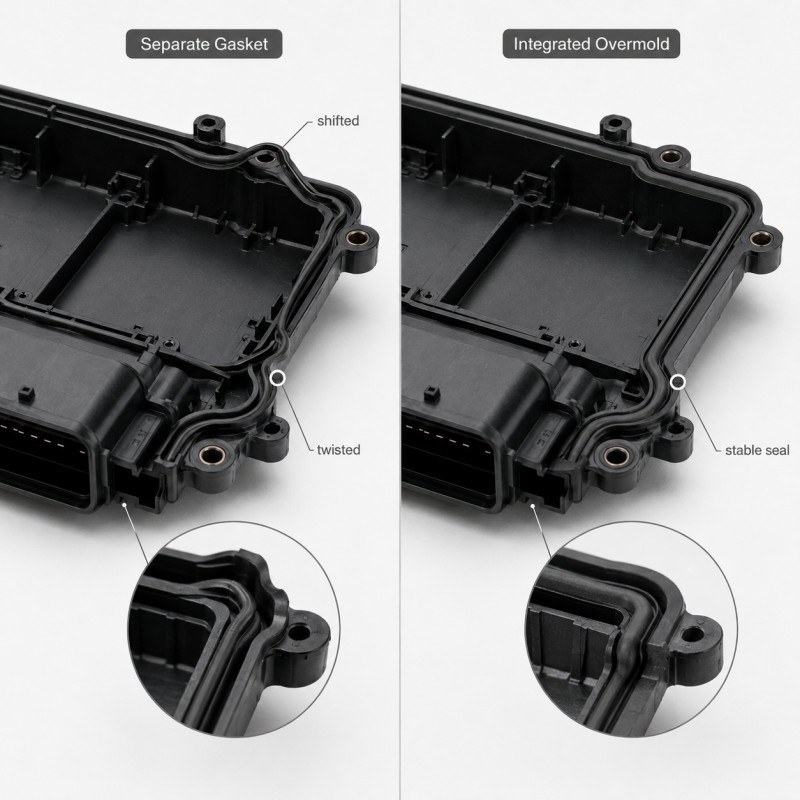
Compared with installing a separate gasket after plastic injection molding, an integrated overmolded seal can reduce gasket displacement, assembly variation and additional handling steps.
The sealing lip, compression area, silicone thickness and bonding zone can all be customized according to the mating housing and waterproof target.
Why Use Integrated Silicone Overmolding for ECU Housings?
Automotive electronic modules may be exposed to water, dust, vibration, temperature changes and assembly pressure. A separate gasket can shift, twist, become pinched or be installed incorrectly during assembly.
Integrated silicone overmolding helps keep the sealing structure in a defined position on the housing.
Main benefits include:
- Integrated silicone and plastic structure
- Reduced loose-gasket assembly steps
- Controlled sealing-lip position
- Waterproof and dustproof design support
- Vibration and impact cushioning
- Custom silicone hardness and compression
- Improved consistency during repeated assembly
- Reduced risk of missing or displaced gaskets
- Suitable for complex housing geometry
- Support for prototype and mass production
The component is produced through precision liquid silicone injection molding, allowing thin sealing lips, small ribs and complex local sealing areas to be molded with controlled dimensions.
Key Design Requirements Before Tooling
Plastic Material and Heat Resistance
The plastic housing must remain stable during the LSR curing process.
Before tooling, the engineering team should review the plastic grade, heat-deflection performance, wall thickness, moisture absorption, shrinkage, internal stress and dimensional stability.
Materials such as PC, PBT, PA, PPS and other engineering plastics may be considered, but the final selection depends on the part structure, molding temperature, bonding method and application environment.
The plastic insert should also be checked for warpage before the second molding process.
For more information, review how to prevent plastic insert deformation in LSR overmolding.
Insert Positioning and Mold Support
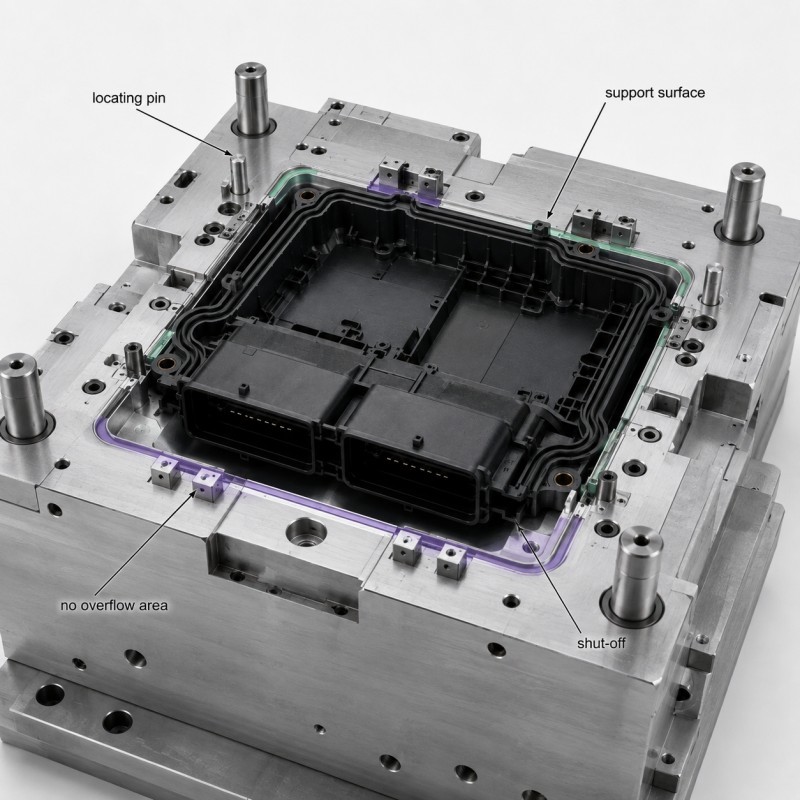
The ECU housing must be positioned accurately inside the overmolding tool.
Locating pins, support surfaces, shut-off areas and clamping points should prevent the insert from moving under silicone injection pressure. Insufficient support can cause uneven silicone thickness, exposed plastic, flash, hole deformation or sealing-lip misalignment.
Critical connector openings, mounting holes and electronic interfaces must remain free from silicone overflow.
Seal Compression
A waterproof sealing structure depends on controlled compression after final assembly.
If compression is too low, the seal may not maintain stable contact with the mating surface. If compression is too high, the silicone may deform, create excessive assembly force or lose recovery after long-term use.
The correct compression ratio should be evaluated together with:
- Silicone hardness
- Seal cross-section
- Housing flatness
- Fastener position
- Assembly tolerance
- Temperature range
- Compression-set requirement
- Waterproof test standard
Mold Shut-Off and Flash Control
Mold shut-off areas determine where the silicone flow stops around the plastic housing.
Poor shut-off design can allow silicone to enter screw holes, connector openings, contact areas or assembly surfaces. Flash on a critical sealing surface may also create a leakage path.
Before mold development, areas where flash is not permitted should be clearly marked on the drawing.
Silicone-to-Plastic Bonding
Bonding performance depends on the plastic material, silicone grade, surface condition, bonding area and molding process.
Some structures use self-bonding LSR. Other applications may require primer treatment, plasma treatment or mechanical locking features.
Bonding should be evaluated through actual samples rather than assumed from the material names alone.
Typical Automotive Applications
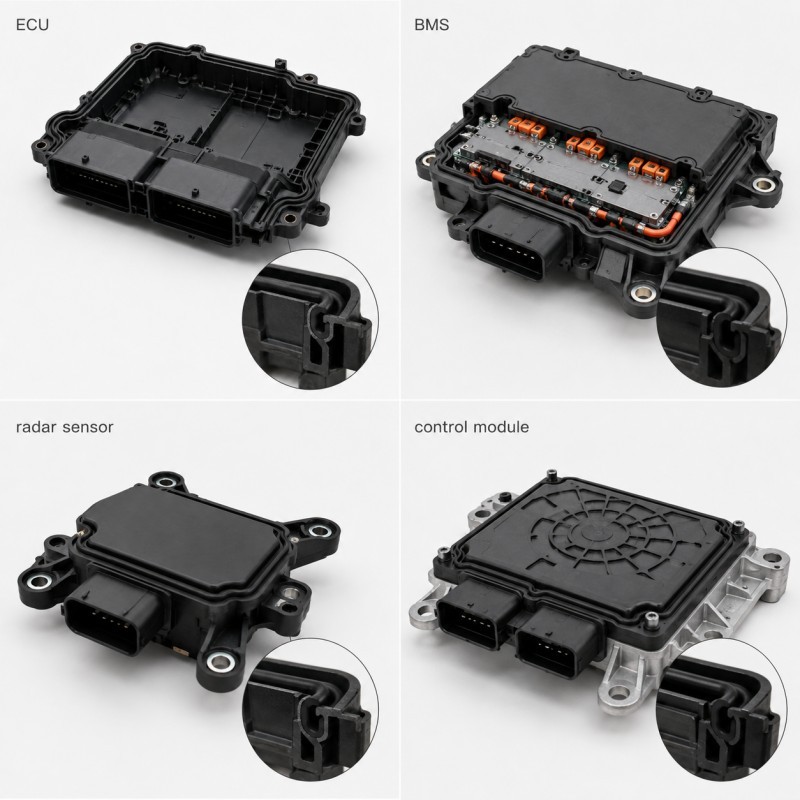
Custom LSR overmolded ECU housing seals can be developed for:
- Electronic control units
- Battery management system housings
- Automotive sensor housings
- Camera and radar modules
- Power distribution modules
- Charging control modules
- Motor control electronics
- Lighting control modules
- Telematics control units
- Waterproof connector housings
For a broader view of related applications, see our automotive silicone customization solutions.
Customization Options
Each ECU housing sealing project is developed according to the customer’s design.
Available customization options include:
- Plastic housing material
- Silicone coverage area
- Silicone hardness
- Seal cross-section
- Sealing-lip geometry
- Bonding or mechanical-locking structure
- Silicone thickness
- Color and surface texture
- Insert positioning structure
- Parting-line position
- Shut-off area
- Waterproof test target
- Dimensional tolerance
- Prototype tooling
- Production tooling
- Packaging method
The final design should consider the complete assembly rather than treating the silicone seal as an isolated part.
Quality Inspection and Validation
A molded component may look acceptable after demolding but still fail during final assembly or environmental testing.
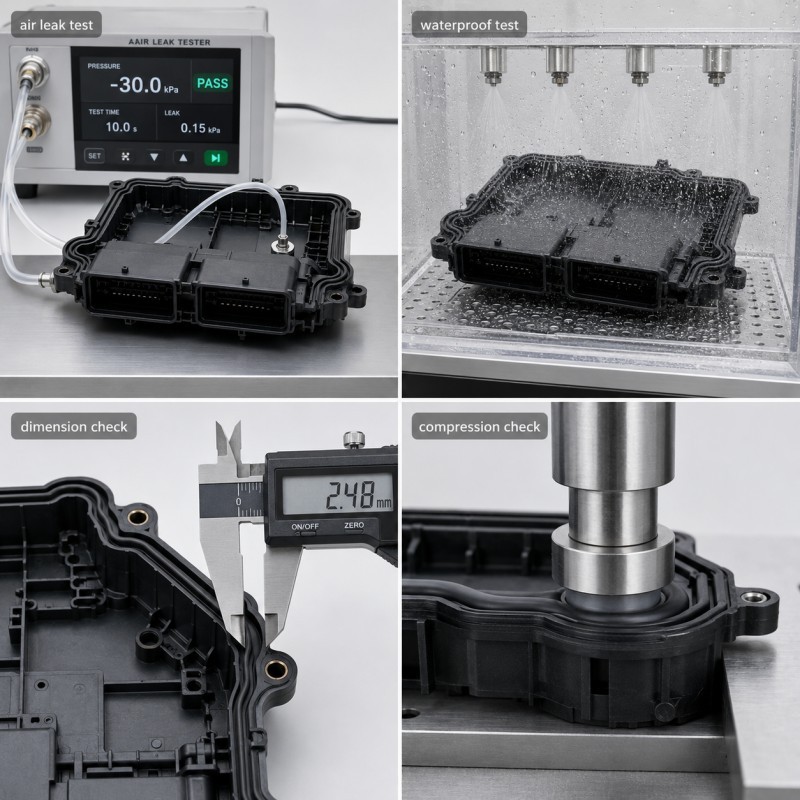
Inspection and validation can include:
- Plastic insert dimensional inspection
- Finished-part dimensional inspection
- Silicone coverage inspection
- Insert-position inspection
- Visual and flash inspection
- Bonding and peel evaluation
- Pull-force test
- Assembly test
- Compression test
- Air-leak test
- Waterproof test
- Heat-aging test
- Temperature-cycling test
- Functional test
Final IP67 or IP68 performance depends on the complete enclosure, mating surface, assembly force and testing method.
Engineers developing sealed automotive electronics can also review our silicone overmolding design guide for waterproof components.
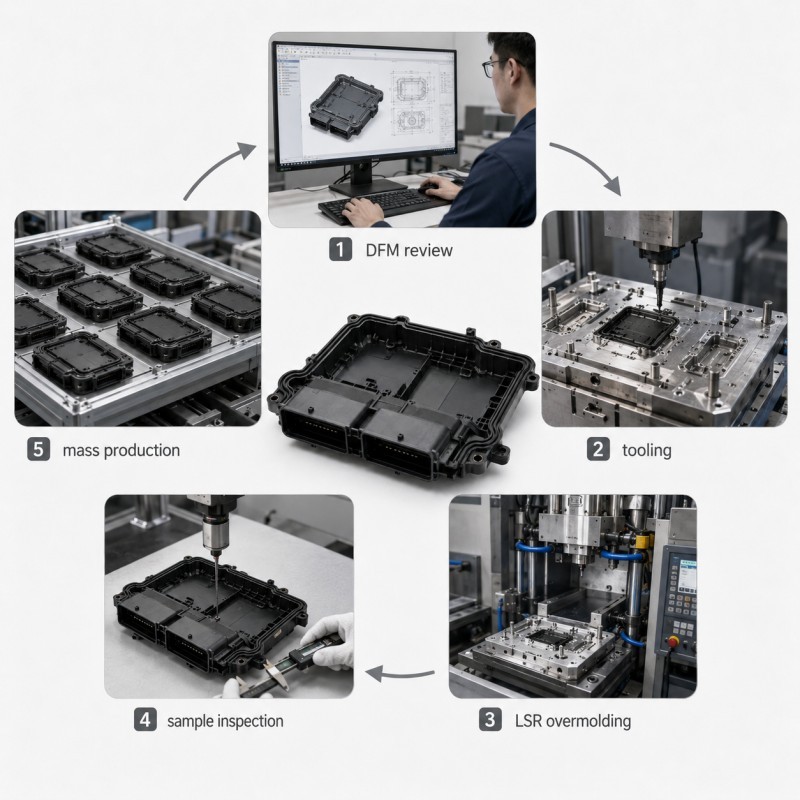
DFM, Tooling and Production Support
SiliconePlus supports custom ECU housing sealing projects from initial review to production.
Project support can include:
- 2D and 3D drawing review
- Plastic material evaluation
- Silicone material selection
- Bonding-area review
- Seal compression review
- Insert-positioning analysis
- Mold shut-off review
- Parting-line and gate review
- Custom mold development
- Prototype sampling
- Dimensional inspection
- Bonding evaluation
- Leak-test support
- Process optimization
- OEM and ODM mass production
Early DFM review can help identify plastic deformation, sealing interference, silicone overflow, insufficient bonding area and assembly risks before tooling.
Information Required for Quotation
To evaluate your custom ECU housing seal, please provide:
- 2D drawing
- 3D file
- Plastic housing sample, if available
- Plastic material and grade
- Silicone hardness requirement
- Silicone coverage area
- Assembly drawing
- Waterproof or leak-test standard
- Operating temperature
- Estimated annual quantity
- Prototype quantity
- Required production schedule
Confidential project files can be reviewed according to your project requirements.
Frequently Asked Questions
Can you manufacture a standard ECU housing seal?
This is mainly a custom manufacturing service. The silicone coverage, housing structure, compression area and mold are developed according to the customer’s drawing or sample.
Can silicone be molded directly onto a plastic ECU housing?
Yes, provided that the plastic material, insert structure, mold temperature, bonding method and support design are suitable for LSR overmolding.
Can the component support IP67 or IP68 waterproof requirements?
We can support the development of IP67 or IP68 sealing structures. Final waterproof performance must be verified on the complete assembled product.
What information is needed before mold development?
Please provide the housing drawing, plastic grade, assembly structure, sealing area, silicone hardness, waterproof target, quantity and testing requirements.
Can you provide samples before mass production?
Yes. Tooling, sample production, DFM review and process optimization can be completed before mass production approval.
Send Your ECU Housing Project
Developing a waterproof automotive ECU, BMS or electronic control housing?
Please contact SiliconePlus for a project review and send your drawings, plastic material information, assembly requirements, test standards and estimated quantity. Our team will evaluate the LSR overmolding structure before tooling.
- 加载中···
- *Phone
- *Title
- *Content

Silicone Empowers Excellence