How to Prevent Plastic Insert Deformation in LSR Overmolding
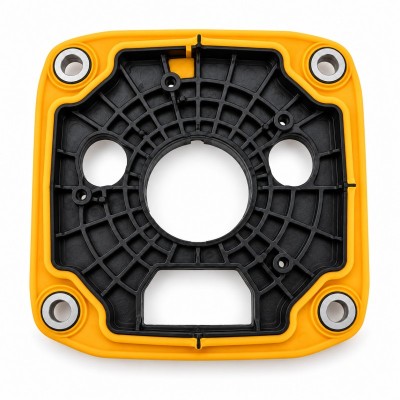
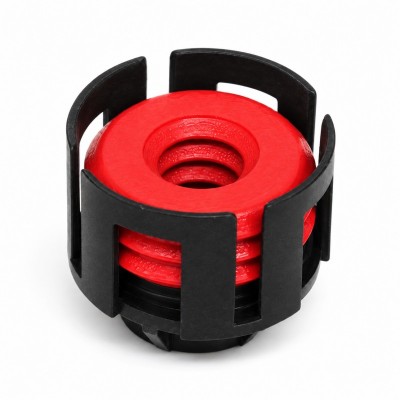
Silicone over plastic overmolding is widely used for electronic housings, connector seals, waterproof buttons, medical device components, wearable parts, beauty device parts, and custom plastic-silicone assemblies. By molding liquid silicone rubber directly onto a plastic insert, manufacturers can create an integrated structure with sealing, soft touch, insulation, shock absorption, and assembly protection.
However, plastic insert deformation is one of the most common risks in LSR overmolding projects.
A plastic insert may look stable before molding, but after being placed into a heated LSR mold, it may warp, shrink, bend, shift, or lose dimensional accuracy. Once this happens, the final part may have poor sealing, uneven silicone thickness, assembly interference, flash, bonding failure, or cosmetic defects.
For OEM/ODM custom silicone overmolding projects, preventing plastic deformation should be reviewed before tooling, not after the first sample fails.
Answer Excerpt
Plastic insert deformation in LSR overmolding can be reduced by selecting heat-resistant plastic materials, controlling insert tolerance, improving mold support, optimizing injection pressure, balancing silicone wall thickness, reviewing parting line position, and testing the part under real assembly conditions before mass production.
Why Plastic Inserts Deform During LSR Overmolding
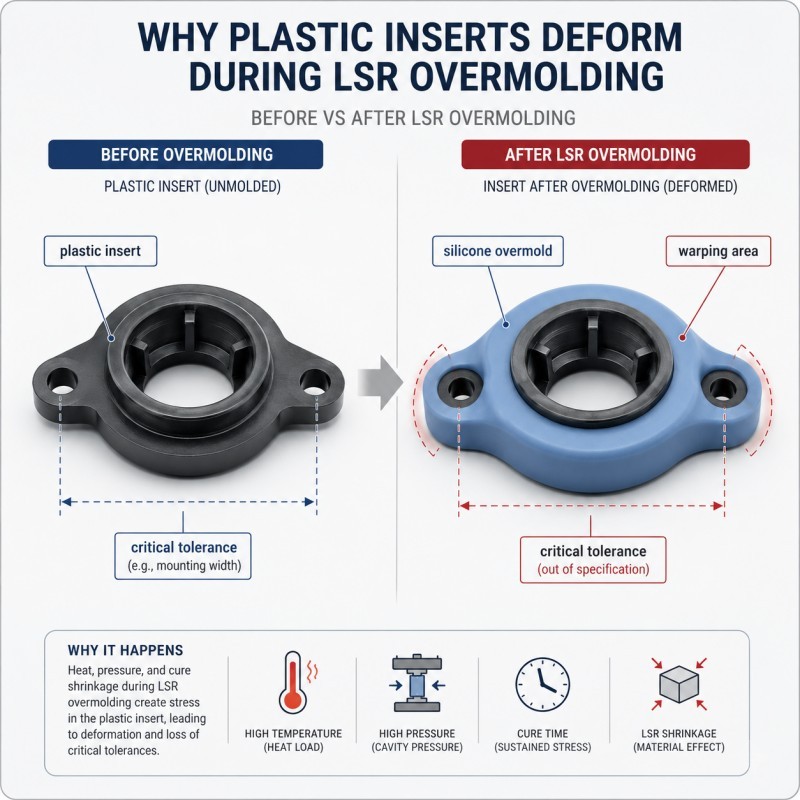
Plastic inserts may deform during LSR overmolding because the process involves heat, pressure, clamping force, silicone flow, insert positioning, and curing time.
Liquid silicone rubber is usually molded in a heated mold. If the plastic material cannot withstand the molding temperature or if the plastic structure is too thin, the insert may soften, warp, or lose its original shape.
Deformation may also happen when the insert is not supported properly inside the mold. During silicone injection, pressure and flow may push the plastic insert away from its designed position.
Common deformation problems include plastic warping, insert bending, thin-wall collapse, hole distortion, connector misalignment, sealing surface unevenness, and assembly dimension change.
Plastic Material Selection Comes First
The first step is to evaluate whether the plastic material is suitable for LSR overmolding.
Different plastics have different heat resistance, shrinkage behavior, dimensional stability, and bonding compatibility with silicone. A plastic material that works well in normal assembly may not remain stable inside a heated LSR mold.
For silicone over plastic projects, engineers should review the plastic grade, heat deflection temperature, glass transition behavior, shrinkage rate, moisture absorption, wall thickness, and whether the plastic part has internal stress from previous injection molding.
Engineering plastics such as PC, PBT, PA, PPS, and other high-temperature materials are often considered for demanding overmolding applications, but the final choice depends on the part structure, bonding requirement, application environment, and molding process.
If the plastic insert material is selected only by cost or appearance, deformation risk may increase during sampling and mass production.
Insert Tolerance Affects Overmolding Stability
Plastic insert tolerance directly affects how accurately the part can be positioned inside the overmolding tool.
If the insert tolerance is too loose, the plastic part may shift during molding. If the tolerance is too tight, it may be difficult to load into the mold or may be damaged by clamping pressure.
Tolerance issues can cause uneven silicone thickness, exposed plastic areas, flash on sealing surfaces, misaligned silicone lips, poor bonding edges, and unstable final dimensions.
Before tooling, engineers should review the plastic insert drawing, actual sample measurements, critical assembly dimensions, sealing areas, and tolerance stack-up with the final product housing.
For precision silicone over plastic parts, the insert itself must be stable before the silicone molding process begins.
Mold Support Structure Is Critical
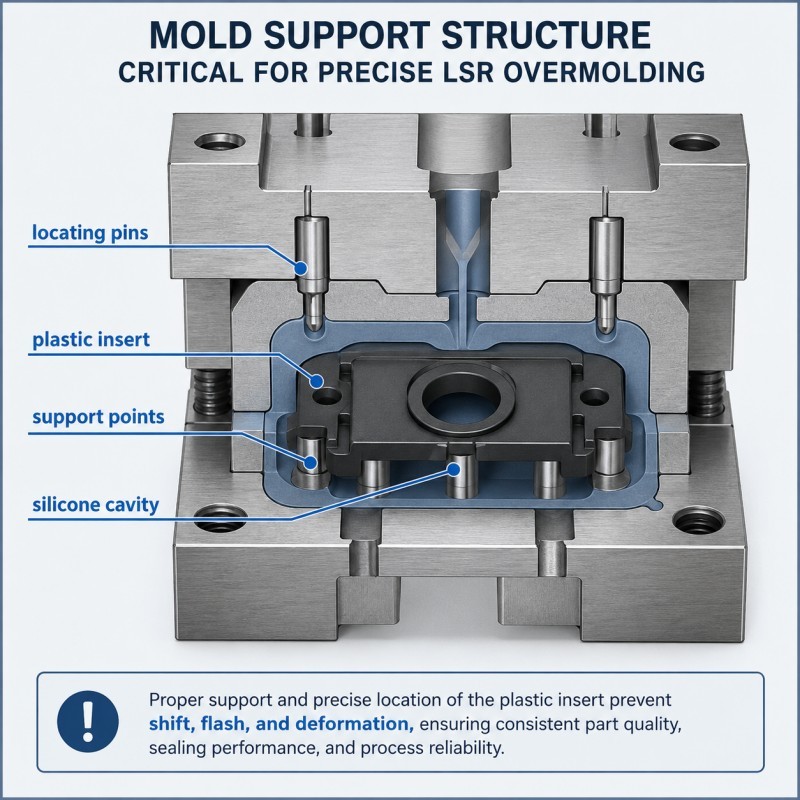
A plastic insert must be supported correctly inside the mold cavity. If the mold only holds the insert at a few weak points, the plastic may deform under injection pressure, clamping force, or heat.
A good support structure should hold the plastic insert in the correct position without damaging functional surfaces.
Engineers should review support points, locating pins, shut-off areas, clamping surfaces, insert loading direction, parting line position, and whether the mold can prevent movement during silicone injection.
For thin plastic housings, connector shells, small electronic parts, and precision sealing components, mold support design can determine whether the final product remains dimensionally stable.
Mold Temperature and Curing Time Must Be Controlled
LSR overmolding requires mold temperature control to cure the silicone properly. However, excessive mold temperature or long exposure time may increase deformation risk for plastic inserts.
The correct process should balance silicone curing efficiency with plastic insert stability.
If the temperature is too low, silicone curing may be incomplete, bonding may become unstable, or cycle time may increase. If the temperature is too high, the plastic insert may warp, shrink, or lose dimensional accuracy.
Engineers should review plastic heat resistance, silicone curing behavior, mold temperature range, insert preheating condition, cycle time, and cooling or handling process after demolding.
For mass production, temperature stability must be controlled consistently, not only adjusted during trial molding.
Injection Pressure and Silicone Flow Direction
Liquid silicone rubber has strong flowability, which is useful for filling thin sealing lips, small ribs, fine details, and complex cavities. But if flow direction and injection pressure are not controlled, the silicone may push the plastic insert out of position.
This is especially risky for thin plastic parts, long narrow inserts, unsupported walls, small connector housings, and plastic parts with weak ribs or holes.
During DFM review, engineers should evaluate gate position, flow path, venting location, cavity balance, air trap risk, and whether the silicone flow may create pressure on a weak plastic area.
The goal is to fill the silicone cavity completely while keeping the plastic insert stable.
Wall Thickness and Rib Design
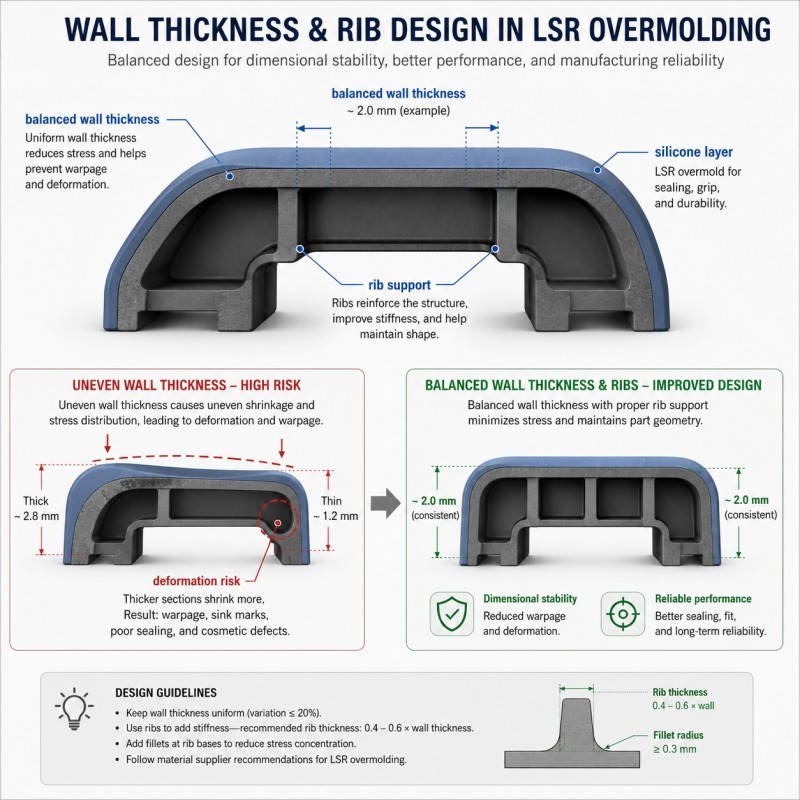
Plastic wall thickness affects deformation risk. If the plastic insert has very thin walls, large flat surfaces, uneven thickness, or weak ribs, it may deform under heat or pressure.
A more stable plastic structure usually has balanced wall thickness, proper ribs, smooth transitions, and enough support around critical areas.
However, adding too much plastic thickness may also create shrinkage, sink marks, or injection molding stress before the overmolding step.
For silicone over plastic projects, the plastic part and silicone layer should be designed together. Engineers should avoid treating the plastic insert as a finished independent part without considering the second LSR molding process.
Bonding Area and Sealing Surface Review
Plastic deformation can also affect bonding and sealing performance.
If the plastic insert bends or shifts during molding, the silicone bonding area may become uneven. The sealing lip may also move away from the designed position.
For waterproof components, even a small deformation around the sealing surface can create leakage risk. For electronic assemblies, deformation may affect connector fit, button travel, contact pressure, or assembly clearance.
Before tooling, engineers should clearly define bonding areas, sealing surfaces, critical dimensions, assembly contact zones, and areas where flash is not allowed.
The mold parting line should avoid critical sealing surfaces whenever possible.
Pre-Molding Condition of Plastic Inserts
Plastic insert deformation may also be related to the condition of the plastic part before overmolding.
If the plastic insert has internal stress from the first injection molding process, it may deform when heated again during LSR overmolding. Moisture absorption, poor storage, surface contamination, and dimensional instability can also affect the final result.
Before overmolding, engineers should check whether the plastic insert needs drying, cleaning, aging, stress relief, dimensional inspection, or surface treatment.
For stable mass production, the plastic insert supply process must also be controlled. A stable LSR overmolding process cannot fully compensate for unstable plastic inserts.
Testing Before Mass Production
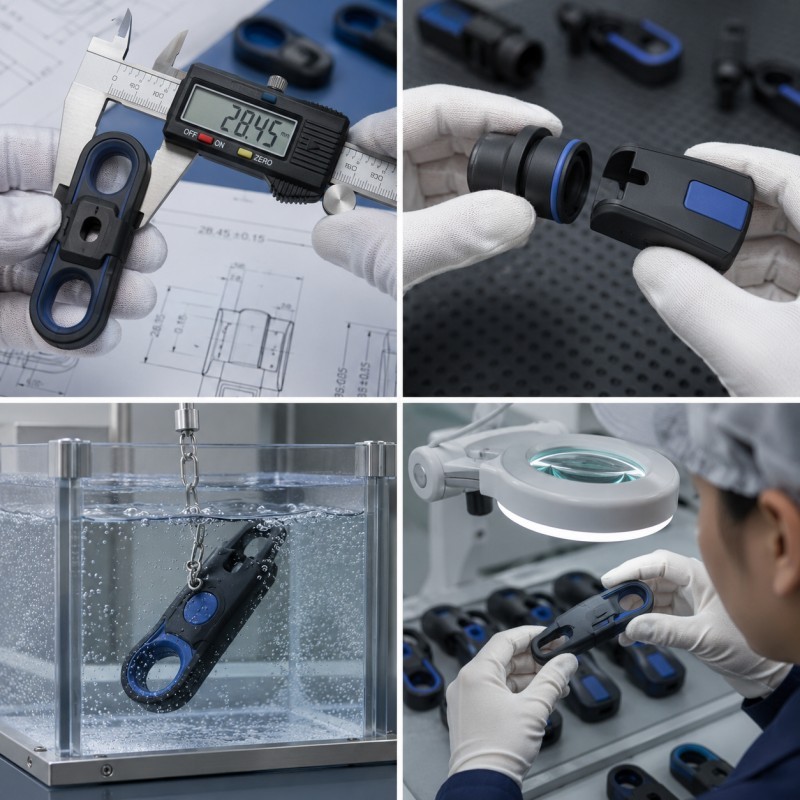
A sample may look acceptable after demolding, but deformation problems may appear during assembly, sealing tests, temperature cycling, or long-term use.
Before mass production, plastic-silicone overmolded parts should be tested according to the real application environment.
Common tests include dimensional inspection, assembly test, waterproof test, air leakage test, pulling force test, peeling test, heat aging test, temperature cycling test, compression test, visual inspection, and functional test.
Testing should compare the plastic insert before overmolding, the finished overmolded part after molding, and the part after application-level testing.
How SiliconePlus Supports Silicone Over Plastic Projects
SiliconePlus supports custom LSR overmolding projects involving plastic, metal, FPC, silicone, cable, and connector structures. For silicone over plastic projects, our team can review plastic material, insert structure, bonding area, sealing function, mold support, silicone coverage, tolerance requirements, and testing standards before mold development.
We can support DFM review, silicone material selection, custom tooling, sample production, bonding evaluation, process optimization, inspection, and OEM/ODM mass production.
For automotive connectors, wearable components, medical device parts, 3C electronic housings, beauty device parts, and industrial sealing components, early engineering review can help reduce plastic deformation, bonding failure, leakage risk, and assembly instability.
Conclusion
Plastic insert deformation is a serious risk in silicone over plastic overmolding projects. It can affect bonding, sealing, appearance, assembly, dimensional accuracy, and long-term product reliability.
To reduce this risk, engineers should evaluate plastic material, heat resistance, insert tolerance, mold support, mold temperature, injection pressure, silicone flow, wall thickness, bonding area, sealing surface, and testing standards before tooling.
If you are developing a custom silicone over plastic part, send us your drawings, samples, plastic material information, application requirements, testing standards, and estimated quantity. SiliconePlus can help evaluate the right overmolding solution from prototype to mass production.