Home / All / Silicone Overmolding Products / Automotive Silicone Overmolding / Custom LSR Overmolded Cable Strain Relief for Automotive Wire Harness
Custom LSR Overmolded Cable Strain Relief for Automotive Wire Harness
| Share | |
|---|---|
| Categories | Automotive Silicone Overmolding |
| Brand | SiliconePlus | Silicone OverMolding Manufacturing |
| Brand | SiliconePlus |
| Material | Liquid Silicone Rubber (LSR) |
| Insert Type | Cable / Wire / Connector Insert |
| Molding Process | LSR Overmolding / Insert Molding |
| Main Function | Strain Relief / Sealing / Vibration Damping |
| Silicone Hardness | Customized to Bending and Sealing Requirements |
| Cable Diameter | Customized According to Customer Drawing |
| Application | Automotive Wire Harness / Sensor Cable / Connector Tail |
| Custom Input | 2D Drawing / 3D File / Physical Sample |
| Service | DFM / Tooling / Sampling / OEM Mass Production |
| Download |  |
Detail Information
Product Overview
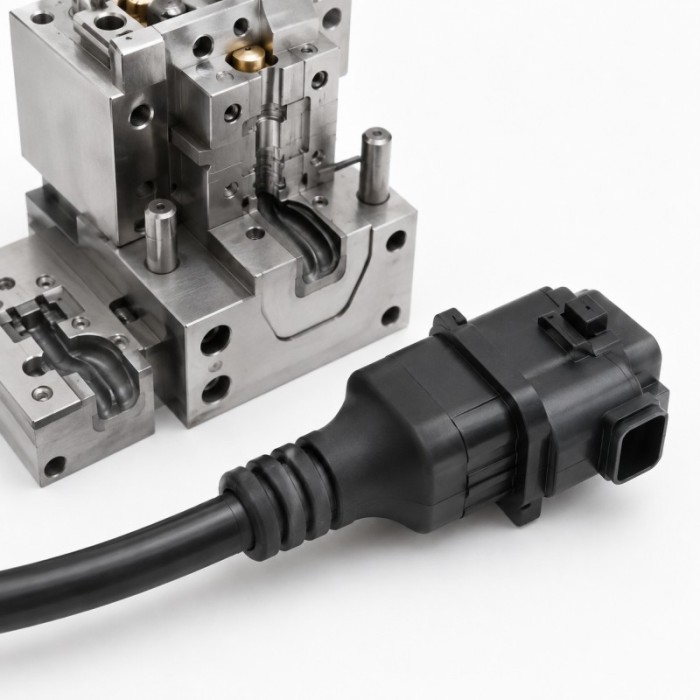
Custom LSR overmolded cable strain relief is designed for automotive wire harnesses, sensor cables, connector tails and electronic module cable outlets that require bending protection, sealing and vibration resistance.
Liquid silicone rubber is molded directly around a cable, wire assembly, connector insert or housing transition area. The resulting structure helps distribute bending stress and protect the cable root from repeated pulling, twisting, vibration and environmental exposure.
The product is manufactured according to customer drawings, cable samples, connector structures, bending requirements and waterproof testing conditions. It is a custom overmolding service rather than a standard stock cable accessory.
SiliconePlus supports project evaluation, mold development, sample production and OEM mass production through precision liquid silicone injection molding.
What Is an LSR Overmolded Cable Strain Relief?
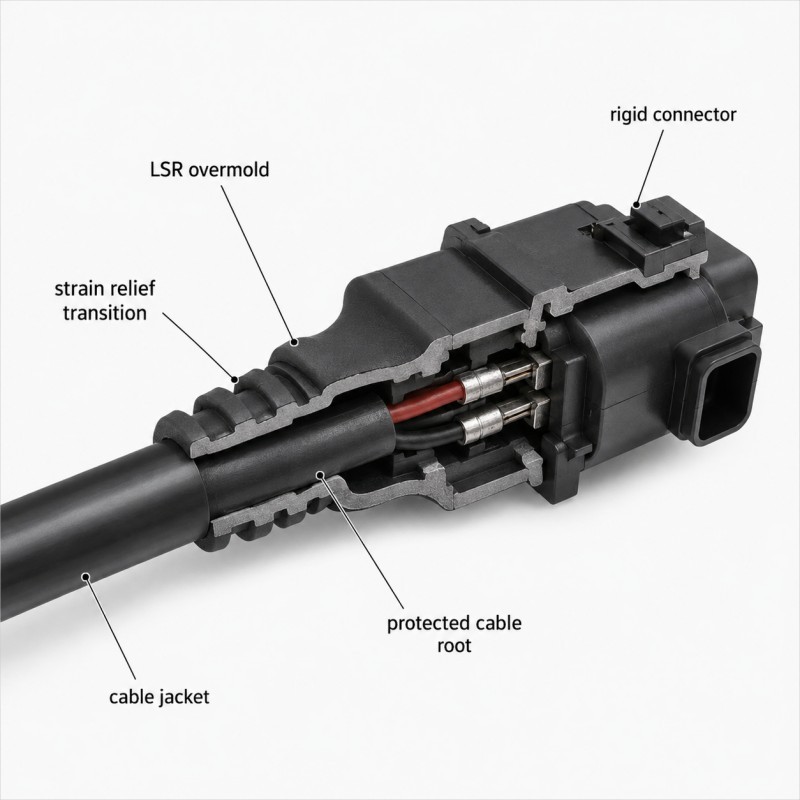
An LSR overmolded cable strain relief is a flexible silicone structure molded around the transition between a cable and a rigid component.
The rigid component may be:
A plastic connector
A metal terminal
A sensor housing
An electronic module
A cable outlet
A wire harness branch
A plastic or metal insert
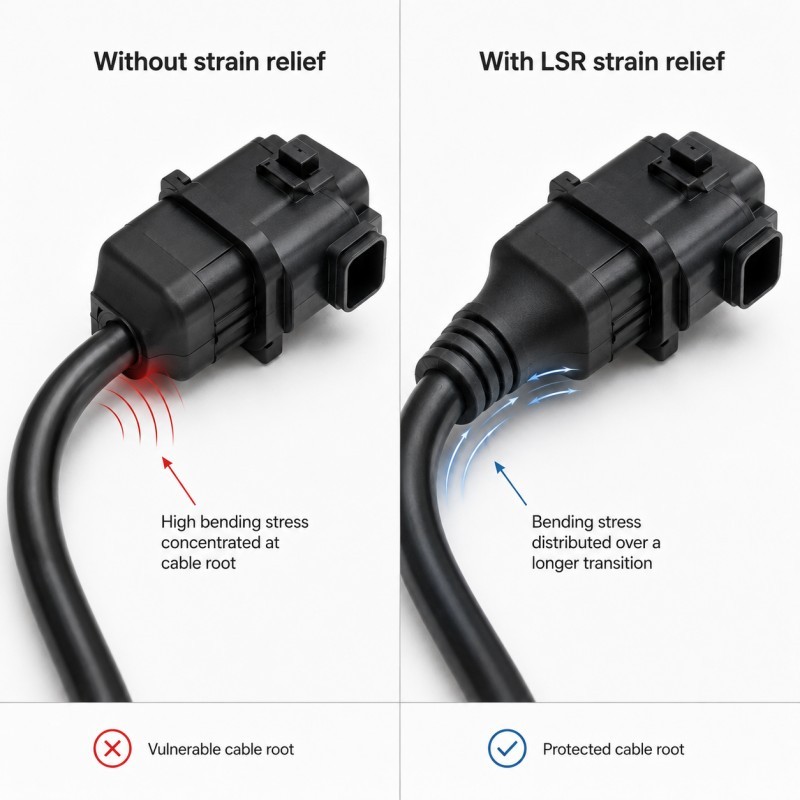
When the cable is bent or pulled, the cable root usually receives the highest mechanical stress. Without a suitable transition structure, the cable jacket, internal wires, solder joints, terminals or connector interface may become damaged.
The molded silicone section creates a more gradual transition from the rigid insert to the flexible cable. This helps distribute stress over a longer area instead of allowing the cable to bend sharply at one point.
Engineers developing similar components can review our strain relief design for LSR overmolded cable parts before tooling.
Key Benefits
Custom LSR overmolded cable strain relief can provide several functions in one molded component:
Reduced bending stress at the cable root
Improved resistance to repeated flexing
Protection against pulling and twisting
Vibration and impact damping
Cable-entry waterproof sealing
Dustproof protection
Electrical insulation support
Stable positioning around the cable
Cleaner appearance than manually applied glue
Improved repeatability during mass production
Reduced risk of separate sleeves becoming displaced
Custom shape, hardness and coverage area
The design can be adjusted according to the cable diameter, cable jacket, connector structure, available assembly space and expected service environment.
Key Design Requirements Before Tooling
Cable and Insert Positioning
Cable positioning is one of the most important factors during overmolding.
The cable may move because of:
Cable flexibility
Cable tension
Diameter variation
Jacket softness
Operator loading
Mold-closing force
LSR injection pressure
If the cable shifts inside the mold, one side of the silicone structure may become too thin while the opposite side becomes too thick.
Cable movement may also cause:
Uneven wall thickness
Exposed cable areas
Incomplete filling
Flash
Off-center strain relief
Poor sealing around the cable
Incorrect final appearance
The mold should include suitable locating points, support areas, cable clamping and shut-off structures.
Strain Relief Length and Transition
The strain relief should guide the cable into a gradual bending path.
If the molded area is too short, the cable may still bend sharply at the exit point. If it is too long or too thick, the component may become too stiff and affect assembly space.
Important design factors include:
Cable diameter
Bending direction
Minimum bending radius
Silicone hardness
Strain relief length
Root thickness
Rib spacing
Taper angle
Pull-force requirement
Repeated bending requirement
A smooth thickness transition is generally more suitable than an abrupt step between the rigid connector and flexible cable.
Cable Jacket Compatibility
The cable jacket material should be reviewed before mold development.
Possible jacket materials may behave differently during LSR molding because of temperature resistance, surface energy, additives, plasticizers and dimensional stability.
The engineering review should confirm:
Cable jacket material
Maximum allowable temperature
Surface condition
Cable diameter tolerance
Bonding requirement
Mechanical-locking requirement
Risk of cable deformation
Risk of material migration
Bonding should not be assumed only from the cable material name. Sample evaluation may be required.
Bonding and Mechanical Retention
Some projects require the silicone to bond to the cable jacket, connector or insert. Other projects use mechanical locking to hold the silicone in position.
Mechanical-locking features may include:
Grooves
Holes
Undercuts
Retention ribs
Enlarged cable sections
Connector-edge wrapping
Embedded insert structures
The selected solution depends on the substrate material, product geometry, operating environment and pull-force requirement.
Waterproof Sealing
A cable strain relief can also form a cable-entry sealing structure.
However, waterproof performance depends on more than simply covering the cable with silicone.
The complete design should consider:
Continuous sealing path
Cable-to-silicone interface
Connector-to-silicone interface
Bonding or mechanical retention
Silicone thickness
Housing assembly
Compression area
Parting-line position
Flash control
Leak-test conditions
For projects requiring a sealed cable outlet, review our waterproof silicone seal design guide.
Final IP performance must be validated on the complete assembled product or an approved test fixture.
Mold Shut-Off and Flash Control
The mold must close securely around the cable without damaging or excessively compressing the jacket.
If the shut-off gap is too large, silicone flash may form along the cable. If the shut-off pressure is too high, the cable jacket may deform or become damaged.
Critical exposed areas should be marked before tooling, including:
Connector contacts
Electrical terminals
Mounting areas
Sealing surfaces
Cable identification marks
Assembly interfaces
Test points
Projects involving connector tails should also review silicone overmolded connector design before confirming the mold structure.
Customization Options
The following features can be customized according to customer requirements:
Cable diameter
Cable jacket material
Silicone hardness
Silicone color
Silicone coverage length
Strain relief geometry
Bending direction
Rib design
Taper structure
Surface texture
Connector insert structure
Bonding area
Mechanical-locking structure
Waterproof sealing area
Parting-line position
Gate position
Pull-force requirement
Bending-cycle requirement
Packaging method
The final design should be based on the complete cable and connector assembly rather than only the outer silicone shape.
Typical Automotive Applications
Custom LSR overmolded cable strain relief can be developed for:
Automotive sensor cables
Wire harness exits
Connector tails
EV charging-related cables
Battery management system cables
Camera and radar module cables
Lighting control cables
Motor control cable outlets
Waterproof electronic modules
Temperature and pressure sensor wires
Industrial vehicle cable assemblies
Vibration-resistant connector components
For additional vehicle applications, see our automotive silicone customization solutions.
SiliconePlus focuses on the custom silicone overmolded protection and sealing section. Complete cable assemblies, connectors or electronic systems must be evaluated according to the customer’s supplied components and project scope.
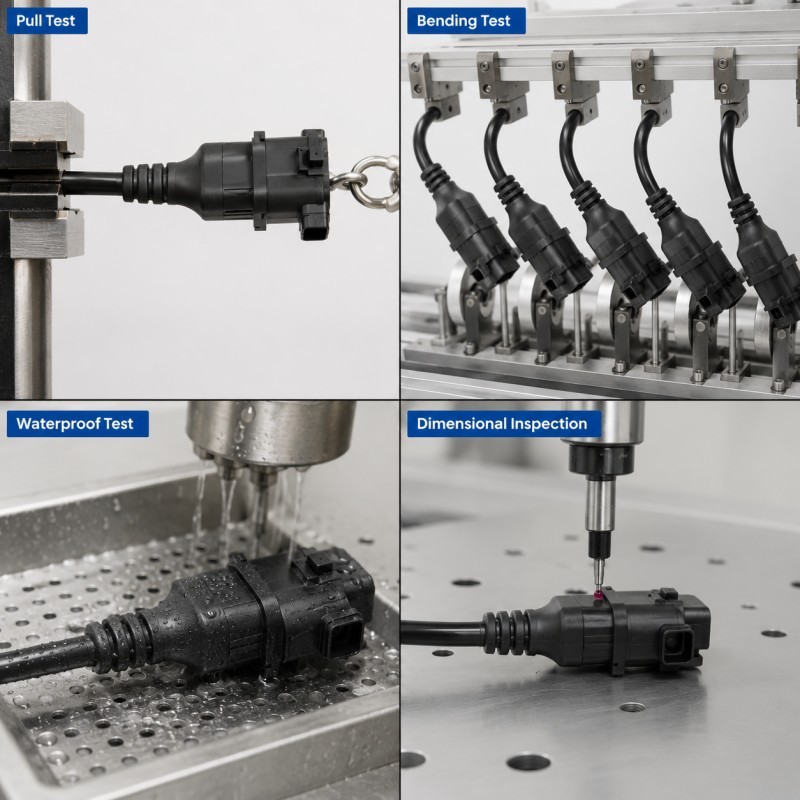
Quality Inspection and Testing
Visual appearance alone cannot confirm whether a cable strain relief will perform reliably.
Inspection and testing may include:
Cable position inspection
Silicone coverage inspection
Dimensional inspection
Wall-thickness inspection
Flash inspection
Surface-defect inspection
Bonding evaluation
Pull-force testing
Repeated bending testing
Torsion testing
Connector retention testing
Air-leak testing
Waterproof testing
Heat-aging testing
Temperature-cycling testing
Assembly verification
Electrical function verification
Test methods, loads, cycle quantities and acceptance standards should be agreed before mass production.
DFM, Tooling and Production Support
SiliconePlus supports custom cable overmolding projects from early design review to production.
Project support can include:
2D and 3D drawing review
Cable sample review
Cable jacket evaluation
Insert-positioning analysis
Strain relief geometry review
Bending-radius review
Bonding-area review
Mechanical-locking review
Mold shut-off review
Gate and venting analysis
Custom mold development
Prototype sampling
Process optimization
Dimensional inspection
Pull and bending test support
Waterproof test support
OEM and ODM mass production
Early DFM review can help identify cable movement, insufficient bending transition, poor sealing, excessive stiffness, flash and incomplete filling before the production tool is completed.
Information Required for Quotation
Please provide as much of the following information as possible:
2D drawing
3D file
Cable or wire sample
Connector or insert sample
Cable diameter
Cable jacket material
Silicone coverage area
Required silicone hardness
Bending direction
Pull-force requirement
Bending-cycle requirement
Waterproof requirement
Operating temperature
Estimated annual quantity
Prototype quantity
Required production schedule
A physical cable sample is especially useful when the cable jacket material, flexibility or dimensional tolerance cannot be confirmed from the drawing.
Frequently Asked Questions
Can you supply a complete automotive wire harness?
Our main service is custom silicone molding and silicone overmolding. Complete wire harness supply depends on the project scope and supplied components. We mainly manufacture the silicone strain-relief, sealing and protective overmolded section.
Can silicone be molded directly around a cable?
Yes, provided that the cable jacket, temperature resistance, insert positioning and mold structure are suitable for LSR overmolding.
Can the strain relief provide waterproof sealing?
It can support waterproof cable-entry design when the cable interface, bonding structure, silicone coverage and final assembly are correctly designed and tested.
Can the silicone hardness be customized?
Yes. Silicone hardness should be selected according to the required bending flexibility, sealing performance, pull resistance and assembly structure.
What is the minimum order quantity?
The general mass-production MOQ starts from 500 pieces, depending on the structure, cable material, mold design and testing requirements. Prototype quantities can be evaluated separately.
Do you need a cable sample before tooling?
A sample is strongly recommended, especially when cable jacket material, diameter tolerance, flexibility and temperature resistance need to be confirmed.
Send Your Cable Overmolding Project
Developing an automotive wire harness, sensor cable, connector tail or waterproof cable outlet?
Please contact SiliconePlus for a project review and send your drawings, cable samples, insert information, bending requirements, waterproof standards and estimated quantity.
Related Products
Review
- 加载中···
Please send your message to us
- *Phone
- *Title
- *Content

Silicone Empowers Excellence
Contact Person
