Silicone Over Metal Insert Molding for Custom Industrial Components
Metal parts are widely used in automotive electronics, medical devices, industrial equipment, sensors, connectors, tools, and consumer electronic assemblies. They provide strength, conductivity, stability, and structural support. However, metal alone may not provide enough sealing, insulation, grip, shock absorption, or long-term protection.
This is where silicone over metal insert molding becomes valuable.
By molding liquid silicone rubber directly onto a metal insert, manufacturers can create an integrated component that combines the strength of metal with the flexibility, sealing performance, insulation, and durability of silicone.
For custom industrial components, silicone over metal molding is not only about covering a metal surface. It is about designing a stable bonding structure, selecting the right silicone material, controlling surface treatment, and ensuring that the finished part can survive real assembly and application conditions.
Answer Excerpt
Silicone over metal insert molding is a custom manufacturing process that molds liquid silicone rubber directly onto metal inserts. It helps improve sealing, insulation, grip, vibration resistance, shock absorption, and surface protection. It is commonly used for automotive connectors, sensors, medical handles, industrial parts, electronic modules, valves, terminals, and precision metal-silicone components.
What Is Silicone Over Metal Insert Molding?
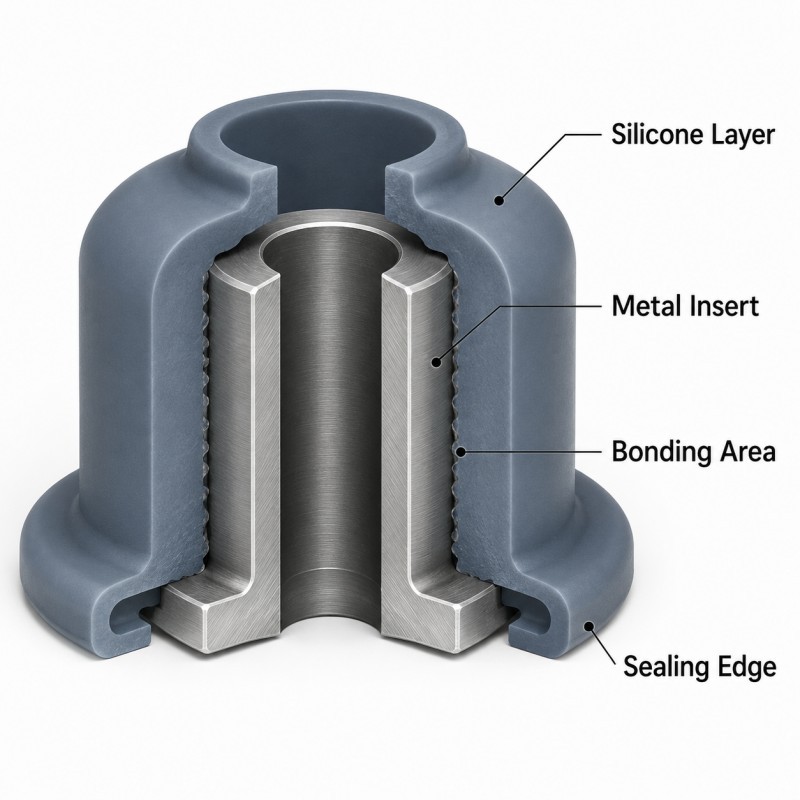
Silicone over metal insert molding is a process where a metal part is placed into a mold cavity, and liquid silicone rubber is injected or molded around specific areas of the metal insert.
After curing, the silicone and metal form one integrated component.
The metal insert may provide mechanical strength, positioning, electrical function, or structural support. The silicone layer may provide sealing, insulation, softness, anti-slip grip, vibration reduction, waterproof protection, or user contact comfort.
Common metal substrates include:
Stainless steel
Aluminum
Copper
Brass
Steel inserts
Metal pins
Metal terminals
Metal shafts
Threaded inserts
Sensor housings
Connector components
The final part can be used in demanding applications where metal strength and silicone flexibility are both required.
Why Use Silicone Over Metal Instead of Separate Assembly?
Some products use a metal part and a separate silicone gasket, sleeve, cover, or sealing ring. This method can work, but it may increase assembly steps and create quality risks.
Separate assembly may cause:
- Silicone sleeve movement
- Gasket displacement
- Uneven compression
- Poor sealing consistency
- Higher labor cost
- More assembly tolerance risk
- Glue overflow
- Weak long-term protection
- Appearance inconsistency
Silicone over metal insert molding helps reduce these problems because the silicone layer is molded directly onto the metal part.
This improves part positioning, reduces assembly complexity, and creates a more stable structure for mass production.
Key Benefits of Silicone Over Metal Molding
1. Improved Sealing Performance
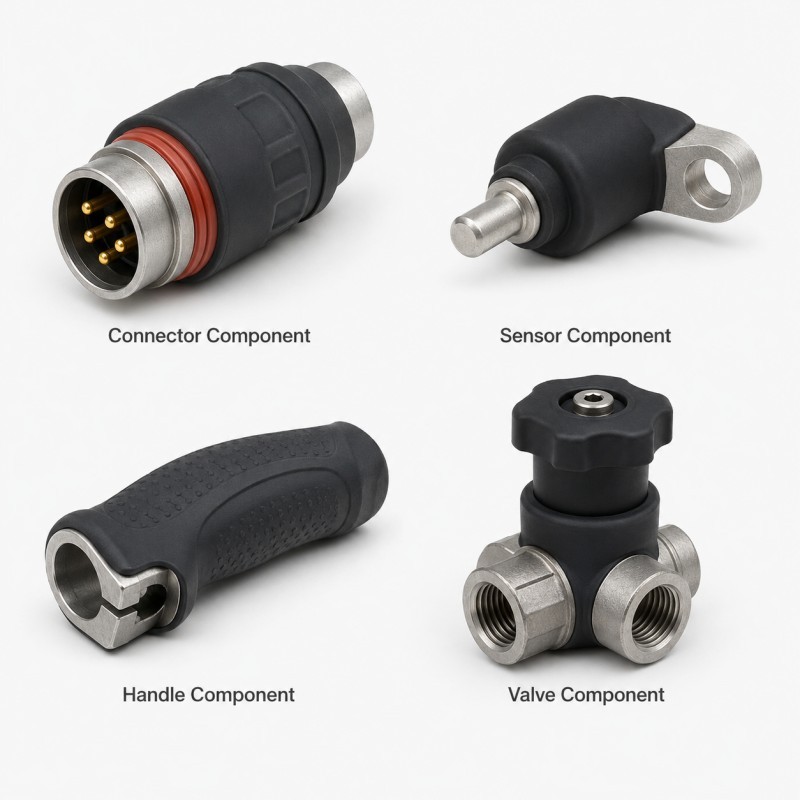
Silicone has excellent flexibility and compression recovery, making it suitable for sealing structures. When molded onto metal, it can create sealing lips, protective barriers, gasket-like structures, and waterproof interfaces.
This is useful for metal connector housings, sensor shells, valve parts, industrial modules, and electronic assemblies that require sealing around a metal area.
The sealing design can be customized according to the product structure, compression space, and working environment.
2. Electrical Insulation
Metal parts may require insulation in electronic and electrical applications. Silicone can provide an insulating layer around selected metal areas, helping reduce contact risk, short-circuit risk, or user contact exposure.
This is useful for:
- Metal terminals
- Electrical connectors
- Sensor parts
- Battery-related components
- Medical device metal inserts
- Industrial electronic modules
The silicone layer must be designed with proper thickness, coverage, and material properties according to the application.
3. Vibration and Shock Absorption
Metal parts are strong but rigid. In automotive, industrial, and electronic applications, vibration may cause noise, loosening, fatigue, or damage.
Silicone can absorb vibration and reduce impact force. Overmolded silicone can work as a cushion, buffer, or protective layer around the metal insert.
This is useful for automotive sensors, industrial equipment, connector components, handheld tools, and electronic protection parts.
4. Better Grip and Touch Feel
Some metal components are used in handheld products, medical handles, beauty device parts, tools, and wearable-related assemblies. Metal alone may feel cold, slippery, or uncomfortable.
Silicone over metal molding can create a soft-touch surface, anti-slip grip, and more comfortable handling experience.
The surface texture, hardness, color, and shape can be customized according to the product design.
5. Protection Against Moisture, Dust, and Chemicals
Metal surfaces may be exposed to moisture, dust, oil, sweat, cleaning agents, or outdoor environments. Silicone overmolding can help protect sensitive areas and reduce exposure.
However, protection depends on material selection, bonding design, and sealing structure. For harsh environments, engineers should evaluate temperature, chemical contact, humidity, UV exposure, and long-term aging conditions before production.
Common Applications of Silicone Over Metal Insert Molding
Automotive Components
Automotive parts often require durability, vibration resistance, sealing, and high-temperature stability. Silicone over metal insert molding can be used for connector parts, sensor housings, wire harness components, sealing structures, metal terminals, and EV-related components.
The design should consider vibration, temperature cycling, dust, moisture, assembly stress, and long-term reliability.
Medical Device Components
Medical components may use metal inserts for strength, positioning, or function, while silicone provides comfort, sealing, insulation, or soft contact.
Silicone over metal molding can be used for medical handles, device buttons, sealing parts, surgical-related components, sensor parts, and medical electronic assemblies.
For medical applications, material selection, cleanliness, surface quality, and inspection requirements must be carefully controlled.
Industrial Equipment Parts
Industrial parts may face vibration, oil, dust, compression, mechanical stress, and frequent use. Silicone over metal molding can improve grip, protection, sealing, and shock resistance.
Typical applications include tool handles, valves, machine interface parts, sensor protection parts, and industrial sealing components.
Electronic and Sensor Components
Metal parts are often used in electronic modules and sensors. Silicone overmolding can help provide insulation, strain relief, sealing, and protection around sensitive areas.
This is especially useful when the part must work in humid, dusty, or vibration-heavy environments.
Beauty and Personal Care Devices
Beauty devices often combine metal contact areas with soft silicone structures. Silicone over metal molding can improve user comfort, sealing, grip, and surface protection.
For these products, appearance, touch feel, color matching, and bonding consistency are important.
Important Design Factors Before Tooling
Silicone over metal insert molding requires more than simply placing metal into a mold. Before tooling, engineers should review the metal material, surface condition, bonding method, silicone structure, and real application environment.
Metal Surface Condition
The bonding between silicone and metal depends heavily on surface condition.
Common risks include:
- Oil contamination
- Oxidation
- Polishing residue
- Dust
- Release agent
- Moisture
- Uneven surface roughness
- Poor storage condition
Even a good silicone material may fail if the metal surface is not properly cleaned or treated.
Surface Treatment and Primer
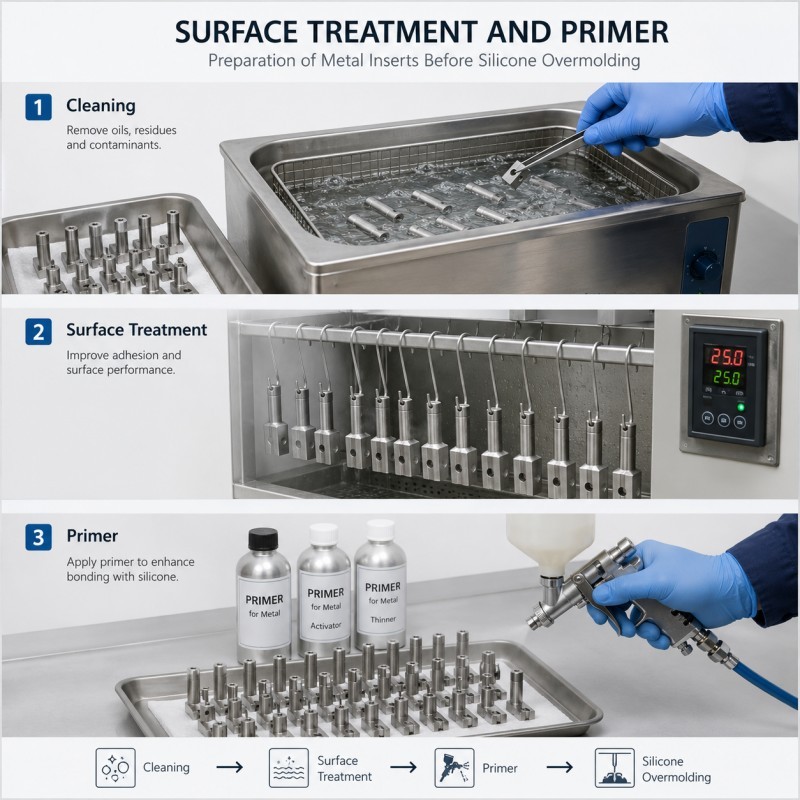
Depending on the metal material and bonding requirement, surface treatment may be needed.
Possible treatments include:
- Cleaning
- Degreasing
- Sandblasting
- Plasma treatment
- Primer coating
- Baking
- Surface roughening
- Mechanical locking design
The correct method depends on the metal type, silicone material, bonding strength requirement, and production process.
For mass production, the treatment process must be stable and repeatable, not only effective during sample making.
Mechanical Locking Structure
Chemical bonding alone may not be enough for high-stress applications. Mechanical locking can improve long-term reliability.
Common mechanical locking features include:
- Holes
- Grooves
- Undercuts
- Wrap-around silicone
- Ribs
- Slots
- Textured surfaces
- Edge retention structures
These structures help the silicone hold onto the metal insert more securely, especially when the part faces pulling, twisting, vibration, or compression.
Silicone Hardness and Thickness
Silicone hardness affects sealing force, grip feel, flexibility, and durability.
A softer silicone may improve comfort and sealing contact, but it may deform more easily. A harder silicone may improve structure stability, but it may reduce softness or increase assembly force.
Silicone thickness also matters. If the silicone is too thin, it may tear or fail to provide enough protection. If it is too thick, it may increase curing time, material cost, and internal stress.
Insert Positioning in the Mold
Metal inserts must be positioned accurately inside the mold before silicone molding.
Poor positioning may cause:
- Uneven silicone coverage
- Exposed metal areas
- Flash in functional zones
- Misaligned sealing lips
- Poor appearance
- Weak bonding at the edge
- Dimensional inconsistency
For small metal inserts, connector parts, sensor components, and precision industrial parts, mold positioning must be carefully designed.
Thermal Expansion Difference
Metal and silicone behave differently under temperature changes. Metal is rigid, while silicone is flexible. During high and low temperature cycling, stress may appear at the bonding interface.
This is important for automotive, outdoor, medical, and industrial applications.
The design should consider temperature range, material expansion, bonding area, silicone thickness, and possible stress concentration.
Manufacturing Process Overview
A typical silicone over metal insert molding project may include the following steps:
- Product requirement review
- Metal insert material evaluation
- DFM review
- Surface treatment plan
- Silicone material selection
- Mold design
- Metal insert positioning design
- Trial molding
- Bonding strength test
- Dimensional inspection
- Functional testing
- Sample approval
- Mass production
- Final quality inspection
Each step affects the final stability of the part. Skipping early evaluation may create problems later in production.
Quality Tests for Silicone Over Metal Parts
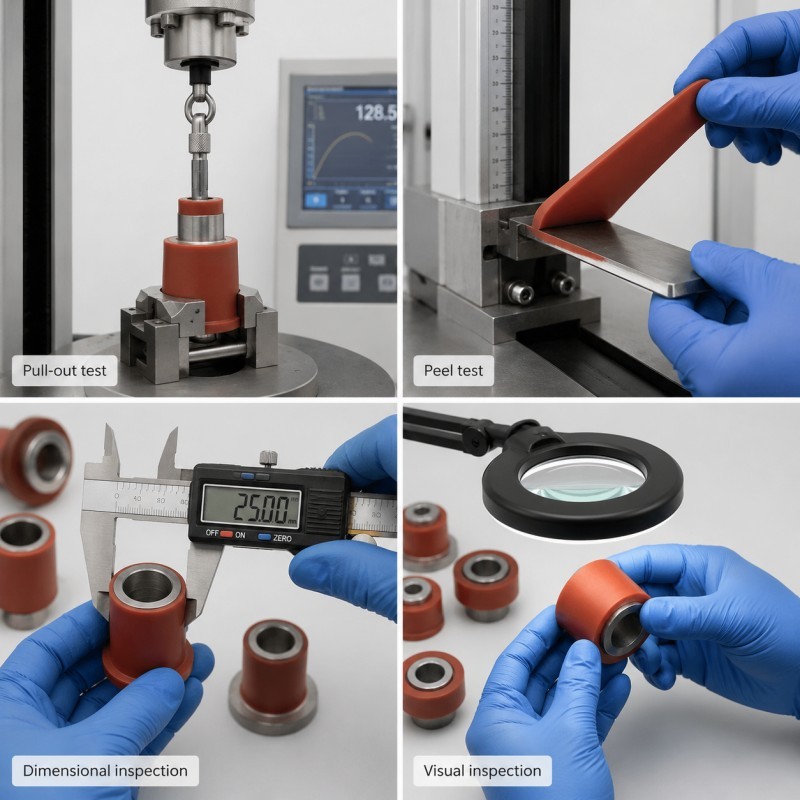
Before mass production, silicone over metal components should be tested according to their real use environment.
Common tests include:
- Pulling force test
- Peeling test
- Torsion test
- Compression test
- Waterproof test
- Aging test
- Temperature cycling test
- Salt spray test if required
- Visual inspection
- Dimensional inspection
- Assembly test
- Functional test
The test plan should be discussed before tooling because it may affect the bonding structure, silicone hardness, metal treatment, and mold design.
Common Problems and How to Avoid Them
Silicone Peeling from Metal
This is usually caused by poor surface treatment, weak bonding area, wrong silicone material, or lack of mechanical locking.
To reduce risk, engineers should review metal cleanliness, primer process, bonding structure, and application stress direction.
Flash Around the Insert
Flash may appear if insert positioning, mold clamping, parting line design, or venting is not controlled properly.
Flash near sealing or assembly areas can affect function, so it should be reviewed during mold design.
Uneven Silicone Thickness
Uneven thickness may happen when the metal insert shifts or when the mold cavity design is not balanced.
This can affect appearance, sealing, grip, and durability.
Metal Insert Deformation
Thin or delicate metal inserts may deform under molding pressure or handling. The mold should support the insert properly and avoid unnecessary stress.
Poor Appearance
Appearance issues may include flow marks, bubbles, color inconsistency, surface contamination, and rough bonding edges. These problems are usually related to material, mold design, cleaning, and production control.
How SiliconePlus Supports Silicone Over Metal Insert Molding
SiliconePlus supports custom silicone overmolding and LSR injection molding projects involving metal, plastic, FPC, and silicone substrates. For silicone over metal projects, our team can review metal insert drawings, bonding areas, surface treatment requirements, silicone hardness, sealing structure, tolerance requirements, and testing standards before mold development.
We can support DFM review, custom tooling, sample production, bonding evaluation, process optimization, inspection, and OEM/ODM mass production.
If your project requires silicone over metal insert molding for automotive components, medical device parts, industrial equipment, sensors, connectors, or electronic assemblies, early engineering evaluation can help reduce bonding risk and improve production stability.
Conclusion
Silicone over metal insert molding is an effective solution for custom components that need metal strength and silicone performance in one integrated structure.
It can improve sealing, insulation, grip, vibration resistance, shock absorption, and surface protection. However, successful silicone over metal molding depends on more than material choice. Engineers must evaluate metal surface condition, bonding area, mechanical locking, surface treatment, silicone hardness, mold positioning, flash control, and real application testing.
For B2B custom projects, early DFM review and sample validation are essential before mass production.
If you are developing a custom silicone over metal insert molded part, send us your drawings, samples, metal material information, application requirements, and estimated quantity. SiliconePlus can help evaluate the right overmolding solution from prototype to mass production.