What Should OEMs Confirm About Linked Metal Terminal Strips Before LSR Overmolding?
Answer Excerpt
Before LSR overmolding, OEMs should confirm the metal terminal strip layout, terminal position, silicone coverage, locating references and separation sequence. These details help the tooling team determine how the connected metal inserts will be held, molded and inspected.
Introduction
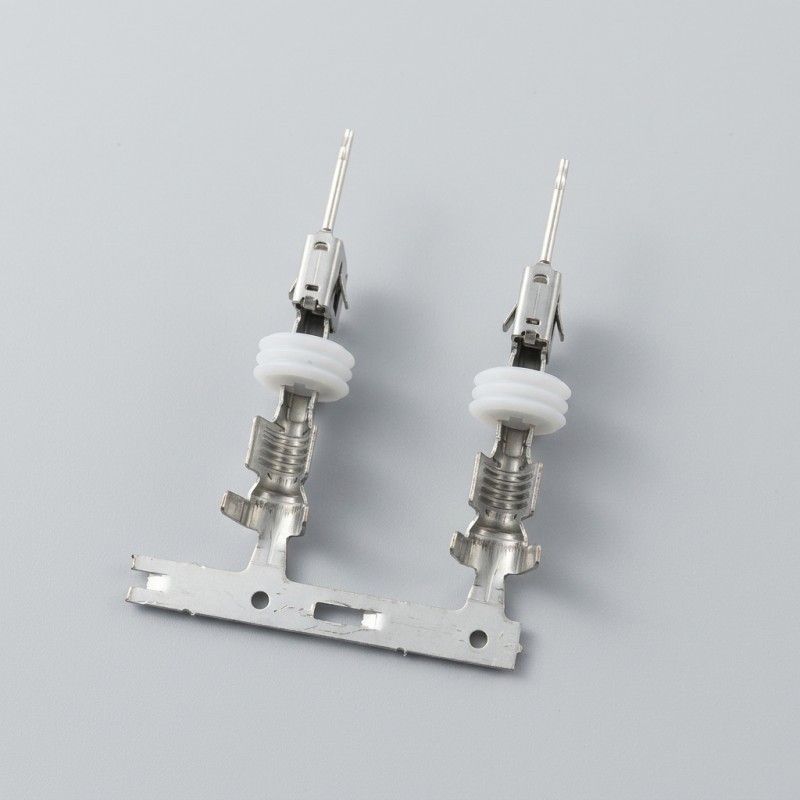
Some automotive connector projects use multiple metal terminals connected by a common metal strip. Before silicone is molded onto these terminals, the relationship between the individual terminals and the connecting strip must be understood.
The strip may serve as a temporary handling feature, or it may remain part of the finished component. The correct manufacturing plan depends on the actual drawing.
For related applications, explore our custom automotive connector silicone seals.
Why Does the Connected Metal Strip Matter?
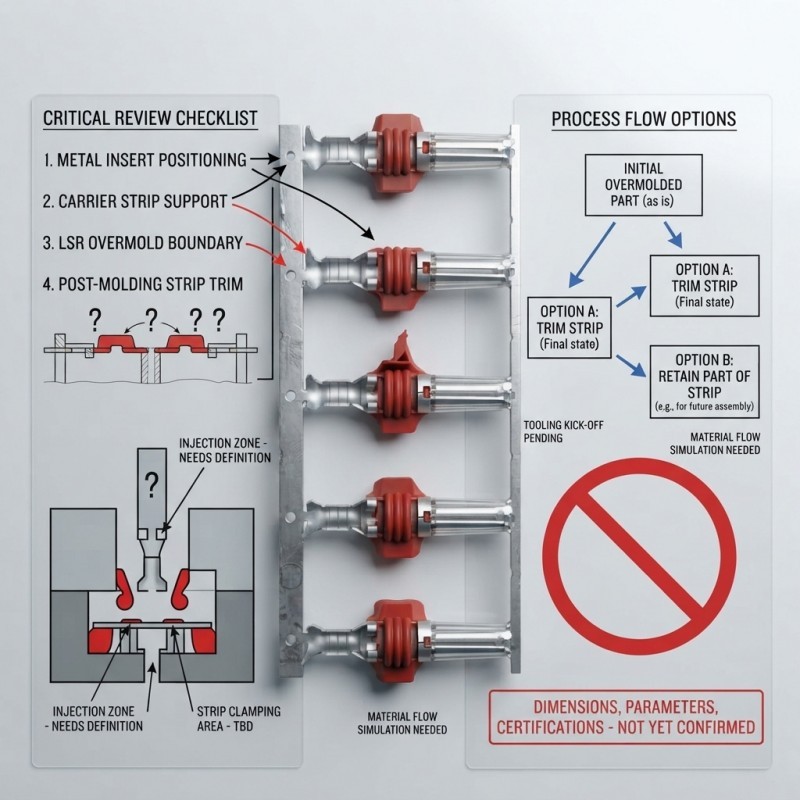
A connected terminal strip can influence how metal inserts are loaded, located and supported during LSR insert molding.
If several terminals are linked together, the tooling review should consider the entire strip rather than evaluating each terminal as an isolated part.
The key question is whether the connecting metal section is a temporary manufacturing carrier or a permanent part of the final design. This must be confirmed before the mold concept is finalized.
What Should Be Checked Before Tooling?
OEMs and engineering teams should confirm:
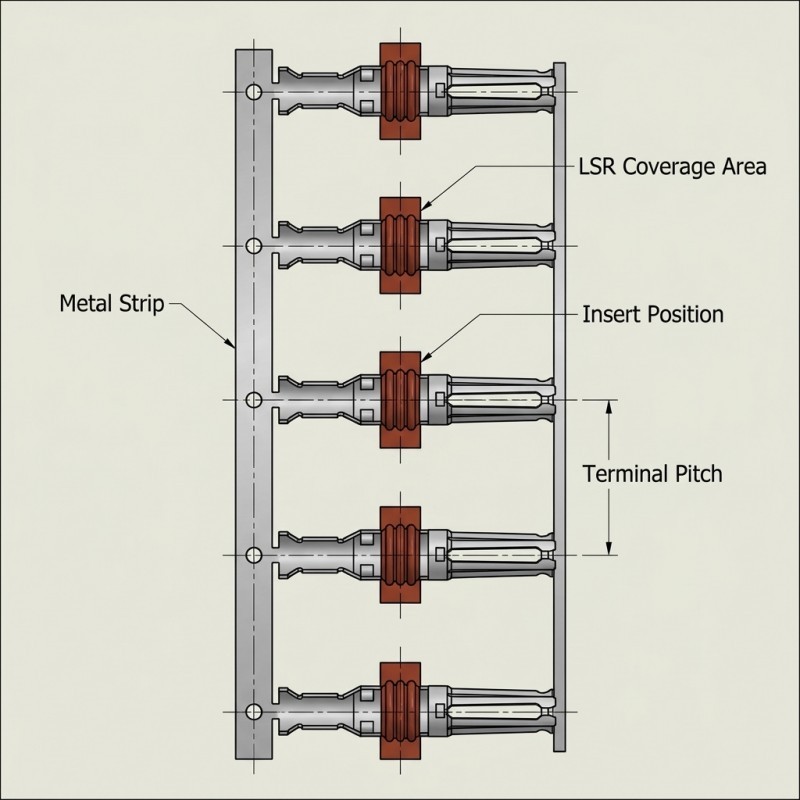
Terminal pitch: The required spacing between individual terminals.
Position and orientation: The location and direction of each terminal relative to the strip.
Strip flatness: Whether bending or twisting could affect mold loading.
Locating references: Which metal features can be used to position and support the insert.
Silicone coverage: Which terminal areas require LSR and which metal surfaces must remain exposed.
Edge condition: Whether burrs or sharp edges may affect silicone molding or handling.
These details should be reviewed together with the actual metal material and surface condition. Learn more about our silicone over metal manufacturing capabilities.
Will the Connecting Strip Remain in the Finished Part?
| Design condition | What must be confirmed |
Strip remains | Final function, exposed areas and dimensional requirements |
| Strip is removed | Separation timing, cut-off location and burr control |
| Strip supports molding | Locating points, support and loading direction |
| Strip is separated after molding | Cutting access and protection of the molded silicone |
There is no universal separation sequence for every terminal design. The process should follow the approved drawing and tooling review.
How Does Strip Layout Affect Insert Molding?
The strip layout should allow the metal inserts to be positioned consistently while leaving sufficient access for the mold to form the specified silicone areas.
The tooling team should review terminal spacing, support locations, mold closing, silicone flow access and possible interference between the connecting strip and mold structure.
The purpose of silicone mold design and tooling is to translate the approved component geometry into a practical and repeatable manufacturing process.
What Should OEMs Provide for a Project Review?
For a custom automotive connector terminal project, prepare:
2D drawing and 3D CAD file
Metal grade and surface-finish information
Terminal strip layout and dimensional requirements
Required silicone coverage areas
Areas that must remain exposed
Whether the connecting strip stays or is removed
Required separation sequence, if applicable
Sample parts and estimated production quantity
SiliconePlus supports custom metal insert projects through engineering review, tooling, sampling and manufacturing using liquid silicone injection molding.
We focus on custom silicone sealing and overmolded components rather than complete automotive connector assemblies.
If you are developing a connected metal terminal component, contact SiliconePlus with your drawings or physical samples for a project review.
FAQ
Is the connecting metal strip always a carrier strip?
Not necessarily. Its role must be confirmed from the product drawing and manufacturing plan.
Can multiple connected metal terminals be overmolded together?
It depends on the strip geometry, terminal spacing, mold access, insert positioning and required silicone coverage.
Should the connecting strip be removed before or after molding?
There is no universal answer. The sequence depends on the strip's function, tooling arrangement and approved component design.
Does SiliconePlus manufacture complete automotive connector assemblies?
No. SiliconePlus focuses on custom silicone sealing parts and LSR-overmolded components used in connector systems.