Why Do Silicone Overmolded Robotic Gripper Pads Slip or Damage Parts?
Answer Excerpt
Silicone overmolded robotic gripper pads may slip or damage workpieces when gripping force, contact area, silicone hardness, surface geometry and workpiece conditions are not properly coordinated.
A silicone contact layer can provide a compliant interface between a rigid robotic finger and the handled part. However, silicone does not automatically prevent slipping, scratches or pressure marks.
A reliable robotic gripper pad design should evaluate:
• Workpiece material and surface finish
• Workpiece weight and handling acceleration
• Required gripping force
• Available contact area
• Silicone hardness and layer thickness
• Grip rib or surface texture geometry
• Rigid plastic insert support
• Silicone-to-plastic retention
• Mounting interface and finger alignment
• Repeated loading and surface wear
• Oil, dust and other contamination
• Functional testing on the actual workpiece
The engineering objective is to achieve stable handling without exceeding the workpiece's acceptable local contact pressure or surface-damage limits.
The correct silicone compound, pad geometry and gripping force must be validated together using representative parts and actual handling conditions.
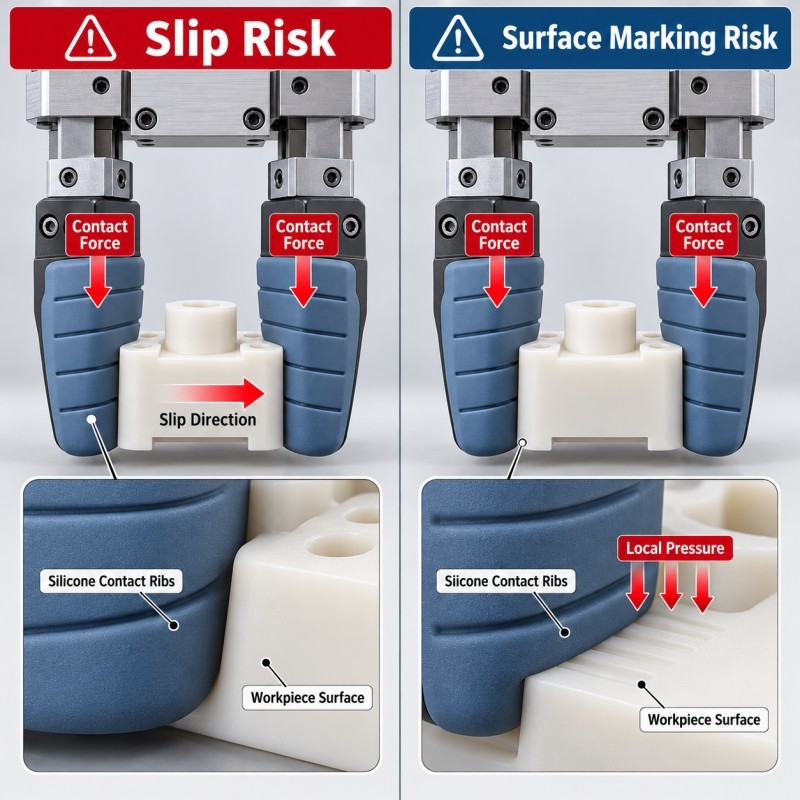
Why Can a Soft Silicone Robotic Gripper Pad Still Slip or Mark a Workpiece?
A robotic gripper transfers force to a workpiece through one or more contact surfaces.
A soft contact layer can deform around the workpiece and may help distribute the load more effectively than a rigid contact surface in suitable applications.
However, two different problems can still occur.
The first is insufficient resistance to sliding.
If the available tangential holding force is lower than the force generated by gravity, acceleration or handling motion, the workpiece may move relative to the pad.
The second is excessive local contact stress.
Even if the workpiece does not slip, concentrated pressure or repeated rubbing may leave marks, deform a delicate surface or damage a finish.
These failure modes should be investigated separately.
Increasing the gripping force may reduce slipping in one application but increase the risk of surface damage.
Reducing force may protect a delicate workpiece but make the handling process unstable.
The correct solution depends on the complete interaction between pad material, pad shape, workpiece surface and gripper motion.
1. Start With Workpiece Geometry and Required Contact Force
The first design decision should be based on the workpiece rather than the silicone material alone.
For a parallel-jaw robotic gripper, engineers should identify the surfaces that the fingers will contact during picking, moving and releasing.
The following information is important:
• Workpiece mass
• Center of gravity
• Contact face dimensions
• Contact surface shape
• Surface roughness or finish
• Permitted local pressure
• Handling direction
• Acceleration and deceleration
• Expected gripping force
• Number and location of contact pads
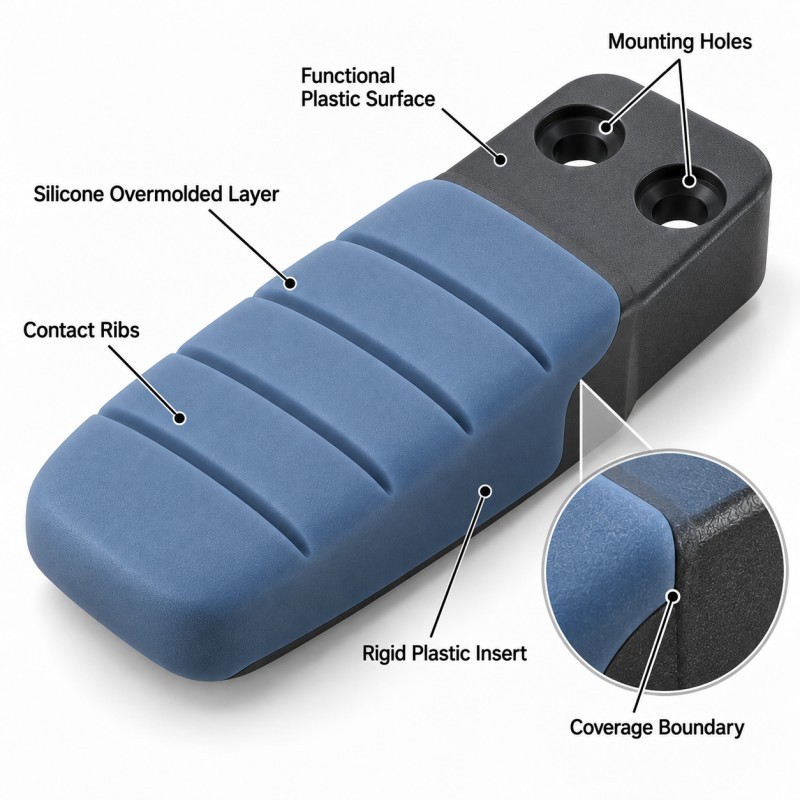
A silicone over plastic structure can combine a rigid gripper-finger insert with a flexible contact layer.
The plastic provides the mounting and positioning structure, while the silicone provides the controlled compliant contact region.
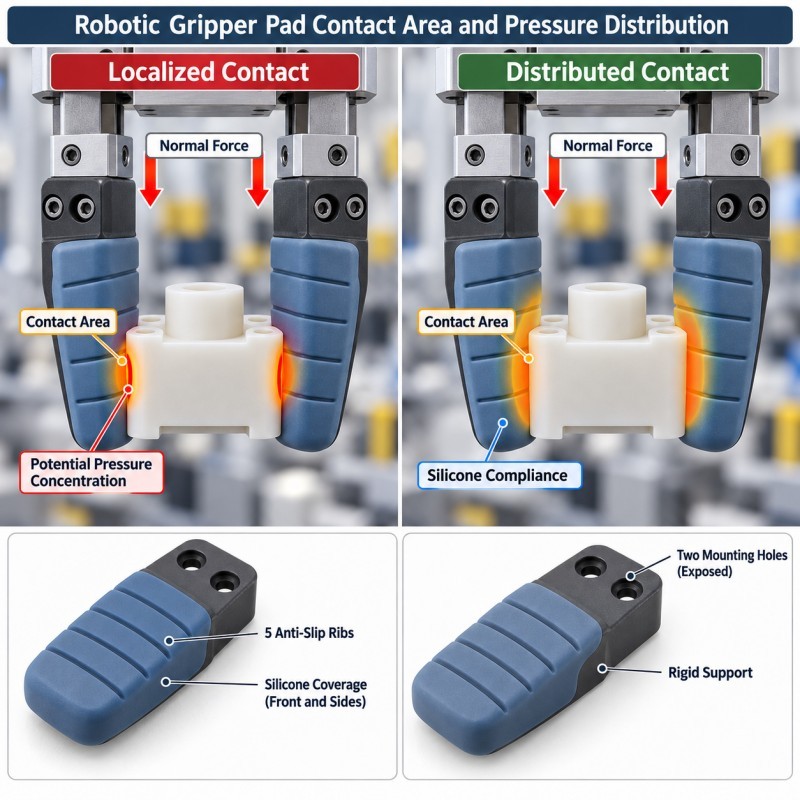
However, the silicone contact area should be located where the gripper can support the actual workpiece.
If the pad contacts only one narrow edge, the load may become concentrated even when the silicone is relatively soft.
If the workpiece has a curved surface, a flat pad may not provide the intended contact distribution.
The design should therefore begin with the workpiece geometry and the complete gripper arrangement.
2. Choose Silicone Hardness Together With Layer Thickness
Silicone hardness influences how the gripper contact layer deforms under load.
However, hardness alone does not determine the complete gripping behavior.
A relatively soft silicone layer may conform to some workpiece surfaces more easily, but excessive deformation can also cause unstable contact geometry or edge movement.
A relatively firm silicone layer may retain its shape more effectively, but it may create higher local contact pressure when the effective contact area is small.
Engineers should consider:
• Silicone hardness
• Silicone layer thickness
• Contact pad width and length
• Underlying plastic support
• Surface profile
• Required normal force
• Expected shear loading
• Compression recovery
• Tear resistance
• Surface wear behavior
A thin layer of soft silicone on a rigid substrate may behave differently from a thick layer of the same compound.
For this reason, silicone hardness should not be selected only from a Shore A value or a hand-feel sample.
Several feasible material and geometry combinations may need to be compared using the same representative workpiece and gripping conditions.
The final specification should identify the approved silicone grade, geometry and functional acceptance criteria.
3. Grip Ribs and Surface Texture Must Match the Sliding Direction
Shallow molded ribs, grooves or contact textures may be considered when designing a silicone gripping surface.
Their function should be evaluated against the real workpiece and direction of relative motion.
Possible design variables include:
• Rib direction
• Rib height
• Rib spacing
• Rib width
• Rounded rib edges
• Contact area between ribs
• Workpiece surface finish
• Silicone deformation under load
• Cleaning accessibility
• Wear during repeated cycles
Raised ribs can change the local contact distribution.
They may help a particular gripping task, but they can also concentrate pressure on a small area.
This is especially important when handling polished plastic, painted parts, coated housings or other appearance-sensitive workpieces.
A deeper or sharper texture is not automatically more effective.
For some workpieces, a smooth silicone surface may perform better than a heavily ribbed design.
For others, a shallow texture may offer a more useful balance between compliance, contact stability and release behavior.
Surface geometry should be evaluated by testing actual slipping, marking and repeated handling performance.
The final rib pattern should also remain feasible for silicone filling, demolding and inspection.
4. Prevent Silicone Layer Peeling Under Repeated Shear Loads
A robotic gripper pad does not experience only compression.
During acceleration, repositioning and workpiece release, the contact surface may also experience shear, bending and local peeling forces.
These loads are transmitted from the silicone layer into the rigid plastic insert.
If the silicone-to-plastic interface is unsuitable, the pad may develop:
• Edge lifting
• Local separation
• Surface movement
• Uneven contact
• Progressive peeling
• Loss of gripping consistency
Depending on the substrate and structure, mechanical locking features may help retain the silicone.
Possible approaches include controlled edge wraparound, suitable retention grooves or other manufacturable locking geometry.
However, retention features should not be added without reviewing:
• Plastic insert strength
• Silicone flow and filling
• Mold shut-off
• Demolding direction
• Contact pad geometry
• Mounting-hole clearance
• Functional load direction
• Final interface inspection
A locking feature must not weaken the gripper finger or interfere with the mounting interface.
Chemical bonding, mechanical retention or a combination of both should be selected and validated for the actual plastic and silicone material grades.
5. Keep Plastic Mounting Holes Exposed and Control Insert Positioning
A silicone overmolded robotic gripper pad requires a stable mechanical connection to the gripper finger or end-of-arm tooling.
The rigid plastic insert may contain mounting holes, locating surfaces or other customer-specific installation features.
These areas should remain accessible after molding.
Critical requirements include:
• Mounting-hole position
• Hole diameter and clearance
• Exposed fastener seating areas
• Plastic datum surfaces
• Silicone coverage boundary
• Pad contact-face position
• Overall part thickness
• Rigid insert flatness
During molding, insert positioning should be controlled so that the silicone contact layer forms in the intended location relative to the mounting features.
If the plastic insert shifts inside the mold, the finished contact pad may become off-center or vary in thickness.
This can change the contact relationship when two opposing gripper pads are installed.
A pair of pads may have acceptable individual dimensions but still produce uneven workpiece contact if their mounting references or silicone surfaces are not aligned.
For production approval, inspection should compare the contact face with the functional mounting datums rather than measuring only the silicone outside dimensions.
6. Higher Gripping Force Is Not Always the Correct Fix for Slipping
When a workpiece slips, increasing the gripper force may appear to be the simplest corrective action.
However, the available resistance to sliding depends on more than the applied normal force.
The workpiece surface, silicone compound, contact condition and loading direction also matter.
For a simplified dry-contact model, the maximum friction force is related to the effective coefficient of friction and normal force.
Actual silicone contacts may behave more complexly because deformation, viscoelastic effects, surface roughness and contamination influence the interface.
Engineers should therefore avoid assigning one universal friction coefficient to every silicone gripper pad.
If slipping occurs, possible investigations include:
• Whether the gripper is aligned
• Whether both pads make full contact
• Whether the workpiece is oily or dusty
• Whether the pad has worn or changed shape
• Whether the contact geometry is suitable
• Whether handling acceleration is excessive
• Whether the applied gripping force is repeatable
• Whether the selected silicone compound is appropriate
If increasing the force causes unacceptable marking or deformation, a material or geometry change may be more useful than further force adjustment.
The actual gripping performance should be evaluated across the customer's required operating conditions.
7. Oil, Dust and Surface Contamination Can Change Gripping Performance
The surface condition of the workpiece and silicone pad may change during production.
A gripper that handles clean parts successfully may behave differently when the process introduces:
• Light machining oil
• Dust
• Surface powder
• Mold-release residue
• Cleaning-agent residue
• Moisture
• Repeated handling deposits
• Wear particles
These conditions can affect the contact interface.
For appearance-sensitive products, transferred contamination may also create unacceptable surface defects.
The engineering review should establish whether the pad will contact dry, wet, oily, coated or otherwise conditioned workpieces.
If the application requires frequent cleaning, the cleaning procedure should be evaluated against the selected silicone material and the complete overmolded component.
The pad surface texture should also be reviewed for residue accumulation and cleaning access.
A contact pad that performs well in a clean laboratory may still require additional validation in the actual production environment.
The test plan should therefore use representative workpiece surface conditions rather than assuming ideal dry contact throughout service.
8. Repeated Gripping Cycles May Cause Wear or Contact Geometry Changes
Robotic gripping applications may involve repeated compression, release and sliding contact.
Over time, the contact layer may experience changes in its surface condition or geometry.
Possible observations include:
• Rib wear
• Edge tearing
• Surface abrasion
• Permanent local deformation
• Interface lifting
• Contact-pad movement
• Changes in gripping force requirements
• Surface contamination
• Differences between opposing pads
The relevant risks depend on the actual workpiece, loading cycle, silicone grade and operating environment.
A gripper pad should not be assigned a universal cycle-life claim without supporting tests.
A suitable durability test should reproduce:
• Gripping direction
• Actual workpiece geometry
• Normal gripping force
• Relative sliding, if applicable
• Handling speed and acceleration
• Loading frequency
• Surface condition
• Temperature and environmental exposure
• Required cycle count
• Inspection intervals
The validation should track both the condition of the silicone component and its functional handling performance.
For some applications, the silicone contact pad may be treated as a replaceable wear component.
If replacement is intended, the mounting arrangement should allow controlled removal and installation without damaging the gripper finger.
9. How Should Robotic Gripper Silicone Pads Be Validated Before Mass Production?
A complete validation plan should confirm that the overmolded pad can be manufactured consistently and that it performs the intended gripping function.
These are two separate questions.
Manufacturing validation may include:
• Plastic insert dimensional inspection
• Silicone coverage inspection
• Contact-layer thickness measurement
• Rib geometry inspection
• Mounting-hole clearance verification
• Silicone-to-plastic retention evaluation
• Flash inspection
• Demolding damage inspection
• Cavity-to-cavity comparison
• Pilot-production repeatability
Functional validation may include:
• Workpiece pickup and retention
• Slip or displacement measurement
• Required gripping force
• Surface marking inspection
• Release consistency
• Repeated-cycle durability
• Performance after contamination exposure
• Pad wear
• Interface integrity after cycling
• Assembly alignment
A sample should be tested using the customer's actual or representative workpiece and gripper arrangement.
The test report should identify the workpiece surface, contact direction, material grade, gripping conditions, environmental state and acceptance criteria.
A smooth-looking molded pad is not automatically a functional gripping solution.
Likewise, a successful gripping test does not automatically prove that the overmolding interface will remain stable during long-term production use.
Both manufacturing and handling performance should be approved before mass production.
| Engineering Issue | Possible Cause | Design or Process Control | Recommended Validation |
Workpiece slipping | Insufficient available tangential holding force | Contact geometry, material and gripping force | Slip test with actual workpiece |
Pressure marks | Excessive local contact stress | Contact area and pad profile | Surface appearance inspection |
Rib imprinting | High pressure at raised ribs | Rib height, width and spacing | Repeated grip and release test |
Silicone peeling | Weak bonding or retention | Validated interface and anchoring | Shear or peel evaluation |
Uneven contact | Insert position or mounting variation | Stable plastic datums | Assembled alignment inspection |
Mounting interference | Silicone blocks fastening areas | Controlled no-silicone zones | Mounting fit check |
Poor performance with oil | Changed surface condition | Contamination-specific testing | Conditioned workpiece test |
| Pad abrasion | Repeated contact or sliding | Material and contact profile | Durability cycling |
| Inconsistent gripping | Pad variation or gripper setup | Process and assembly control | Repeatability testing |
| Unexpected surface transfer | Residue or material interaction | Workpiece compatibility review | Cleanliness and marking inspection |
When Is an Integrated Silicone Overmolded Robotic Gripper Pad Worth Considering?
An integrated silicone overmolded gripping surface may be useful when the application requires a flexible contact layer in a repeatable position on a rigid mounting structure.
Potential applications include:
• Parallel-jaw robotic grippers
• Automated pick-and-place systems
• Electronic housing handling
• Precision plastic component transfer
• Light industrial assembly equipment
• Custom end-of-arm tooling
Compared with a separately installed sleeve or loose contact layer, integrated overmolding may reduce variation in the position of the soft contact surface.
However, the correct solution depends on the actual application.
In some cases, a mechanically attached replaceable pad may be more suitable when frequent replacement, alternative materials or field maintenance is required.
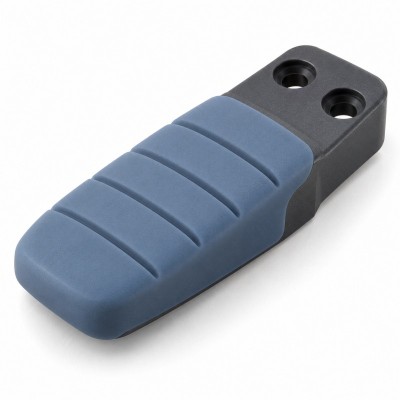
SiliconePlus offers custom silicone overmolded robotic gripper finger pads with engineering plastic inserts and localized silicone contact surfaces, based on customer drawings and project requirements.
The proposed contact surface may include shallow molded ribs, while mounting holes and other functional plastic regions remain exposed.
Material suitability, silicone retention, friction behavior, surface protection and durability must be validated for the customer's workpiece.
SiliconePlus manufactures the custom contact component rather than the complete robotic gripper, actuator or automation control system.
What Should Buyers Include in a Custom Robotic Gripper Pad RFQ?
For an accurate engineering review, the buyer should provide information about both the gripping component and the workpiece.
Recommended project inputs include:
• 2D gripper-finger drawing
• 3D CAD model
• Existing plastic finger or mounting sample
• Workpiece material
• Workpiece dimensions and surface finish
• Workpiece mass
• Expected gripping orientation
• Handling acceleration
• Available gripping force
• Required contact area
• Preferred silicone surface profile
• Plastic substrate material
• Mounting-hole layout
• Silicone coverage boundary
• Environmental and contamination conditions
• Expected gripping cycles
• Surface marking acceptance criteria
• Planned order quantity
• Annual production forecast
If the current gripper pad slips or damages parts, provide photographs or inspection evidence and describe the actual failure conditions.
This information helps the manufacturing team distinguish contact geometry problems from material selection, insert-positioning or interface-retention issues.
Before final tooling approval, the customer should define the required handling performance and the tests that representative samples must pass.
Frequently Asked Questions
Are Silicone Gripper Pads Always More Slip-Resistant Than Plastic Pads?
No. The effective grip depends on the silicone compound, workpiece surface, contact geometry, gripping force and contamination conditions. Performance should be verified on representative workpieces rather than assumed from the material name.
Does Softer Silicone Always Reduce Workpiece Damage?
Not necessarily. Softer silicone may improve conformity in some applications, but pad thickness, contact area, surface ribs and applied force also determine local pressure and possible marking. The complete contact design must be evaluated.
Can Silicone Be Molded Directly Onto a Robotic Gripper Plastic Insert?
Yes, when the selected plastic grade, silicone material, insert geometry and molding conditions are compatible. Bonding or mechanical retention, mold shut-off and mounting clearance must be reviewed before production.
Should a Gripper Pad Have Ribs or a Smooth Contact Surface?
The choice depends on the workpiece surface, motion and acceptance criteria. Rib geometry may affect contact distribution and marking. Smooth and textured prototypes should be compared where performance is uncertain.
How Do You Test the Life of a Silicone Robotic Gripper Pad?
Use a defined gripping cycle with representative workpieces, force, speed, surface condition and environmental exposure. Inspect slipping, pad wear, contact marks, silicone retention and functional handling performance at agreed intervals.
Conclusion: Design the Contact System, Not Just the Silicone Layer
A silicone overmolded robotic gripper pad should be engineered as part of the complete workpiece-handling system.
The most important requirements include:
• Workpiece geometry and surface condition
• Actual gripping force and motion
• Silicone hardness and contact-layer thickness
• Contact area and pressure distribution
• Grip texture and rib geometry
• Plastic mounting and positioning
• Silicone interface retention
• Wear and contamination exposure
• Functional testing under representative conditions
A successful gripper pad is not simply the softest or most textured component.
It is a custom contact structure that provides the required handling stability without exceeding the workpiece's allowable surface-damage limits.
For a new robotic gripper project, send your 2D/3D drawing, plastic material, workpiece information, contact requirements, gripping conditions and estimated production volume.
You can contact SiliconePlus to discuss silicone overmolding feasibility, material selection, DFM review, tooling, prototype sampling and OEM production.