How Does Material Compatibility Affect Silicone Overmolding?
Introduction
Material compatibility is one of the most important factors in custom silicone overmolding. A part may have a good structure and a beautiful appearance, but if silicone does not bond well with the substrate, the final product may peel, leak, deform, or fail during assembly. This guide explains how material compatibility affects silicone over plastic, silicone over metal, FPC silicone overmolding, silicone over silicone, waterproof sealing, and mass production reliability.
Answer Excerpt
Material compatibility affects silicone overmolding because silicone must work with the substrate during molding, bonding, assembly, and long-term use. Buyers should confirm silicone grade, hardness, substrate material, surface condition, bonding method, mold temperature, curing system, waterproof requirements, and testing standards before mold development. Good compatibility helps reduce peeling, delamination, leakage, flash, deformation, and mass production instability.
Transition Paragraph
Below are the key questions engineers, product developers, sourcing managers, and OEM/ODM buyers usually ask before starting a silicone overmolding project.
People Also Ask: What does material compatibility mean in silicone overmolding?
Material compatibility in silicone overmolding means the silicone material and the substrate can work together during molding and final product use. The substrate may be plastic, metal, FPC, silicone, cable, connector, or another insert. The silicone must be able to form the required shape, bond or lock onto the substrate, and maintain performance under real application conditions.
In a simple silicone part, the manufacturer mainly controls silicone material, mold design, curing, trimming, and inspection. In an overmolded part, there is another important variable: the substrate. The substrate may shrink, deform, oxidize, release oil, absorb moisture, shift during molding, or resist bonding with silicone.
Material compatibility is not only about whether silicone can cover the substrate. It is about whether the final part can resist peeling, water leakage, edge lifting, cracking, deformation, and long-term failure.
For example, a plastic connector housing may need silicone for waterproof sealing. If the plastic cannot tolerate the molding temperature, it may deform. If the surface energy is unsuitable, silicone bonding may be weak. If the sealing edge is poorly designed, the part may leak even if the material looks acceptable.
Before choosing a molding process, silicone material selection should be reviewed together with substrate material, hardness, bonding method, surface treatment, and application environment.
People Also Ask: Why does silicone fail to bond with some substrates?
Silicone may fail to bond with some substrates because the surface is not suitable, the material is incompatible, the bonding area is too small, the surface is contaminated, or the molding process is not controlled correctly.
Silicone is chemically stable, which is one reason it is useful in medical devices, electronics, automotive components, and industrial products. However, this stability also means silicone does not automatically bond strongly to every material. Some substrates may require special structure design, surface treatment, primer, plasma treatment, roughening, cleaning, or mechanical locking.
Common reasons for bonding failure include:
Oil, dust, or release agent on the substrate
Wrong plastic material selection
Poor metal surface treatment
Oxidation or plating issues
FPC surface contamination
Over-cured silicone substrate
Insufficient bonding area
No mechanical locking design
Wrong mold temperature
Unsuitable curing time
Incorrect silicone grade
Poor insert positioning
Excessive stress after assembly
Bonding failure is especially risky in waterproof projects. If silicone lifts from the substrate edge, water can enter through the separation line. The part may look good before assembly but fail after bending, compression, vibration, or aging.
People Also Ask: How should silicone material be selected for overmolding?
Silicone material should be selected according to hardness, bonding requirement, sealing function, application environment, molding process, and final product performance. A material that works for one project may not be suitable for another.
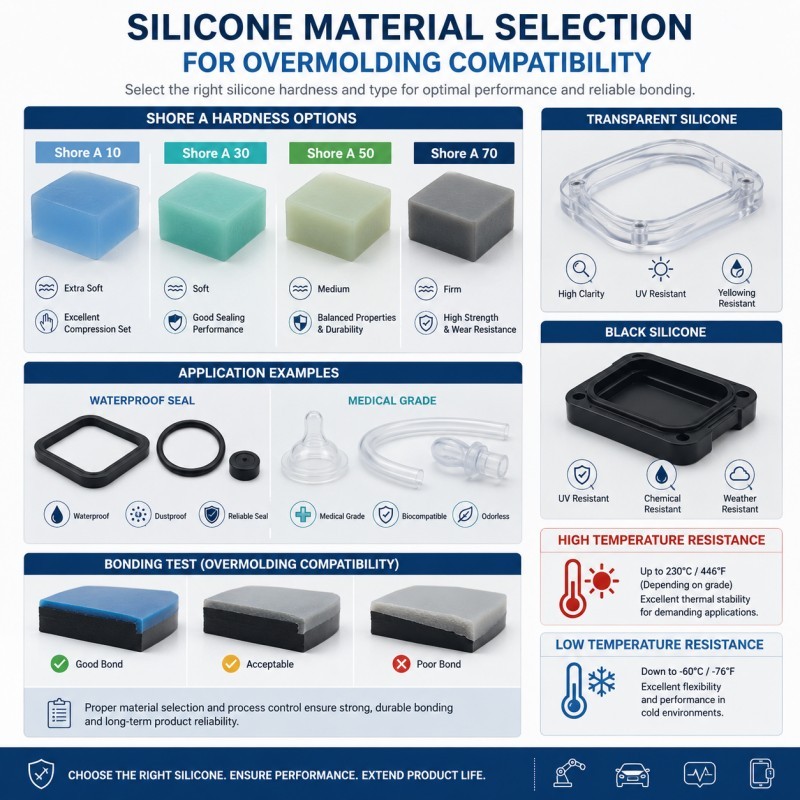
Hardness is one of the first points to confirm. Softer silicone may improve sealing and touch feel, but it may deform more easily. Harder silicone may provide better support, but it may require higher assembly force and may not seal small gaps as effectively.
For waterproof seals, the material must match the compression design. The correct hardness depends on the sealing lip, groove depth, mating surface, assembly gap, and target waterproof level.
For overmolded parts, bonding performance is also important. Some projects require self-adhesive LSR. Some require primer or surface treatment. Some rely more on mechanical locking than chemical bonding. The supplier should evaluate the best combination before tooling.
For medical or wearable applications, buyers may care about softness, skin contact, transparency, cleanliness, and surface quality. For automotive or industrial applications, buyers may care more about temperature resistance, aging resistance, oil resistance, vibration resistance, and long-term compression recovery.
For high-precision overmolded components, liquid silicone injection molding can support fine details, stable dimensions, complex sealing features, and repeatable production when the material and process are properly matched.
People Also Ask: How does plastic compatibility affect silicone overmolding?
Plastic compatibility affects bonding, deformation risk, dimensional stability, and mass production consistency. Not all plastics are suitable for silicone overmolding under the same process conditions.
Plastic substrates may include PC, PA, PBT, PPS, ABS, PP, TPU, or other engineering plastics. Each plastic has different heat resistance, shrinkage, surface energy, moisture absorption, rigidity, and bonding behavior. If the plastic cannot tolerate the mold temperature, it may warp or deform. If the surface is unsuitable, silicone may peel.
For plastic overmolding projects, engineers should check:
Exact plastic material grade
Heat resistance
Moisture absorption
Surface treatment
Dimensional tolerance
Shrinkage behavior
Bonding area
Mechanical locking design
Assembly stress
Waterproof sealing path
Final product environment
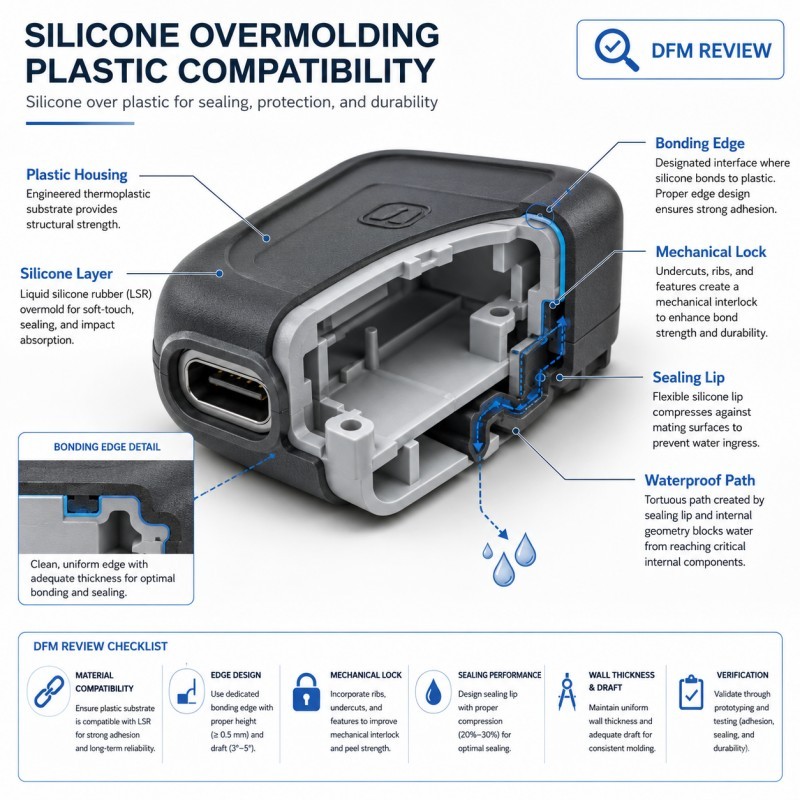
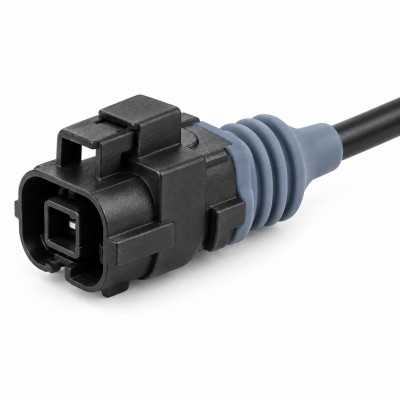
For connector housings, electronic enclosures, buttons, waterproof modules, and soft-touch structures, plastic with silicone overmolding can integrate sealing, protection, grip, and assembly functions into one molded component.
A good plastic overmolding design should not depend only on surface adhesion. Mechanical features such as grooves, undercuts, holes, ribs, wraparound edges, or locking windows can improve retention and reduce peeling risk.
People Also Ask: How does metal compatibility affect silicone overmolding?
Metal compatibility affects surface bonding, sealing stability, electrical insulation, corrosion risk, and long-term durability. Metal is strong and dimensionally stable, but its surface condition must be controlled before silicone overmolding.
Common metal substrates may include stainless steel, aluminum, copper, brass, plated terminals, stamped parts, brackets, shafts, or conductive contacts. Each metal surface may respond differently to silicone bonding.
For metal overmolding projects, engineers should confirm:
Metal type
Surface roughness
Plating condition
Oxidation level
Oil or dust contamination
Cleaning method
Primer or plasma treatment
Mechanical locking structure
Electrical function
Corrosion resistance
Bonding test requirement
Final application environment
Metal parts are often used in automotive connectors, medical device components, wearable charging contacts, beauty device electrodes, industrial sensors, and electrical assemblies. Silicone may provide waterproof sealing, insulation, soft touch, vibration damping, and protection.
For terminals, inserts, brackets, sensors, and waterproof components, metal with silicone overmolding requires surface condition review, bonding validation, insert positioning, and sealing inspection.
If the metal surface has oil residue or oxidation, bonding may fail. If plating thickness varies, the final overmolded dimension may shift. If the metal insert is not positioned correctly, silicone may cover functional areas or fail to seal the target zone.
People Also Ask: How does FPC compatibility affect silicone overmolding?
FPC compatibility affects insert positioning, silicone flow, electrical function, bending performance, waterproof sealing, and long-term reliability. FPC is thin, flexible, and sensitive to molding pressure, temperature, and positioning error.
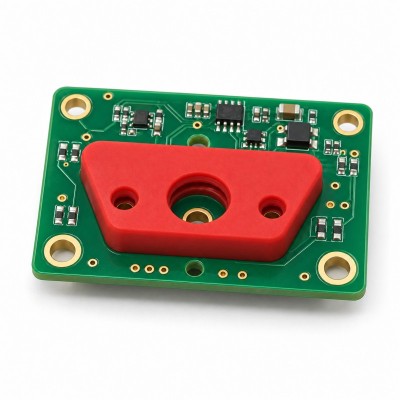
FPC silicone overmolding is common in wearable sensors, medical electronics, smart devices, automotive sensor modules, flexible electronic assemblies, and waterproof compact modules. Silicone can protect the circuit, seal edges, provide strain relief, and improve dustproof or waterproof performance.
However, FPC overmolding has unique risks. The silicone must not cover exposed pads, connector areas, test points, or contact surfaces. The mold must protect copper traces, solder joints, stiffeners, and bending zones. The FPC must stay fixed during molding.
For compact electronic modules, FPC with silicone overmolding requires accurate positioning, protected contact areas, controlled silicone flow, and validation of both sealing and electrical function.
A reliable FPC overmolding project should define covered areas and exposed areas clearly before mold design. If the drawing is unclear, the supplier may need assembly samples or functional diagrams to avoid covering important electrical zones.
People Also Ask: What is the difference between material compatibility risks for plastic, metal, FPC, and silicone?
Different substrates create different compatibility risks. The supplier should not use one standard solution for every overmolding project.
| Substrate Type | Key Compatibility Risk | What Buyers Should Confirm | Typical Application |
|---|---|---|---|
| Plastic | Deformation, weak bonding, shrinkage, moisture, poor surface energy | Plastic grade, heat resistance, surface condition, mechanical locking, tolerance | Electronic housings, connector frames, waterproof modules |
| Metal | Oil, oxidation, plating variation, weak adhesion, exposed functional areas | Metal type, plating, cleaning, surface treatment, bonding test, insert position | Terminals, brackets, sensors, medical inserts |
| FPC | Position shift, covered pads, bending stress, electrical failure | Pad location, bending zone, silicone coverage, fixture design, electrical test | Wearable sensors, medical electronics, smart modules |
| Silicone | Poor silicone-to-silicone bonding, color bleeding, over-curing, contamination | Silicone type, hardness, curing system, color boundary, bonding area | Two-color silicone parts, dual-hardness seals, soft-touch components |
This table helps buyers understand why early material review is important. The same silicone material may perform differently depending on the substrate, surface condition, molding method, and final application.
People Also Ask: How does surface treatment improve silicone bonding?
Surface treatment improves silicone bonding by cleaning, activating, roughening, or preparing the substrate surface before overmolding. The right treatment depends on substrate type, bonding requirement, and production process.
For plastic substrates, surface treatment may include cleaning, drying, plasma treatment, primer application, or mechanical locking design. Some plastics may bond better than others, while some need additional preparation.
For metal substrates, cleaning and surface condition are critical. Oil, oxidation, dust, or inconsistent plating may reduce bonding. Surface roughening, primer, plasma treatment, or mechanical structures may improve bonding reliability.
For FPC substrates, treatment must be carefully controlled because the material is thin and functional. The supplier must protect contact pads, copper traces, solder joints, and bending zones.
For silicone substrates, cleanliness and curing state are important. If the first silicone part is contaminated or fully cured in a way that reduces bonding, the second silicone layer may not attach well.
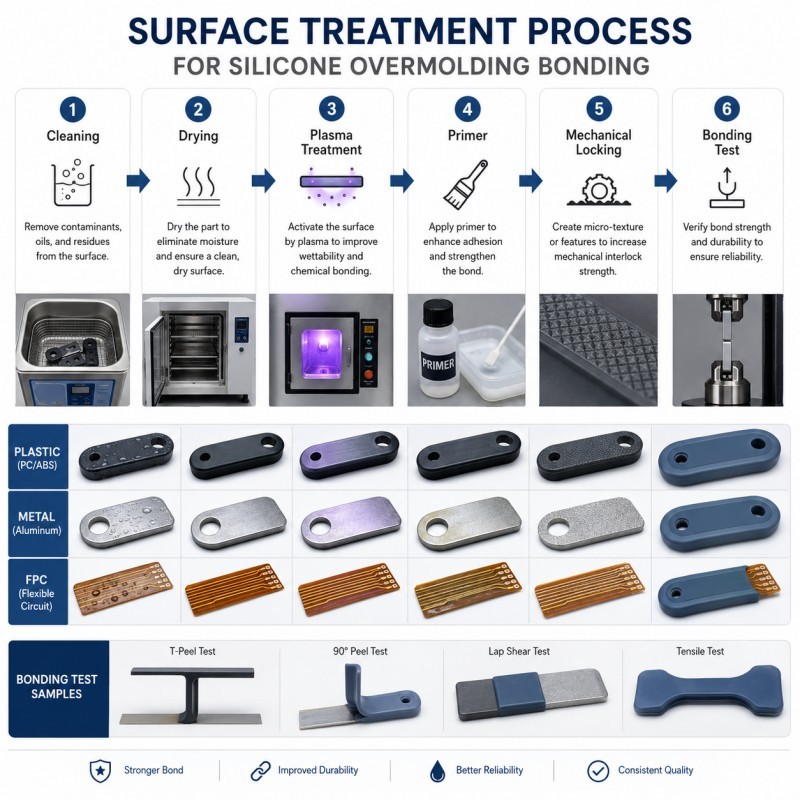
Surface treatment should be validated during sampling. A treatment that works in one trial should also be stable in production. Buyers and suppliers should define the process and inspection standards before mass production.
People Also Ask: How should material compatibility be tested before production?
Material compatibility should be tested through sample molding, bonding inspection, peel testing, pull testing, bending testing, waterproof testing, aging testing, assembly testing, or customer-specific validation methods.
The test method should match the application. A wearable electronic part may need bending and sweat exposure review. An automotive connector seal may need waterproof, vibration, and temperature cycling evaluation. A medical device component may need appearance, cleanliness, and material-related checks. An industrial seal may need oil, compression, or aging evaluation.
Testing should answer practical questions:
Does silicone bond to the substrate?
Does the part peel after bending?
Does water enter through the bonding edge?
Does the insert shift during molding?
Does the substrate deform?
Does the part fit the final assembly?
Does the seal still work after aging or repeated use?
Can the process be repeated in mass production?
Material compatibility testing should happen before production approval. A good-looking sample is not enough if the product needs long-term bonding and sealing reliability.
People Also Ask: What information should buyers provide for material compatibility review?
Buyers should provide drawings, 3D files, samples, substrate material, surface treatment information, silicone coverage area, bonding requirements, hardness, color, tolerance, waterproof level, application environment, testing requirements, and estimated quantity.
If the substrate is plastic, provide the exact plastic grade. If the substrate is metal, provide metal type, plating, and surface treatment. If the substrate is FPC, provide pad location, bending areas, and exposed functional zones. If the substrate is silicone, provide hardness, curing system, and material information if available.
A clear project brief helps the manufacturer choose the right silicone material, molding process, bonding method, and tooling plan.
A typical compatibility review may include:
Substrate material confirmation
Silicone material selection
Hardness and color review
Bonding method discussion
Surface treatment evaluation
Mechanical locking design review
DFM review
Sample molding
Bonding test
Waterproof or assembly test
Pilot production review
Mass production approval
People Also Ask: How does SiliconePlus support material compatibility review?
SiliconePlus supports material compatibility review by evaluating substrate type, silicone material, bonding requirement, overmolding structure, mold feasibility, surface treatment, sealing function, and production stability before tooling and mass production.
Shenzhen Liyongan Silicone Rubber Products Co., Ltd. focuses on custom silicone overmolding manufacturing solutions, including liquid silicone injection molding, silicone over plastic, silicone over metal, FPC silicone overmolding, silicone over silicone, compression molding, mold development, sample production, inspection, and OEM/ODM mass production support.
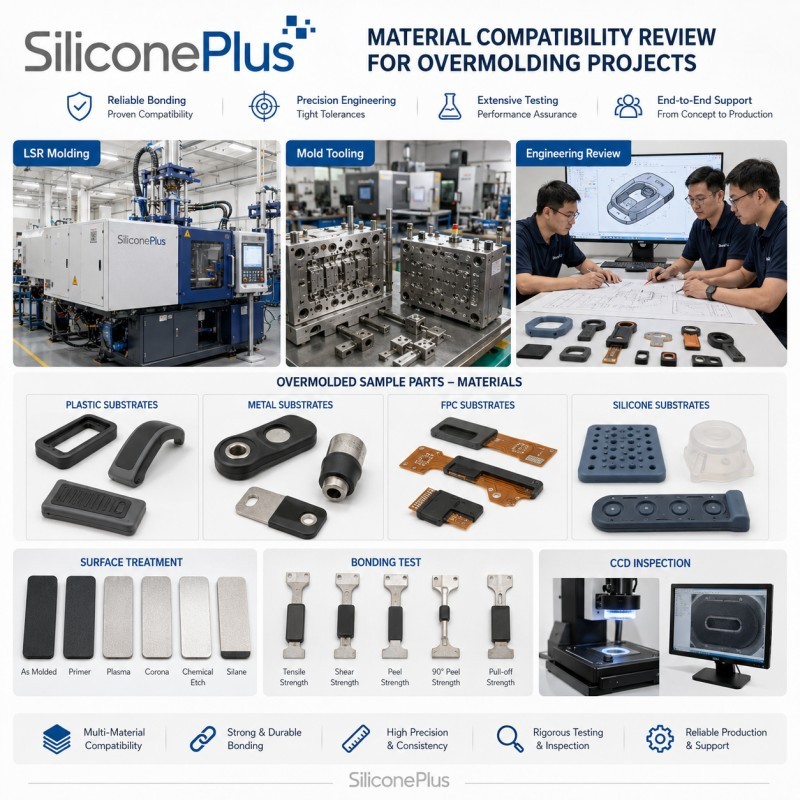
The company can support projects for medical devices, automotive and transportation, 3C electronics, mobile phone waterproofing, wearable electronics, beauty and health care devices, and industrial silicone applications.
For early-stage projects, the engineering team can help buyers review whether the part is suitable for silicone over plastic, silicone over metal, FPC silicone overmolding, silicone over silicone, or another molding method. For existing projects, the team can evaluate drawings or samples to improve bonding reliability, waterproof sealing, and production consistency.
A reliable silicone overmolding supplier should not only ask for the part size. It should ask about substrate material, surface condition, hardness, bonding requirement, application environment, waterproof target, and testing method.
FAQ About Material Compatibility in Silicone Overmolding
1. Why is material compatibility important in silicone overmolding?
Material compatibility is important because silicone must work with the substrate during molding, bonding, assembly, and long-term use. Poor compatibility can cause peeling, delamination, water leakage, deformation, weak bonding, and production instability.
2. Can silicone bond to plastic directly?
Silicone can bond to some plastic materials when the material, surface condition, silicone grade, mold temperature, and bonding design are suitable. Some plastics may require primer, plasma treatment, cleaning, or mechanical locking structures.
3. Can silicone bond to metal?
Yes. Silicone can bond to metal when the surface is clean, suitable, and properly prepared. Metal type, plating, oxidation, oil residue, surface roughness, primer, and mechanical locking design can all affect bonding strength.
4. What makes FPC silicone overmolding difficult?
FPC silicone overmolding is difficult because FPC is thin, flexible, and sensitive to position shift. Silicone must protect the selected area without covering pads, damaging copper traces, or affecting bending and electrical function.
5. How can bonding strength be tested?
Bonding strength can be tested by peel testing, pull testing, bending testing, edge lifting inspection, aging testing, waterproof testing, or customer-specific test methods. The right method depends on application and substrate type.
6. What should I provide for a silicone overmolding compatibility review?
Buyers should provide drawings, 3D files, samples, substrate material, silicone coverage area, hardness, color, bonding requirement, surface treatment information, waterproof level, application environment, testing requirement, and estimated quantity.
Conclusion
Material compatibility is a key factor in silicone overmolding success. A custom overmolded part may fail if the silicone material, substrate, surface condition, bonding method, mold design, or application environment is not properly evaluated.
For B2B buyers, the best approach is to review material compatibility before mold opening. This helps reduce peeling, leakage, deformation, sample failure, mold modification, and mass production risk.
Shenzhen Liyongan Silicone Rubber Products Co., Ltd. provides custom silicone overmolding, liquid silicone injection molding, silicone over plastic, silicone over metal, FPC silicone overmolding, silicone over silicone, waterproof silicone seals, medical silicone parts, automotive silicone components, 3C electronic silicone parts, wearable device seals, and industrial custom silicone components.
If you are developing a silicone overmolded part and are not sure whether the substrate is compatible with silicone, share your drawings, samples, substrate material, waterproof target, and project requirements with our engineering team. We can help review the material compatibility and suggest a suitable manufacturing solution.
What type of substrate do you need to overmold with silicone? Leave a comment, share this guide with your engineering or sourcing team, or contact SiliconePlus to discuss your custom silicone overmolding project.