How to Choose the Right LSR Hardness for Custom Overmolded Parts
Liquid silicone rubber hardness is one of the most important material decisions in a custom overmolding project. A part may have the correct drawing, mold design, and substrate, but if the silicone hardness is not suitable, the final product may still fail during assembly, sealing, bending, pulling, or long-term use.
For custom LSR overmolded parts, hardness affects more than touch feel. It can influence sealing compression, bonding edge stress, demolding stability, flash control, assembly force, deformation, durability, and user experience.
This is especially important for silicone over plastic, silicone over metal, FPC silicone overmolding, wearable components, medical silicone parts, automotive connector seals, waterproof buttons, and precision electronic sealing components.
Answer Excerpt
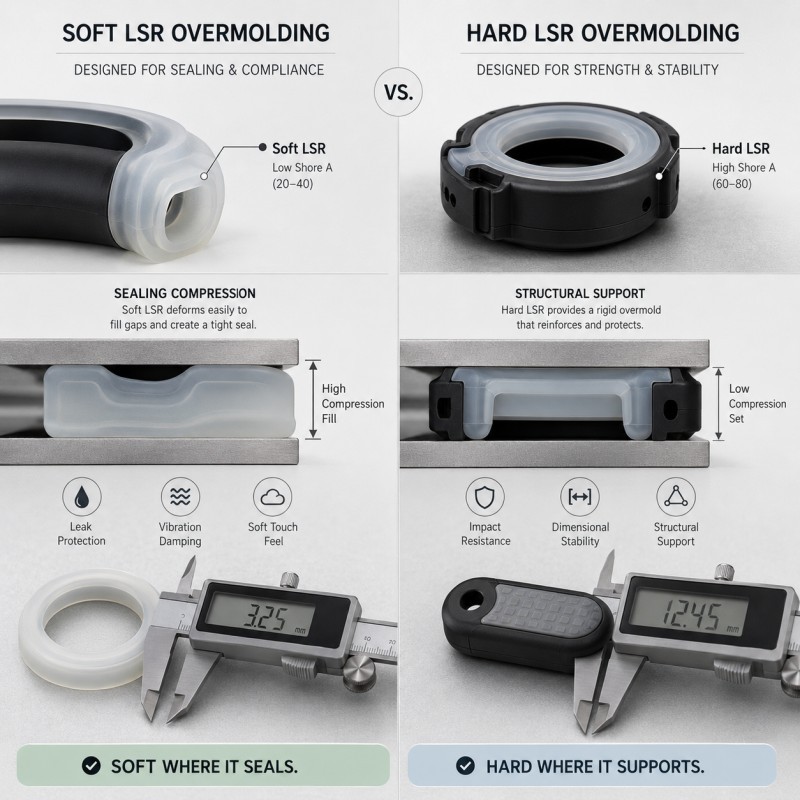
The right LSR hardness depends on the part function, sealing compression, assembly force, substrate material, bonding area, wall thickness, bending requirement, touch feel, and working environment. Softer LSR is often used for sealing, comfort, and flexibility, while harder LSR may be better for structural stability, dimensional control, and assembly support.
What Does LSR Hardness Mean?
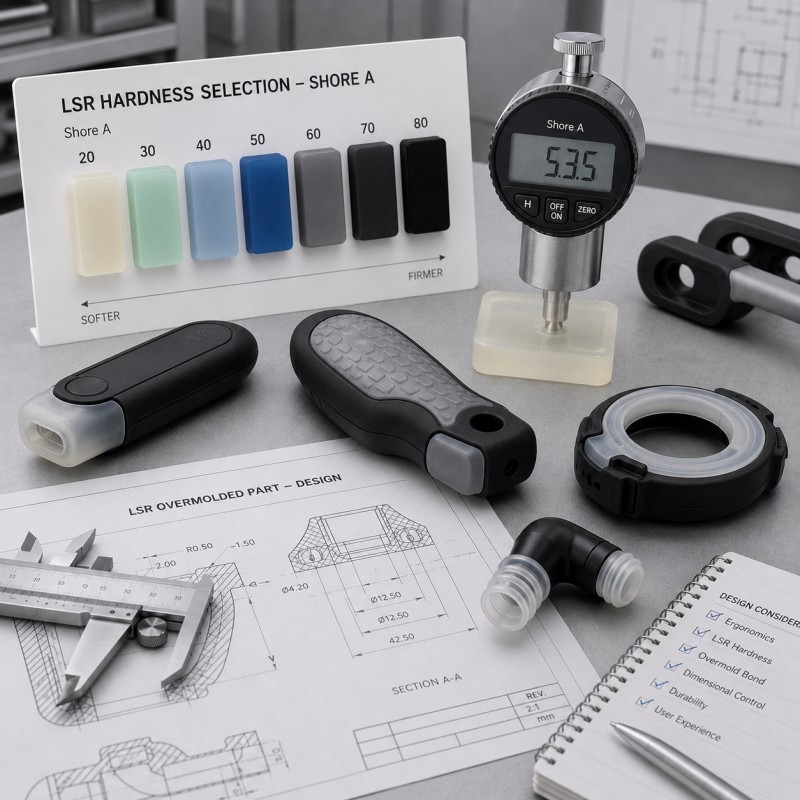
LSR hardness usually refers to Shore A hardness. It describes how soft or firm the cured silicone material feels and performs under pressure.
A lower Shore A value means the silicone is softer and easier to compress. A higher Shore A value means the silicone is firmer and more resistant to deformation.
In custom silicone overmolding, hardness should not be selected only by hand feel. It should be chosen according to the product function, assembly condition, sealing structure, and long-term performance requirement.
For example, a soft silicone may be suitable for sealing or skin contact, but it may deform too much if the structure needs dimensional support. A harder silicone may improve shape stability, but it may not provide enough sealing compression in a small gap.
Why LSR Hardness Matters in Overmolding
LSR overmolding combines silicone with another substrate, such as plastic, metal, FPC, or another silicone component. Because two or more materials work together, the silicone hardness must match the whole structure.
Hardness can affect waterproof sealing performance, dustproof performance, compression recovery, assembly force, soft-touch feel, bonding edge stress, demolding risk, bending performance, tear resistance, long-term deformation, appearance stability, and user contact comfort.
For B2B custom projects, choosing the right hardness early can reduce sampling revisions, mold modification risk, and customer-side testing failure.
Softer LSR: When Should It Be Used?
Softer LSR is often used when the part needs better compression, flexibility, soft touch, or comfort.
It may be suitable for waterproof sealing lips, dustproof sealing parts, wearable skin-contact components, medical soft-touch parts, flexible strain relief areas, soft buttons, cushioning structures, anti-vibration protection, and FPC protection zones.
Soft silicone can adapt better to uneven surfaces and small assembly gaps. This can help improve sealing contact when the compression design is correct.
However, softer LSR also has limitations. If the silicone is too soft, it may deform during assembly, tear more easily at thin edges, create demolding difficulty, or lose dimensional stability.
Harder LSR: When Should It Be Used?
Harder LSR is often selected when the part needs better shape retention, stronger structural support, or more stable assembly performance.
It may be suitable for structural silicone overmolded parts, connector protection components, thicker sealing structures, industrial silicone parts, components requiring dimensional stability, silicone over metal parts requiring firm support, and parts that must resist excessive deformation.
Harder silicone can help maintain the designed shape more effectively. It may also make demolding easier in some structures and reduce unwanted deformation during assembly.
However, harder LSR may require higher compression force to seal. If the assembly space is limited, a harder material may cause difficult installation, poor sealing contact, or stress on the plastic, metal, or FPC substrate.
Medium Hardness LSR: A Balanced Option
For many custom overmolding projects, medium hardness LSR is used as a balanced option.
It can provide a combination of sealing performance, flexibility, durability, and dimensional stability. This makes it useful for electronic sealing parts, wearable components, automotive connector seals, medical device parts, and general OEM/ODM silicone overmolded components.
However, medium hardness is not automatically the safest choice. Engineers still need to evaluate the part function, compression ratio, bonding structure, assembly force, and test requirements.
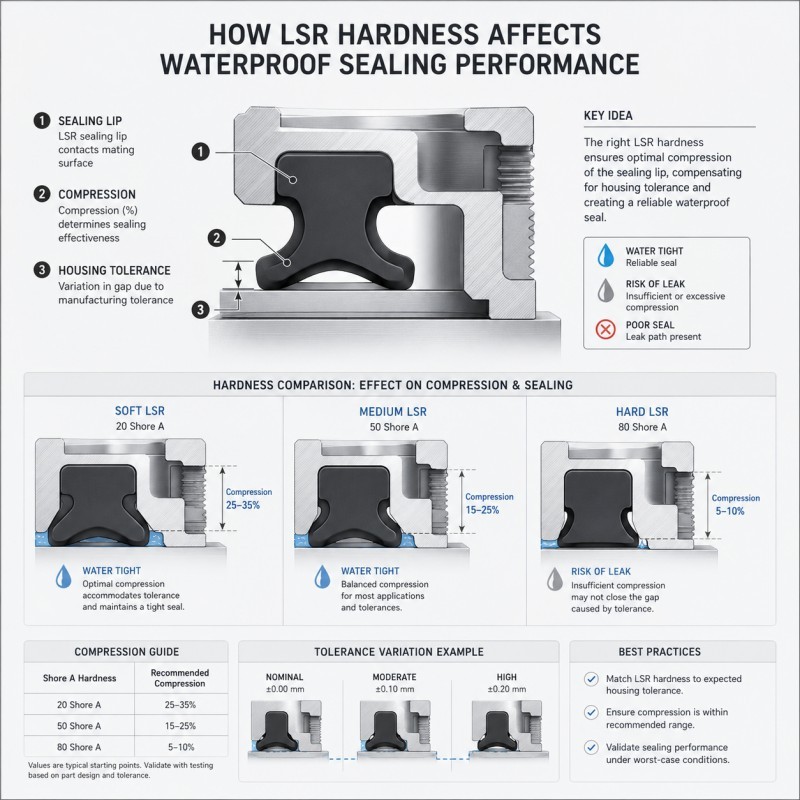
How Hardness Affects Waterproof Sealing
For waterproof sealing parts, hardness directly affects compression behavior.
If the silicone is too hard, the sealing lip may not compress enough under the available assembly force. This can create leakage risk.
If the silicone is too soft, the sealing lip may collapse, roll over, or lose stable contact pressure after long-term compression.
A good waterproof sealing design should consider silicone hardness, sealing lip height, sealing lip width, compression ratio, contact surface flatness, housing tolerance, assembly direction, long-term compression set, temperature range, and waterproof test standard.
The key point is balance. The silicone must be soft enough to seal, but stable enough to keep its shape and compression force over time.
How Hardness Affects Bonding and Edge Stress
In silicone overmolding, bonding strength is not only related to material compatibility and surface treatment. Hardness can also affect the stress at the bonding edge.
If the silicone is too hard, bending or pulling may create higher stress at the interface between silicone and the substrate. This may increase the risk of edge lifting or peeling.
If the silicone is too soft, the material may stretch too much under load, especially in thin areas or weak bonding zones.
For silicone over plastic, silicone over metal, and FPC silicone overmolding, engineers should evaluate hardness together with bonding area design, mechanical locking structure, substrate stiffness, and expected pulling or bending direction.
How Hardness Affects FPC and Flexible Components
FPC silicone overmolding often needs a softer or more flexible silicone structure because the flexible circuit must still bend or move under controlled conditions.
If the silicone is too hard around the bending area, it may create a rigid transition point and increase stress on the copper traces or solder joints.
For FPC protection, engineers should check bend radius, silicone edge position, silicone thickness, hardness, strain relief length, circuit layout, solder joint location, pulling direction, and bending fatigue requirement.
The goal is not simply to cover the FPC. The goal is to protect the circuit while allowing safe and controlled flexibility.
Design Factors Before Choosing LSR Hardness
Before confirming silicone hardness, engineers should review the full product structure, not only the material datasheet.
The first question is what the silicone needs to do. Is it used for sealing, insulation, soft touch, strain relief, shock absorption, structural support, or protection?
The substrate may be plastic, metal, FPC, or silicone. Each substrate has different stiffness, heat resistance, bonding behavior, and deformation risk.
Silicone wall thickness also matters. The same hardness can feel and perform differently depending on thickness. A thin silicone layer may feel firmer, while a thick silicone structure may feel softer and deform more.
For sealing parts, compression ratio is critical. Hardness must match the available compression space and assembly force.
Testing Requirements
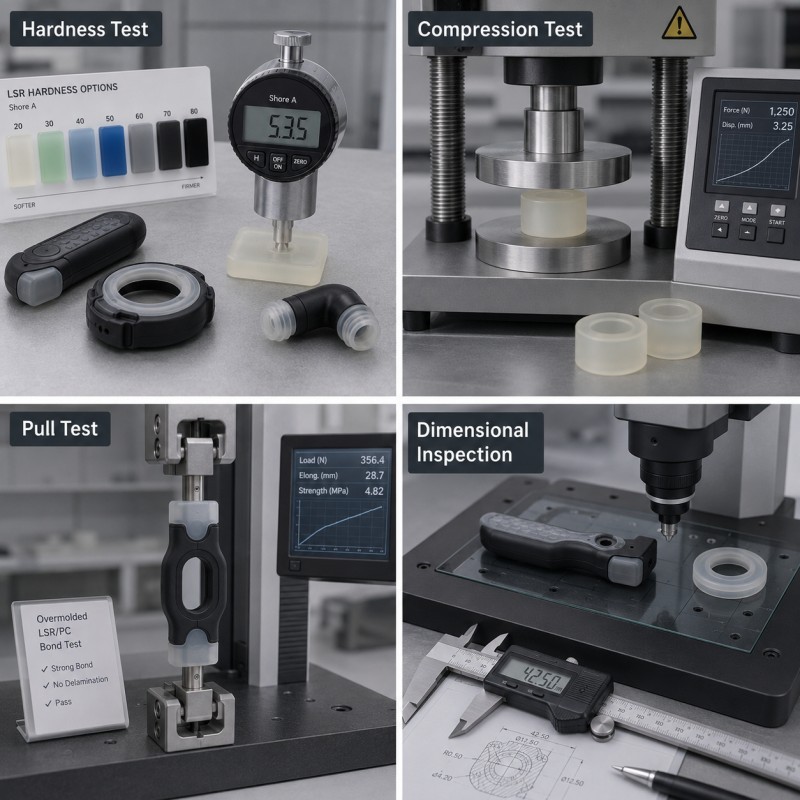
The final hardness should be validated through real testing. Depending on the application, tests may include waterproof testing, pulling force testing, compression testing, bending testing, aging testing, temperature cycling, assembly testing, and dimensional inspection.
Very soft silicone may be more difficult to demold, especially in thin lips, deep grooves, or complex undercut structures. Very hard silicone may create different flow and filling behavior.
The selected hardness should be manufacturable, not only functional on paper.
Common Mistakes When Selecting LSR Hardness
One common mistake is choosing hardness only by hand feel. Hand feel is subjective. It may help with early discussion, but it should not replace engineering evaluation.
Another mistake is copying another product’s hardness. Even if two products look similar, their housing tolerance, compression ratio, wall thickness, substrate material, and test requirements may be different.
Ignoring assembly force is also risky. If the selected silicone is too hard, assembly may become difficult. If it is too soft, the part may deform or shift during assembly.
For waterproof or dustproof components, long-term compression should also be reviewed before mass production. A sealing part may work during the first test but lose performance after heat aging, temperature cycling, or long-term compression.
How SiliconePlus Supports LSR Hardness Selection
SiliconePlus supports custom LSR overmolding projects involving plastic, metal, FPC, and silicone substrates. For each custom project, our team can review the product drawings, substrate material, silicone coverage area, sealing structure, bonding requirement, assembly condition, and testing standard before recommending a suitable silicone hardness.
We can support DFM review, material selection, custom tooling, sample production, process optimization, inspection, and OEM/ODM mass production.
For applications such as automotive connector seals, wearable device parts, medical silicone components, FPC protection parts, 3C electronic sealing parts, and industrial silicone components, choosing the right hardness early can help reduce sampling risk and improve production stability.
Conclusion
LSR hardness is not just a material number. It affects sealing compression, touch feel, bonding edge stress, demolding, assembly force, bending performance, durability, and mass production consistency.
Softer LSR may be better for sealing, flexibility, and comfort. Harder LSR may be better for structural support, dimensional stability, and handling strength. Medium hardness may provide a balanced solution for many custom overmolded parts.
However, the best choice always depends on the actual product structure, substrate material, compression space, bonding design, wall thickness, assembly method, and testing requirements.
If you are developing a custom LSR overmolded part and need help selecting silicone hardness, send us your drawings, samples, material requirements, application environment, and estimated quantity. SiliconePlus can help evaluate the right overmolding solution from prototype to mass production.