Strain Relief Design for LSR Overmolded Cable Parts
Cable outlets and connector transition areas are often the weakest points in electronic assemblies. Even when the connector, housing, or sensor body is well designed, repeated bending, pulling, vibration, and assembly stress can damage the cable root over time.
For automotive electronics, medical devices, wearable products, industrial sensors, and compact 3C components, cable strain relief is not only a protection detail. It can directly affect product durability, waterproof sealing, electrical stability, and customer-side reliability.
LSR overmolding provides an effective way to form a soft, integrated, and precisely positioned strain relief structure around cable outlets, connector ends, FPC transitions, and wire assemblies. Instead of relying only on glue, heat shrink tubing, or separate rubber sleeves, liquid silicone rubber can be molded directly onto the cable or insert area to create a more stable protective structure.
Answer Excerpt
LSR overmolded cable strain relief is a custom manufacturing solution that molds liquid silicone rubber around cable outlets, connector transitions, wires, FPC areas, or electronic modules. It helps reduce bending stress, pulling damage, vibration fatigue, moisture ingress, and assembly failure. It is widely used in automotive connectors, medical cables, wearable sensors, industrial electronics, and compact electronic assemblies.
What Is LSR Overmolded Cable Strain Relief?
LSR overmolded cable strain relief is a protective silicone structure molded around the transition area between a cable and another component, such as a connector, sensor, plastic housing, metal insert, FPC module, or electronic assembly.
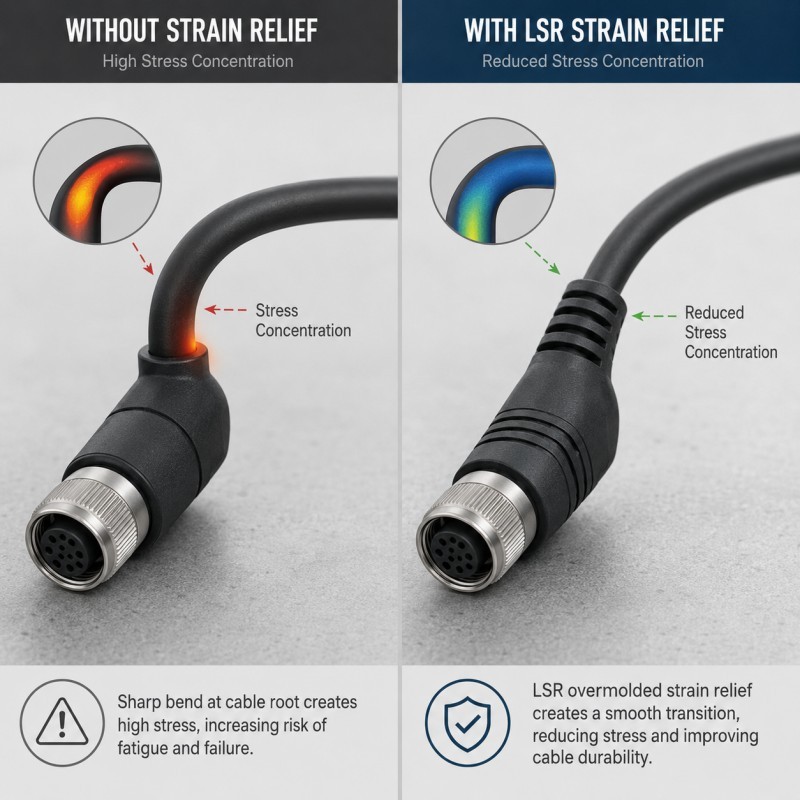
The purpose is to reduce stress concentration at the cable root. When a cable is bent, pulled, twisted, or vibrated, the transition area often receives the highest mechanical load. If there is no proper strain relief design, the cable jacket, internal wires, solder joints, terminals, or FPC traces may fail.
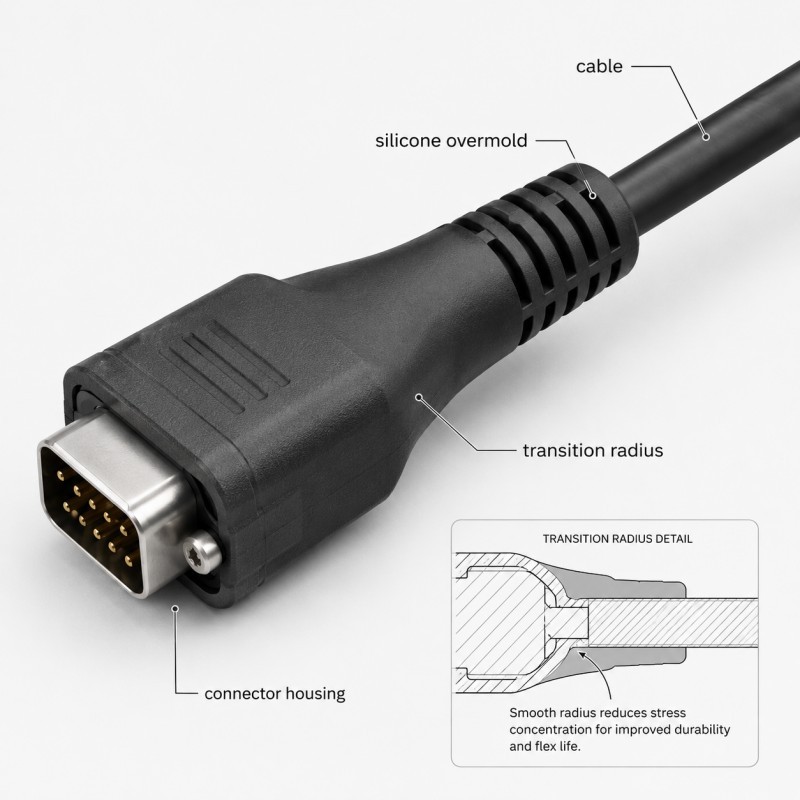
Liquid silicone rubber can create a soft and elastic transition zone. This allows the cable to bend more gradually instead of bending sharply at one fixed point.
Why Cable Transition Areas Fail
Cable transition failure usually happens because the cable root is too stiff, too thin, too sharp, or not supported properly.
During real use, the cable may be pulled during assembly, bent repeatedly by the user, vibrated inside equipment, compressed inside a housing, exposed to moisture, or stressed by temperature changes.
Common failure risks include broken internal wires, cracked solder joints, damaged FPC traces, cable jacket tearing, connector loosening, water entering the transition area, poor insulation, and unstable electrical contact.
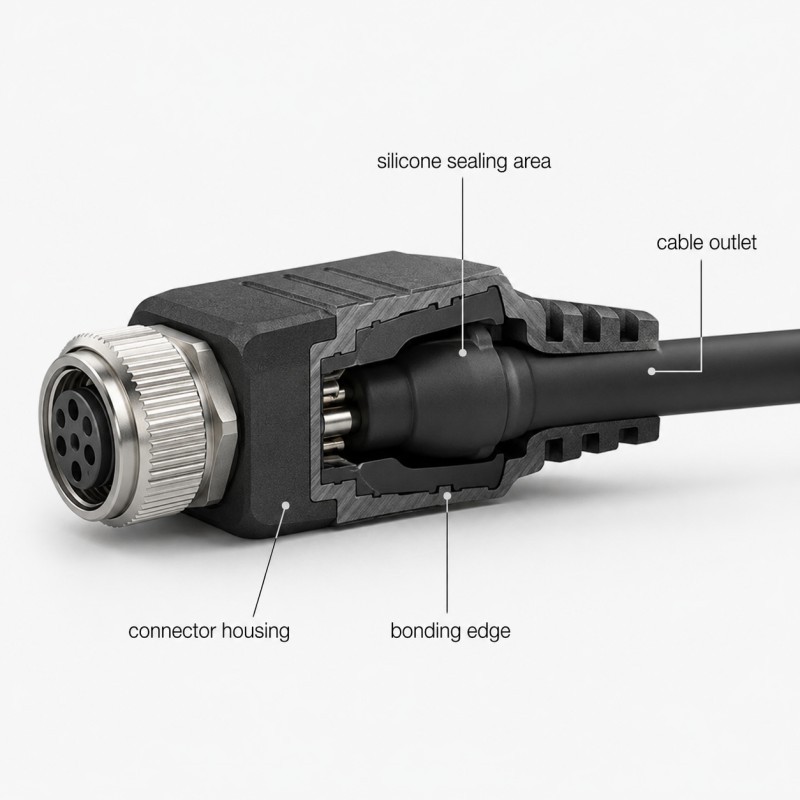
A good strain relief design should not only cover the cable. It should guide the bending direction, distribute force, protect the bonding area, and maintain stable assembly performance over time.
Key Benefits of LSR Overmolded Strain Relief
LSR overmolded strain relief can improve bending durability by creating a flexible transition between the rigid component and the flexible cable.
It can also improve sealing around cable outlets when the silicone structure is designed with proper compression, bonding, and coverage.
For products exposed to vibration, silicone can help absorb movement and reduce stress transfer to the internal connection area.
For handheld, wearable, medical, and beauty device products, silicone can also improve touch feel, appearance consistency, and user contact comfort.
Compared with separate rubber sleeves or manual glue dispensing, LSR overmolding offers better shape control, cleaner appearance, more stable positioning, and better repeatability in OEM/ODM mass production.
Important Design Factors Before Tooling
Before developing a mold, engineers should review the cable diameter, cable jacket material, wire structure, connector shape, assembly direction, bending radius, sealing requirement, and expected pulling force.
The strain relief length should be long enough to distribute bending stress. If it is too short, the cable may still bend sharply at the exit point. If it is too long or too thick, it may affect flexibility, appearance, assembly space, or user experience.
The silicone thickness should also be balanced. Thin silicone may not provide enough protection, while overly thick silicone may increase material cost, curing time, and stiffness.
The transition radius is especially important. A smooth transition can reduce stress concentration and improve long-term bending performance.
Material Compatibility and Bonding
Cable overmolding may involve silicone bonding with plastic, metal, cable jacket material, FPC, or other inserts. Each material has different bonding behavior.
For plastic connector housings, engineers should check heat resistance, deformation risk, surface energy, and bonding compatibility.
For metal terminals or metal inserts, surface cleanliness, oil contamination, oxidation, primer control, and mechanical locking design may affect bonding.
For FPC or flexible electronic assemblies, the design must protect the circuit while avoiding excessive molding pressure and stress concentration.
If chemical bonding is not enough, mechanical retention features such as grooves, holes, wrap-around silicone, or undercut structures may be needed.
Sealing Around Cable Outlets
Many cable strain relief parts also need waterproof or dustproof performance. In this case, the silicone overmold must be designed not only for bending protection but also for sealing.
The sealing area should be clearly defined. Engineers should check the silicone coverage, compression area, cable jacket contact, housing tolerance, parting line position, and possible leakage paths.
If the silicone does not bond well around the cable or connector edge, water may enter through the interface. If the sealing lip is too thin or poorly positioned, the part may leak even when the strain relief looks strong.
For automotive sensors, outdoor electronics, wearable devices, and medical cables, sealing and strain relief should be reviewed together.
Applications of LSR Overmolded Cable Strain Relief
In automotive electronics, LSR overmolded strain relief can be used for connector tails, sensor wires, wire harness exits, EV-related modules, and vibration-resistant cable assemblies.
In medical devices, it can be used for handheld diagnostic cables, sensor leads, wearable monitoring modules, and soft-touch cable protection parts.
In wearable electronics, it can protect compact cable outlets, charging areas, sensor transitions, and FPC-to-cable connection zones.
In industrial electronics, it can improve durability for sensor cables, machine interface wires, control modules, and harsh-environment electronic assemblies.
In 3C and beauty device products, it can improve appearance, soft touch, cable root durability, and assembly consistency.
Testing Before Mass Production
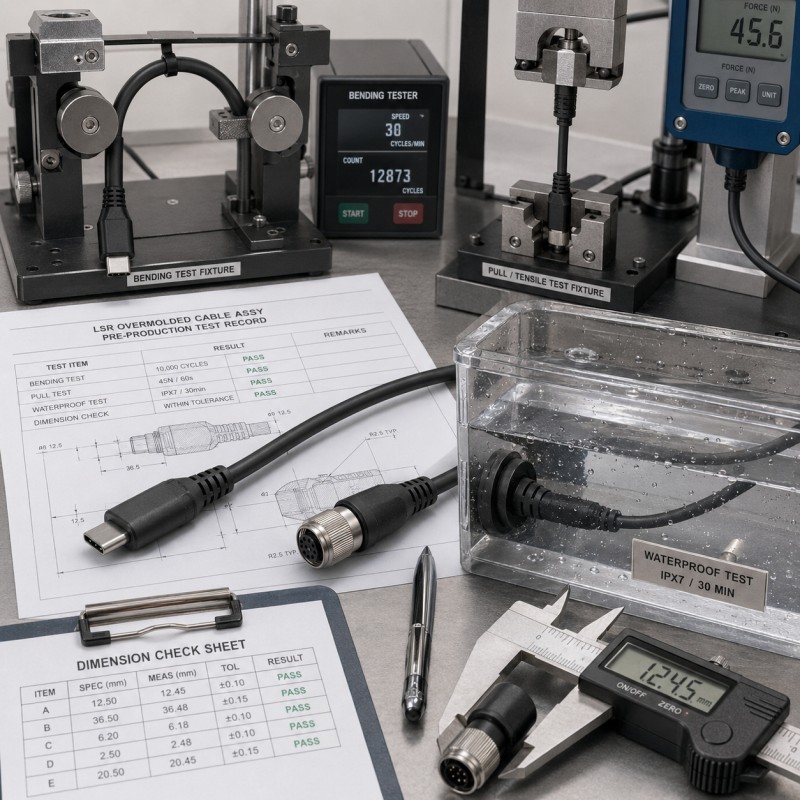
A good-looking cable overmolded sample does not always mean the design is safe for mass production. The part should be tested according to the real application environment.
Common validation tests include bending fatigue test, pulling force test, torsion test, waterproof test, air leakage test, aging test, temperature cycling test, visual inspection, dimensional inspection, and assembly test.
For electronic products, electrical function should also be checked before and after mechanical testing.
Testing helps confirm whether the silicone strain relief can protect the cable root, maintain bonding, resist fatigue, and stay stable during long-term use.
How SiliconePlus Supports Custom Cable Overmolding Projects
SiliconePlus supports custom LSR overmolding projects involving plastic, metal, FPC, silicone, cable, and connector structures. For cable strain relief projects, our team can review drawings, samples, cable materials, connector structures, silicone coverage areas, bending requirements, sealing requirements, and testing standards before mold development.
We can support DFM review, material selection, custom tooling, sample production, bonding evaluation, process optimization, inspection, and OEM/ODM mass production.
For automotive connector cables, medical device cables, wearable sensor wires, industrial sensor cables, and compact electronic cable assemblies, early engineering review can help reduce bending failure, sealing risk, and mass production instability.
Conclusion
LSR overmolded cable strain relief is an effective solution for protecting cable outlets, connector transitions, FPC areas, and electronic assemblies from bending stress, pulling force, vibration, moisture, and fatigue failure.
A successful design depends on more than adding silicone around a cable. Engineers should review cable diameter, substrate material, bonding method, transition radius, silicone thickness, sealing path, mold positioning, and testing requirements before tooling.
If you are developing a custom LSR overmolded cable or connector part, send us your drawings, samples, cable specifications, application requirements, testing standards, and estimated quantity. SiliconePlus can help evaluate the right overmolding solution from prototype to mass production.