LSR Injection Molding Cost: What Actually Drives Tooling and Part Price?
Answer Excerpt
LSR injection molding cost is mainly determined by tooling complexity, part geometry, cavity count, insert handling, silicone volume, cycle time, automation, inspection and production volume. For overmolded parts, the substrate material, positioning method, shut-off requirements and protected no-silicone areas can influence cost more than the LSR material itself. A reliable quotation therefore requires the actual 3D CAD, substrate information, expected quantity and functional requirements.
This is why two LSR parts of similar size can have very different tooling and unit prices.
A simple standalone silicone component may require only a controlled cavity, gate, venting and demolding strategy.
An LSR overmolded connector or housing may also require:
• Precision insert positioning
• Protected functional cavities
• Mold shut-off around no-silicone areas
• Controlled bonding or retention
• Additional insert loading time
• More dimensional inspection
• Functional or waterproof validation
The correct question is therefore not:
“How much does one gram of silicone cost?”
The better question is:
“What manufacturing system is required to produce this part repeatedly at the required quality level?”
For an overview of the manufacturing process, review our liquid silicone injection molding capabilities.
What Drives LSR Tooling Cost?
Tooling is usually the first major investment in an LSR injection molding project.
The mold must do more than reproduce the visible outside shape of the component.
Depending on the design, it may need to control:
• Silicone flow
• Gate location
• Venting
• Parting lines
• Shut-off surfaces
• Insert positioning
• Flash-sensitive areas
• Demolding direction
• Multiple cavities
• Cold-runner or feeding strategy
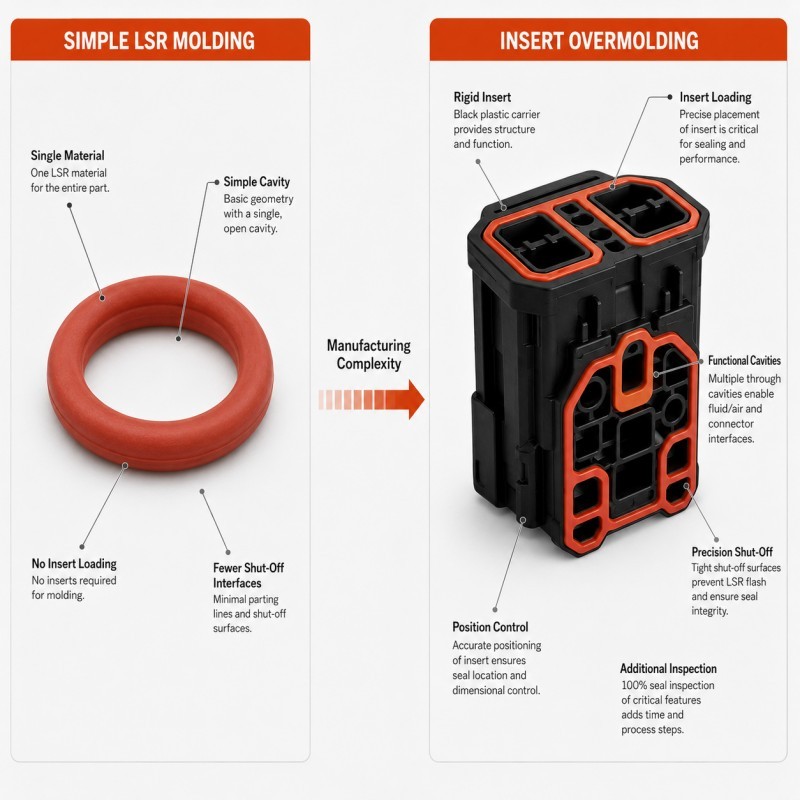
Overmolded parts add another level of complexity because the mold also needs to hold the rigid substrate accurately while preventing LSR from entering protected functional areas.
A connector with several open cavities, for example, may require multiple precision shut-off surfaces.
A simple solid silicone cap of similar external size may not.
This is why physical part size alone is a poor predictor of tooling cost.
Tooling cost should be evaluated from the number of controlled interfaces and manufacturing risks built into the design.
How Does Cavity Count Affect Tooling and Unit Price?
Cavity count creates a trade-off between tooling investment and production efficiency.
A lower-cavity mold may require less initial tooling investment, but it produces fewer parts per molding cycle.
A higher-cavity mold can increase output, but the tool becomes more complex.
Additional cavities may require:
• More precision machining
• More balanced silicone distribution
• Additional shut-off surfaces
• More cavity-to-cavity dimensional control
• More inspection during qualification
• Greater tooling maintenance responsibility
The most economical cavity count therefore depends on expected production volume.
For a low or uncertain annual demand, maximizing cavity count may not provide the best total project economics.
For stable high-volume production, additional cavities may reduce labor and machine cost per part enough to justify the higher tooling investment.
The decision should be based on forecast volume rather than choosing the maximum possible cavity count automatically.
Why Does Insert Overmolding Change the Cost Structure?
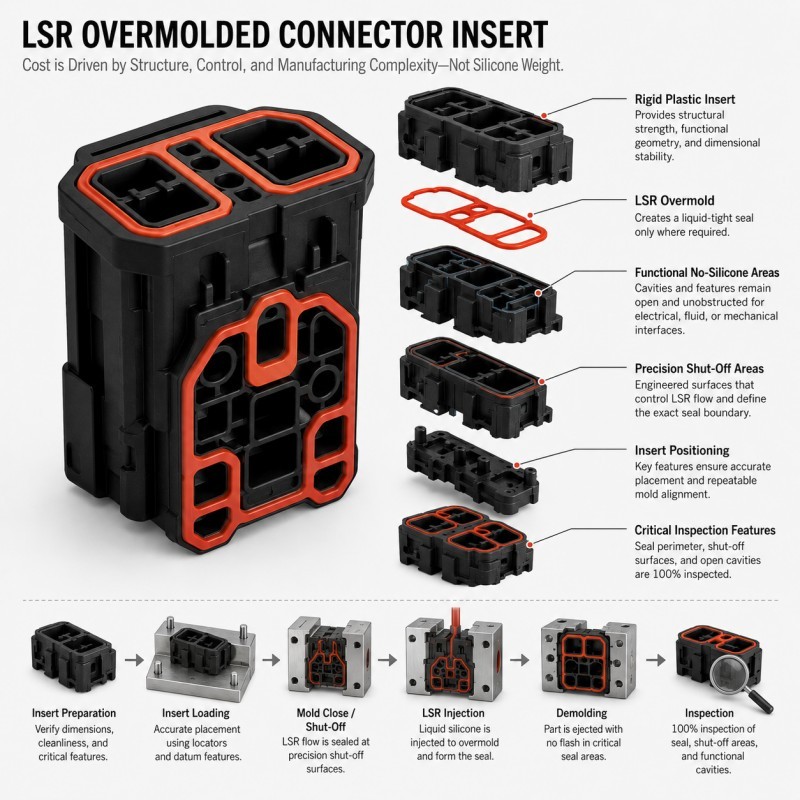
Insert overmolding introduces operations that do not exist in a simple standalone silicone molding cycle.
The rigid plastic, metal or FPC substrate must first be available, inspected and positioned in the mold.
Cost can be affected by:
• Insert purchase or manufacturing cost
• Incoming insert tolerance
• Manual or automated loading
• Insert orientation
• Mold locating features
• Insert deformation risk
• Shut-off complexity
• Silicone-to-substrate bonding strategy
• Scrap value when an overmolded assembly fails
Insert positioning is especially important.
If an insert shifts, a small amount of silicone may enter a functional cavity or create uneven wall thickness.
The entire assembly may then become scrap, including both the silicone and the previously manufactured substrate.
For this reason, insert positioning is both a quality issue and a cost issue.
How Does Part Geometry Affect LSR Molding Cost?
Geometry affects both mold complexity and process stability.
Cost-sensitive design features may include:
• Very thin silicone sections
• Large thickness transitions
• Deep undercuts
• Difficult demolding geometry
• Long flow paths
• Multiple isolated silicone regions
• Tight cosmetic requirements
• Narrow shut-off areas
• Small holes or protected openings
A difficult geometry can increase cost in several ways.
The mold may require additional inserts or moving structures.
Processing windows may become narrower.
Sampling may require more optimization.
Cycle time may increase.
Inspection may become more detailed.
Most importantly, unstable geometry can reduce yield.
A design that saves a small amount of silicone material but creates a difficult molding condition may actually increase total part cost.
This is why cost reduction should begin during DFM rather than after the mold is already built.
Why Does Cycle Time Matter to Unit Price?
The molding machine, tool and operator are occupied for every production cycle.
Longer cycle time therefore increases the manufacturing time required for the same quantity of parts.
Cycle time can be influenced by:
• Silicone volume
• Part thickness
• Cure requirement
• Mold temperature
• Insert loading time
• Demolding difficulty
• Automation level
• Inspection performed during production
For an overmolded component, insert loading can become a significant part of the cycle even when the silicone itself cures quickly.
A part that requires careful manual orientation and loading will have a different cost structure from a substrate that can be automatically fed or quickly located.
The most useful cost discussion therefore considers both molding time and handling time.
How Much Does Silicone Material Affect Part Cost?
Silicone material does contribute to unit cost, especially for larger or high-volume components, but it should not be treated as the only pricing variable.
Material-related cost can depend on:
• Silicone grade
• Hardness
• Color
• Required performance
• Material consumption
• Runner or process loss
• Customer-specific material requirements
For small precision overmolded components, tooling, handling, process control and inspection may represent a larger share of the total manufacturing cost than the LSR volume itself.
This is why reducing a small amount of silicone from a precision connector seal may produce very little savings if the change creates a more difficult shut-off or thinner, less stable geometry.
Material optimization should therefore be evaluated together with manufacturability.
When Does Automation Reduce LSR Overmolding Cost?
Automation can reduce labor variation and improve output, but it also requires investment.
Possible automation includes:
• Insert feeding
• Insert placement
• Part removal
• Vision inspection
• Counting and packaging
• Automated handling between processes
Automation is most attractive when:
• Production volume is stable
• Insert geometry is consistent
• Orientation can be controlled
• Cycle-time savings are meaningful
• The project is expected to run long enough to recover the investment
For low-volume development or early pilot production, manual loading may be more economical.
The manufacturing strategy can then be upgraded when production volume becomes stable.
This is why expected annual quantity should be shared during RFQ instead of providing only the first purchase quantity.
How Do Inspection and Validation Requirements Affect Cost?
Inspection is part of manufacturing cost when the project requires controlled quality characteristics.
Possible inspection requirements include:
• Critical dimensions
• Seal height
• Flash limits
• Insert position
• Cosmetic surfaces
• Bonding or retention
• Functional openings
• Leak testing
• Pull testing
• Electrical or assembly verification
A component requiring only visual inspection does not have the same production cost as a part requiring dimensional inspection plus functional waterproof testing.
The quotation should therefore identify which characteristics are critical to function and which are general appearance requirements.
This prevents two common problems:
One supplier quotes a low price without including the required validation.
Another supplier includes extensive inspection that the customer never requested.
A clear quality plan makes cost comparison more meaningful.
Engineering Decision: Where Should Cost Be Reduced First?
| Cost Driver | Better Cost-Reduction Direction | Avoid |
Tool complexity | Simplify shut-off and unnecessary features | Sacrificing functional sealing |
Cavity count | Match cavities to real annual volume | Maximum cavities without demand |
Insert loading | Improve datum and loading orientation | Difficult manual positioning |
Wall thickness | Use stable, manufacturable geometry | Extremely thin sections only to save material |
Cycle time | Reduce unnecessary handling | Compromising cure or quality |
| Inspection | Define true critical dimensions | Inspecting every noncritical feature |
| Automation | Add when volume justifies investment | Automating unstable early designs |
| Validation | Define test method before quoting | Adding requirements after tooling |
What Should You Send for an Accurate LSR Injection Molding Quote?
A useful quotation requires more than a product photo.
For an LSR injection molding or overmolding project, provide as much of the following information as possible:
3D CAD
STEP, STP or another usable 3D format helps the engineering team evaluate geometry and tooling.
2D Drawing
Include critical dimensions, tolerances and functional areas where available.
Substrate Information
For overmolding, specify whether the insert is plastic, metal, FPC or another material.
Silicone Requirements
Provide hardness, color, material grade or other performance requirements if already defined.
Silicone Coverage Map
Clearly identify where silicone should be molded and which areas must remain exposed.
Expected Quantity
Include sample demand, initial production demand and expected annual volume where possible.
Functional Requirements
Examples include waterproof sealing, cushioning, insulation, grip, strain relief or retention.
Validation Requirements
Provide required leak tests, pull tests, dimensional checks or other acceptance conditions.
The more complete this information is, the more accurately the tooling concept and production cost can be evaluated.
How Can DFM Reduce LSR Tooling and Production Cost?
DFM is most valuable before mold steel is finalized.
A useful review can identify:
• Unnecessary shut-off complexity
• Difficult insert loading
• Thin or unstable silicone sections
• High-risk parting-line locations
• Poor gate access
• Air-trap risks
• Excessive tolerance requirements
• Features that complicate demolding
• Opportunities to improve cavity layout
The objective is not simply to make the mold cheaper.
It is to reduce the total cost of producing acceptable parts.
A slightly more robust tooling concept may cost more initially but reduce scrap, manual correction and production instability later.
For this reason, tooling cost and unit cost should always be reviewed together rather than optimized independently.
The silicone mold design and tooling review should confirm the cavity strategy, insert datum, shut-off surfaces, gate, venting, parting line, demolding direction and expected production volume before the tooling quotation is finalized.
How SiliconePlus Supports LSR Project Cost Evaluation
SiliconePlus supports custom LSR injection molding and silicone overmolding projects from early DFM through tooling, sampling, inspection and mass production.
Project evaluation can include:
• 3D CAD and drawing review
• Silicone coverage review
• Plastic, metal or FPC insert analysis
• Cavity-count discussion
• Insert-loading assessment
• Mold shut-off review
• Gate and venting analysis
• Tooling concept evaluation
• LSR injection molding
• Dimensional and appearance inspection
• Functional validation support
• Pilot-production review
The most useful quotation is based on the actual product structure, production volume and validation requirements rather than a generic per-part price.
Early engineering review also makes it easier to separate necessary manufacturing cost from complexity that can still be designed out before tooling.
FAQ
Why Can't an LSR Part Be Quoted Accurately From a Photo?
A photo does not show wall thickness, hidden geometry, tolerance, insert positioning, shut-off requirements or annual volume. CAD and project requirements provide a much better basis for quotation.
Does a Smaller LSR Part Always Cost Less?
No. A small precision overmolded part with difficult inserts and multiple shut-offs can cost more to manufacture than a larger simple silicone component.
Does a Higher-Cavity Mold Always Reduce Cost?
No. More cavities can lower unit manufacturing cost at sufficient volume, but they also increase tooling investment and qualification complexity.
Can Tooling Cost Be Reduced Through DFM?
Often yes. Simplifying unnecessary complexity, improving insert positioning and defining realistic tolerances before tooling can reduce both tooling risk and long-term production cost.
Conclusion
LSR injection molding cost cannot be reduced to silicone weight or part size.
The total project cost is influenced by:
• Tooling complexity
• Cavity count
• Insert handling
• Part geometry
• Silicone material
• Cycle time
• Automation
• Inspection
• Validation
• Production volume
For silicone overmolding projects, insert positioning and protected functional areas can add significant manufacturing complexity even when the visible LSR volume is small.
The best way to control cost is to review manufacturability before tooling and provide accurate production-volume and quality requirements during RFQ.
This allows the tooling concept, automation level and quality plan to match the real business case instead of being built around assumptions.
Need an Accurate LSR Injection Molding Quote?
If you are evaluating a custom LSR injection molding or silicone overmolding project, send your 3D CAD, 2D drawing, substrate material, silicone requirements, expected annual volume and validation requirements to the SiliconePlus engineering team. We can review the design, tooling concept and production requirements before preparing a project-specific quotation.