Why Do Circular LSR Overmolded Seals Leak When the Insert Is Off-Center?
Answer Excerpt
Circular LSR overmolded seals can leak even when the silicone rings look complete if the rigid insert, seal profile and mating housing are not concentric. An off-center condition reduces the sealing gap on one side while increasing it on the opposite side, creating over-compression and under-compression around the same circular sealing path.
A circular seal works differently from a short straight sealing feature.
Because the sealing path continues around the full circumference, dimensional errors can redistribute compression around the entire assembly.
If the rigid insert moves slightly away from the intended center, the LSR does not necessarily appear defective when inspected as a loose component.
The silicone may still have a continuous surface, correct color and acceptable local dimensions.
The problem becomes visible only after the mating housing is installed.
One side may be squeezed harder than intended while the opposite side barely develops enough sealing contact.
For a broader review of waterproof seal geometry, see how waterproof silicone seals should be designed for overmolded parts.
What Does Concentricity Mean for a Circular LSR Seal?
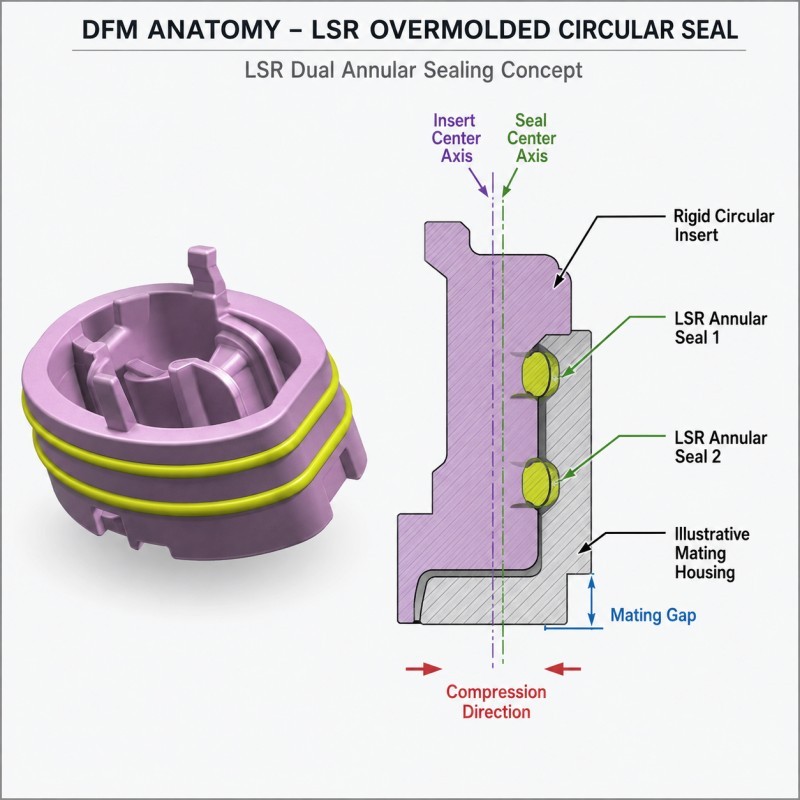
Concentricity describes how closely the center of the rigid insert, the circular LSR sealing profile and the mating structure share the same intended axis.
In an ideal assembly:
• The rigid insert is centered
• The LSR sealing bands follow the intended circular path
• The mating housing is aligned to the same axis
• The sealing clearance remains relatively consistent around the circumference
If one element shifts, the available sealing gap changes.
An offset does not need to be visually dramatic.
On a compact circular component, a small positional error may represent a significant percentage of the intended sealing interference.
The important engineering question is therefore not only whether the silicone ring is round.
It is whether the complete rigid-and-soft assembly remains correctly centered after molding and final assembly.
How Does an Off-Center Insert Create Uneven Seal Compression?
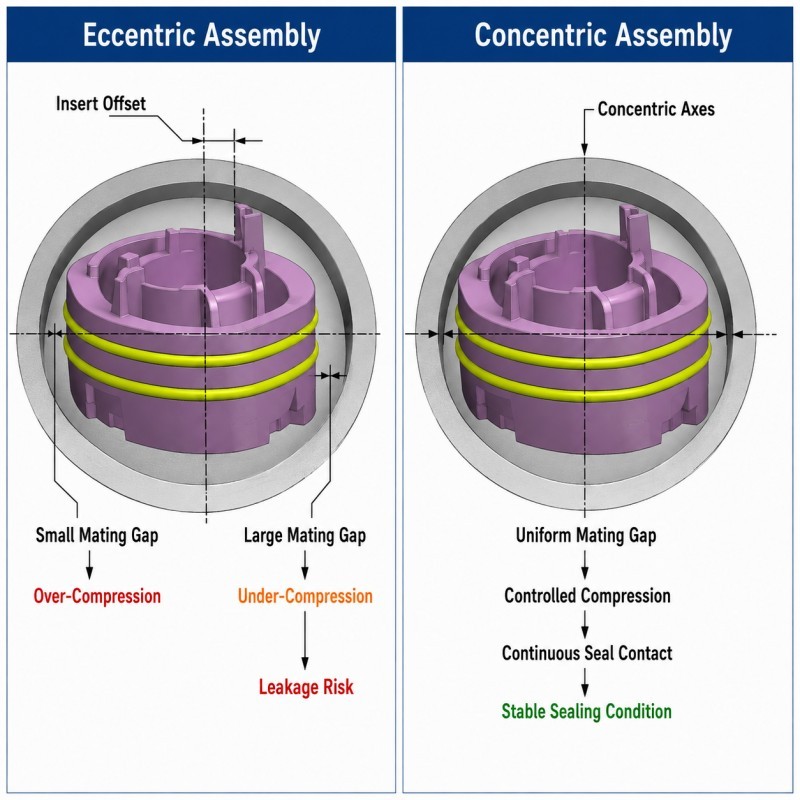
When a circular insert shifts away from the mating-housing center, the clearance becomes asymmetric.
On the side where the insert moves closer to the housing, the LSR seal experiences more compression.
On the opposite side, the gap becomes larger and the silicone experiences less compression.
The result can include:
• Over-compression on one side
• Under-compression on the opposite side
• Sideways silicone bulging
• Higher local friction
• Uneven assembly force
• Reduced recovery
• A low-contact leakage path
This explains why a complete circular seal can still leak.
There may be no missing silicone at all.
The problem is that the sealing pressure is not distributed consistently around the full circumference.
For this reason, waterproof validation should evaluate the assembled sealing condition rather than only checking whether the LSR ring is visually continuous.
Why Does Roundness Matter in Addition to Concentricity?
A seal can be centered and still experience uneven compression if the rigid component or mating surface is not sufficiently round.
Roundness variation can come from:
• Insert molding variation
• Local wall-thickness differences
• Part deformation
• Uneven cooling
• Mold-cavity variation
• Handling or assembly stress
• Mating-part dimensional variation
An oval or locally distorted circular component changes the sealing gap even when its nominal center remains correct.
This means concentricity and roundness should be treated as related but different controls.
Concentricity answers:
“Are the centers aligned?”
Roundness answers:
“Does the circular surface remain consistently shaped around that center?”
Both can affect the final LSR compression window.
How Does Insert Positioning Create Seal Eccentricity?
The rigid circular insert must remain accurately positioned while LSR is injected and cured.
If the insert shifts inside the mold, the silicone cavity does not move with it.
The final result may therefore have a seal that is correctly shaped relative to the mold cavity but incorrectly positioned relative to the rigid component.
Possible consequences include:
• Uneven silicone thickness
• Different seal-to-edge distances
• Eccentric sealing bands
• Local flash
• Reduced shut-off width
• Uneven final compression
A circular component also requires control against tilt.
Even when the insert center appears acceptable from one viewing direction, angular tilt can create a different sealing gap at different heights around the circumference.
The mold should therefore locate the insert from stable rigid datums and support it in the directions that affect the final sealing axis.
For detailed guidance, review how insert positioning affects custom LSR overmolding quality.
Can Multiple Annular Sealing Bands Compensate for Eccentricity?
Adding more than one circular sealing band can provide multiple contact regions, but it does not eliminate the need for proper alignment.
If the complete insert is eccentric, the same dimensional error can affect every sealing band.
On the compressed side, multiple ribs may all experience excessive deformation.
On the opposite side, several ribs may all receive reduced contact.
Multiple sealing bands should therefore be designed as part of the same dimensional system.
Engineers should review:
• Band height
• Band width
• Spacing
• Root support
• Silicone hardness
• Mating clearance
• Insert concentricity
• Mating-part roundness
More sealing ribs do not automatically compensate for poor rigid-part geometry.
The objective is to maintain controlled contact across each intended sealing band.
How Should the Compression Window Be Defined?
The compression window should be defined from the complete rigid assembly rather than from the free-state silicone dimension alone.
Important variables include:
• Minimum insert diameter or profile
• Maximum insert diameter or profile
• Mating-housing size
• Seal height
• Silicone molding variation
• Concentricity
• Roundness
• Final assembly position
The worst-case condition is not always created by one maximum dimension.
For example, a slightly off-center insert combined with a small mating gap can create severe local over-compression even when each individual dimension remains within its own drawing tolerance.
The opposite side of the same component may simultaneously experience under-compression.
Tolerance analysis should therefore consider combinations of dimensional variation.
Where rigid geometry limits the final assembly position, review how compression stops should be designed for LSR overmolded seals.
Why Should the Mating Housing Be Measured Too?
The LSR overmolded component is only one half of the sealing interface.
The mating housing can introduce its own variation.
Relevant factors may include:
• Bore or cavity size
• Roundness
• Coaxiality
• Surface condition
• Taper
• Lead-in geometry
• Assembly position
• Local deformation
A perfectly centered overmolded seal can still experience uneven compression if the mating housing is eccentric or out of round.
This is why a supplier cannot validate waterproof performance from the silicone component alone.
The sealing system should be evaluated using production-representative mating parts or a validated fixture that reproduces the real geometry.
Circular LSR Seal Concentricity DFM Checklist
| DFM Item | What Engineers Should Confirm | Main Risk |
Insert center | Rigid insert axis is defined from stable datums | Eccentric seal |
Seal center | LSR bands follow intended axis | Uneven compression |
Insert roundness | Circular rigid feature remains stable | Local gap variation |
Mating housing | Bore or mating surface is controlled | Seal mismatch |
Seal height | Free-state height matches assembly clearance | Under/over-compression |
Seal width | Bands remain moldable and stable | Distortion |
Multiple bands | Each contact band has a defined function | Redundant unstable ribs |
Insert support | Part cannot shift or tilt during molding | Axis change |
| Shut-off | Circular boundary remains repeatable | Flash or edge variation |
| Tolerance stack | Worst-case eccentricity is reviewed | Local leakage |
| Validation | Concentricity, compression and leak tests are defined | Visually good part leaks |
The silicone mold design and tooling review should confirm the insert datum, seal centerline, annular profile, circular shut-off, insert support, gate, venting and mating-axis relationship before mold steel is finalized.
How Should Circular Seal Concentricity Be Validated?
Circular LSR sealing should be validated as a complete rigid-and-soft assembly.
Recommended validation includes:
Insert Position Inspection
Measure the location of the rigid circular feature relative to the specified datum.
Roundness Inspection
Check the relevant rigid circular surface where required by the sealing design.
Seal Position Inspection
Confirm the LSR sealing bands remain correctly located relative to the insert axis.
Cross-Section or Profile Review
Where appropriate, compare silicone height and profile around multiple angular positions.
Mating-Part Inspection
Confirm the mating housing or bore is within the dimensional condition used during DFM.
Assembly Check
Observe whether the circular part enters the mating structure without excessive side loading or tilt.
Compression Review
Where practical, confirm the sealing contact remains reasonably consistent around the circumference.
Leak Testing
Perform the agreed waterproof or air-leak test in the final assembled condition.
Worst-Case Evaluation
Test representative combinations of dimensional variation instead of using nominal parts only.
Pilot-Production Validation
Compare multiple mold cavities and realistic incoming insert lots before mass-production approval.
Concentricity, roundness, compression and leakage acceptance limits should always come from the real product assembly and customer requirements.
How SiliconePlus Supports Precision Circular Seal DFM
SiliconePlus supports custom circular sealing and precision LSR overmolding projects from structural review through tooling, sampling, inspection and mass production.
Project support can include:
• Circular insert DFM
• Annular LSR sealing-profile review
• Concentricity and tolerance analysis
• Silicone wall-thickness evaluation
• Insert-positioning and support review
• Compression-condition review
• Mold shut-off analysis
• Gate and venting review
• Precision mold development
• LSR injection molding
• Dimensional and appearance inspection
• Assembly and waterproof test support
• Pilot-production validation
Specific insert geometry, substrate material, silicone hardness, mating clearance, concentricity requirements and waterproof acceptance criteria should always be confirmed according to the actual product assembly.
FAQ
Can a Circular LSR Seal Leak Even If the Ring Looks Complete?
Yes. The seal may be continuous but still experience uneven compression if the insert or mating housing is off-center.
Is Concentricity the Same as Roundness?
No. Concentricity describes alignment between centers or axes, while roundness describes how consistently circular a surface is.
Can Softer Silicone Compensate for an Off-Center Insert?
Only to a limited extent. Softer LSR may tolerate more variation, but it cannot correct unlimited eccentricity or a severely uneven mating gap.
Do Two Sealing Bands Always Seal Better Than One?
No. Multiple bands can provide multiple contact regions, but all of them still depend on correct alignment, compression and mating geometry.
Should Only the LSR Part Be Measured?
No. The rigid insert and mating housing can both contribute to eccentric compression.
Should Leak Testing Use Nominal Parts Only?
No. Representative worst-case dimensional combinations are more useful for validating sealing robustness.
Conclusion
A circular LSR seal does not become reliable simply because the silicone ring is continuous.
Reliable annular sealing requires coordinated control of:
• Insert concentricity
• Insert roundness
• Seal position
• Seal height
• Multiple sealing bands
• Mating-housing geometry
• Compression window
• Insert positioning
• Tolerance stack-up
• Final leak validation
The key is to maintain a reasonably consistent sealing gap around the full circumference.
When the rigid insert, LSR profile and mating housing no longer share the intended axis, one side of the seal can be over-compressed while the opposite side loses contact.
These conditions should be reviewed during DFM before tooling, when the insert datum, sealing profile and mating geometry can still be optimized efficiently.
Developing a Circular LSR Overmolded Seal?
If you are developing a circular housing, insert, connector or another component with an integrated annular LSR sealing structure, send your 3D drawing, substrate material, sealing profile, mating-part drawing, tolerance requirements and estimated quantity to the SiliconePlus engineering team for a project-specific DFM review.