How to Evaluate an LSR Overmolding Manufacturer Before Tooling: 8 Engineering Questions
Answer Excerpt
Choosing an LSR overmolding manufacturer should not be based only on unit price or tooling price.
A qualified supplier should be able to review the insert, silicone coverage, functional no-silicone zones, bonding strategy, mold structure, production tolerance and validation requirements before tooling begins.
When comparing liquid silicone rubber manufacturers, product engineers and purchasing teams should focus on whether the supplier can convert the drawing into a repeatable manufacturing process.
Strong LSR injection molding capability should therefore include engineering review, precision tooling, controlled insert molding, validation and mass-production quality control.
Why Supplier Evaluation Matters Before LSR Tooling
Two suppliers can receive the same 3D model and still develop very different manufacturing solutions.
The difference may appear in:
• Insert positioning
• Silicone coverage control
• Mold shut-off design
• Gate and vent strategy
• Material compatibility
• Cavity planning
• Inspection methods
• Pilot-production control
These differences may not be obvious from the first sample.
A prototype can look acceptable while hidden manufacturing risks remain in the tooling or process.
That is why supplier evaluation should happen before mold steel is finalized, not after a mass-production problem appears.
1. Can the Supplier Review the Part Before Tooling?
The first question is whether the manufacturer performs an engineering review before mold development.
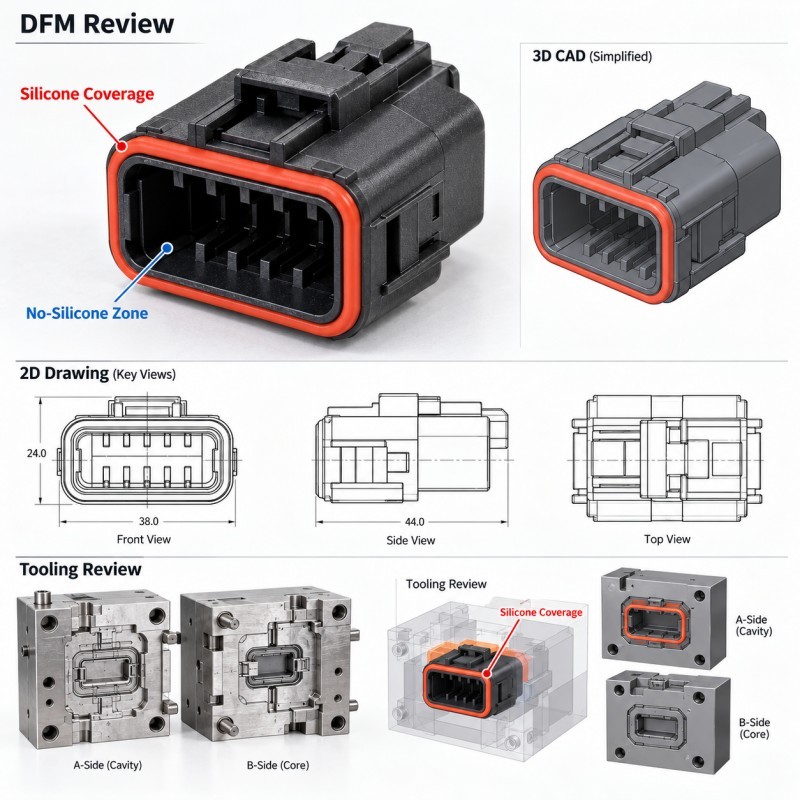
A useful DFM review should evaluate:
• Insert structure
• Silicone wall thickness
• Silicone coverage boundary
• Functional no-silicone zones
• Assembly interface
• Shut-off feasibility
• Gate and venting risks
• Demolding direction
• Critical tolerances
The purpose of DFM is not simply to tell the customer that a part can be molded.
It should identify areas that may create flash, leakage, incomplete filling, insert movement, difficult demolding or unstable dimensions.
A supplier that begins tooling without reviewing these items may move faster at the beginning but create expensive changes later.
2. Can the Supplier Control Insert Positioning?
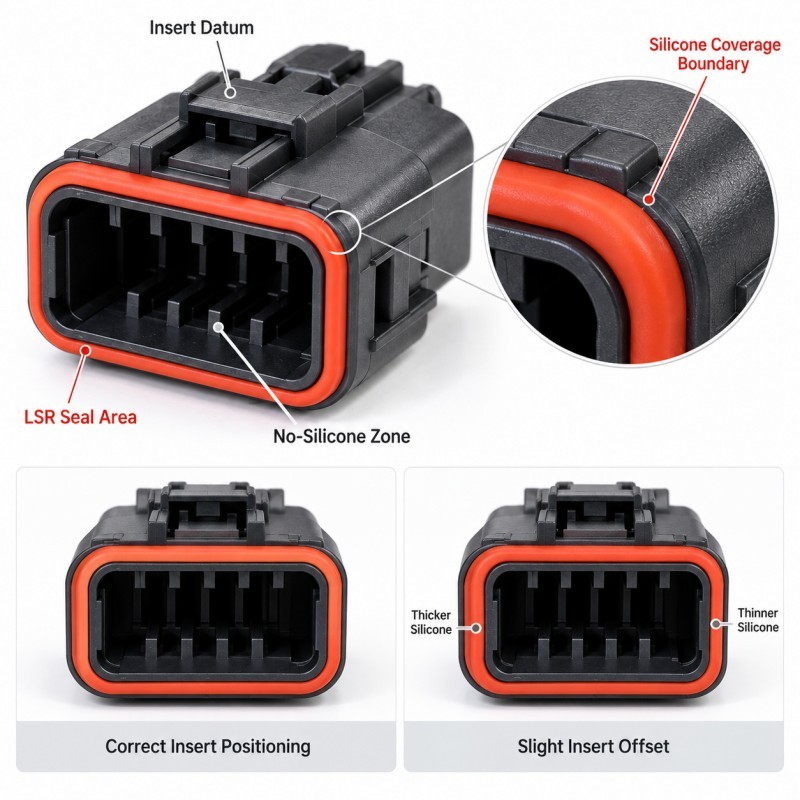
Insert positioning is critical in silicone overmolding because the rigid substrate defines the final silicone thickness and coverage position.
During LSR injection, an insert may shift, tilt or lift if the locating structure is not stable.
This can change:
• Silicone wall thickness
• Seal geometry
• Coverage boundary
• Assembly dimensions
• Functional no-silicone zones
For precision components, the supplier should be able to explain how the insert is located, supported and protected during molding.
Reliable insert positioning is especially important for plastic housings, metal inserts, connectors, cables and FPC components.
3. Can the Supplier Control Silicone Coverage and Shut-Off?
Silicone should not simply cover as much of the insert as possible.
The coverage area must follow the actual functional requirement.
For a connector or electronic housing, some areas may require silicone sealing while other areas must remain completely exposed.
Typical no-silicone areas include:
• Connector openings
• Electrical contacts
• Mating surfaces
• Sensors
• Optical surfaces
• Assembly datums
• Screw or fastening areas
The mold shut-off structure creates the physical boundary between the silicone-covered area and the protected area.
A capable silicone overmolding supplier should be able to review whether this boundary can be manufactured repeatedly without excessive flash or silicone intrusion.
4. Does the Supplier Have In-House Mold Engineering Capability?
LSR overmolding quality depends heavily on tooling.
Important mold-engineering factors include:
• Insert location
• Parting line
• Shut-off surfaces
• Gate position
• Venting
• Cavity balance
• Demolding strategy
• Mold maintenance
For complex projects, the manufacturer should be able to explain why a particular tooling concept was selected rather than simply providing a mold price.
Strong silicone mold design and tooling capability also allows the engineering team to make DFM changes before they become expensive production problems.
5. Can the Supplier Evaluate Silicone and Substrate Compatibility?
Silicone overmolding often combines LSR with another material rather than molding silicone alone.
Typical substrates include:
• PC
• PA
• PBT
• PPS
• Metal inserts
• FPC
• Cable components
The supplier should understand that bonding behavior depends on the actual substrate grade, surface condition, silicone chemistry and processing method.
For silicone over plastic projects, the team should evaluate whether the design relies on chemical adhesion, mechanical retention or a combination of both.
Material compatibility should be discussed before tooling because a visually acceptable sample does not automatically guarantee long-term bonding reliability.
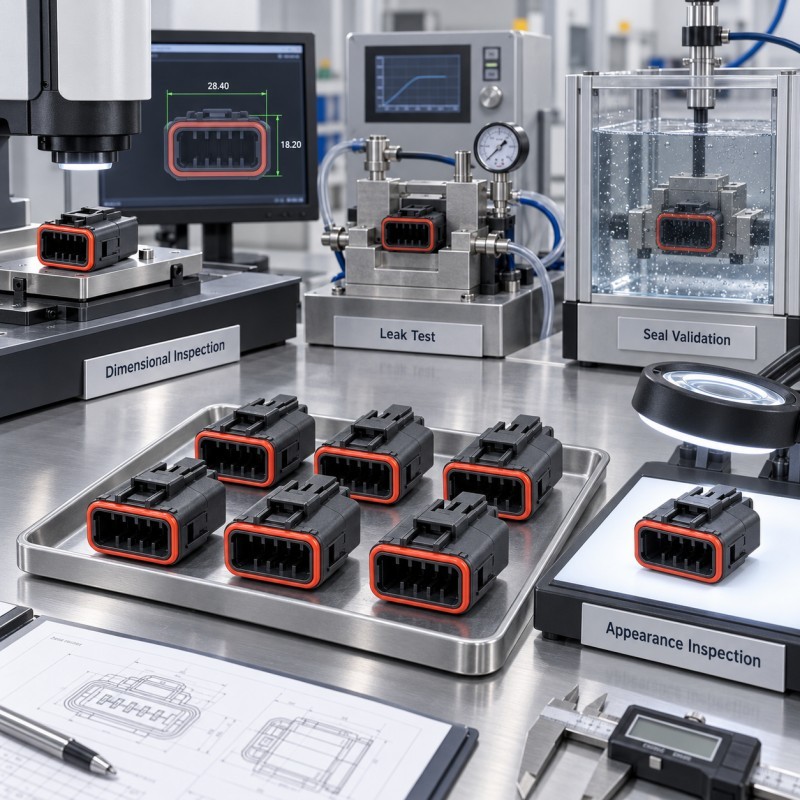
6. Can the Supplier Define Validation Before Mass Production?
A reliable LSR overmolding manufacturer should discuss validation requirements before production approval.
Depending on the application, validation may include:
• Dimensional inspection
• Appearance inspection
• Adhesion or peel testing
• Pull testing
• Waterproof or leak testing
• Thermal cycling
• Assembly verification
The test method should match the actual product function.
For example, a waterproof requirement should ideally define the assembly condition and test method rather than simply state “waterproof required.”
The supplier should also explain how sample approval will be translated into repeatable inspection during mass production.
7. Can the Supplier Manage Pilot Production and Process Variation?
One successful sample is not enough to prove mass-production capability.
Pilot production should evaluate whether the process remains stable across:
• Multiple molding cycles
• Different inserts
• Multiple cavities
• Material batches
• Repeated loading and demolding
• Inspection lots
Important questions include:
• Does silicone coverage remain consistent?
• Does insert position remain stable?
• Is flash controlled repeatedly?
• Are critical dimensions stable?
• Does the sealing result remain consistent?
A supplier should be able to distinguish between “we successfully molded the part once” and “we have a repeatable manufacturing process.”
8. Can the Supplier Explain the Quote Instead of Only Giving a Price?
A useful quotation should reflect the actual manufacturing structure.
For an LSR overmolding project, cost may be affected by:
• Mold complexity
• Cavity count
• Insert handling
• Silicone consumption
• Cycle time
• Automation
• Inspection
• Validation
• Packaging requirements
The lowest tooling price does not automatically create the lowest total production cost.
A technically useful supplier should be able to explain which project requirements are driving tooling complexity and part price.
That makes it easier for engineering and purchasing teams to compare quotations on the same manufacturing scope.
LSR Overmolding Manufacturer Evaluation Checklist
| Evaluation Item | What to Check | Warning Sign |
DFM Review | Structure reviewed before tooling | Quote issued without technical review |
Insert Positioning | Clear locating and support strategy | Insert control not explained |
Silicone Coverage | Coverage and no-silicone zones defined | Boundary only based on appearance |
Mold Engineering | Gate, vent, shut-off and parting line reviewed | Tooling treated as a generic mold |
Material Compatibility | Substrate and LSR reviewed together | Bonding assumed without validation |
| Validation | Test plan defined before production | Only visual sample approval |
| Pilot Production | Process repeatability evaluated | One good sample treated as approval |
| Quotation | Cost drivers can be explained | Only total price is provided |
How SiliconePlus Supports Custom LSR Overmolding Projects
SiliconePlus supports custom LSR overmolding projects from engineering review through tooling, sampling and mass production.
Project support can include:
• DFM review
• Insert positioning evaluation
• Silicone coverage definition
• No-silicone-zone review
• Mold shut-off analysis
• Gate and venting review
• Material and bonding evaluation
• Prototype validation
• Pilot-production review
• Dimensional and functional inspection
The objective is to identify manufacturing risks before they become tooling changes or mass-production failures.
For engineering teams comparing suppliers, technical communication during the RFQ and DFM stages is often a better indicator of future project performance than a sample photo alone.
FAQ
What Files Should I Send To An LSR Overmolding Manufacturer?
Provide the 3D CAD, 2D drawing, substrate material, silicone coverage, functional requirements, expected production volume and available validation specifications.
Should A Manufacturer Quote Before DFM Review?
A preliminary estimate may be possible, but final tooling and production evaluation should follow an engineering review when insert structure, silicone coverage or functional requirements affect manufacturing complexity.
What Makes LSR Overmolding Different From Standard Silicone Molding?
LSR overmolding requires the supplier to control both the silicone process and the rigid insert. Insert positioning, shut-off boundaries, material compatibility and interface quality add engineering requirements that are not present in a simple single-material silicone part.
Conclusion
Choosing an LSR overmolding manufacturer requires more than comparing price, equipment lists or sample photos.
The supplier should demonstrate the ability to review the product, control inserts, design tooling, define silicone boundaries, evaluate material compatibility and validate production repeatability.
For engineering and purchasing teams, these capabilities help reduce the risk of late tooling changes, unstable production and product failures after assembly.
Planning a Custom LSR Overmolding Project?
If you are evaluating an LSR overmolding manufacturer, send your 3D drawing, substrate information, silicone coverage, expected quantity and validation requirements to the SiliconePlus engineering team for project review.